The Future of AI in the Creative Industry #podcast #creativepodcast
Chris Do and motion graphics veteran Kevin Lau discuss how AI will transform the creative industry, arguing that taste, not technical skill, will be the key to survival.
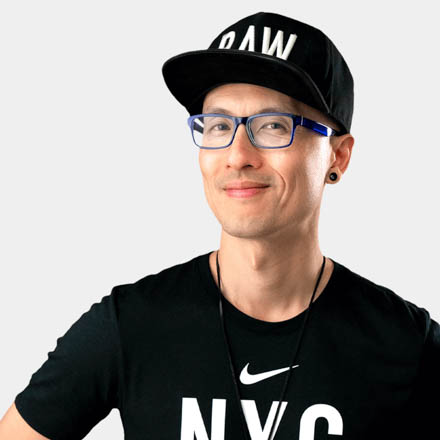
Chris Do
Founder, The Futur™ · November 8, 2023
The Great Divide
There is a fault line running through the creative industry, and it is not between humans and machines. It is between two types of creatives. On one side are the seasoned professionals, the directors and leaders who have built careers orchestrating complex projects. On the other are the aspiring artists, those still fighting to make a living.
Artificial intelligence is the tremor revealing this divide. For the established pro, AI is a powerful new tool. For the emerging artist, it can feel like an existential threat.
“The people I know who are professionals who are creative who know how to direct and lead teams and put things together, they're not as threatened by AI as the people who have yet to kind of make their living doing it,” says motion graphics veteran Kevin Lau in conversation with The Futur’s Chris Do.
This is not a story about robots taking jobs. This is a story about where true creative value lies in an age of infinite content. The answer is not in the execution, but in the judgment.
Echoes of a Revolution
To understand the current moment, you must first look back. Chris Do and Kevin Lau go way back, their careers forged in the crucible of the 1990s motion design boom in Los Angeles. It was, as Do describes it, the “wild wild west.”
Lau got his start at a company called Fuel, a legendary shop that was, as he puts it, “one of the early OG motion graphic shops.” Founded by Seth Epstein, Fuel was a pioneer in using new desktop tools to create a fresh visual language.
It was an era of radical experimentation. The term “motion design” had not even been coined yet. Artists were figuring it out as they went. “The rules weren't even written so you can't even say breaking the rules,” Do recalls. “We're just trying stuff and seeing what we can get away with.”
This renaissance was driven by a collision of forces:
- New Tools: Early versions of After Effects, then called CoSA, and Future Splash, which became Flash, put powerful animation capabilities into the hands of designers, not just high-end effects operators on expensive systems like the Henry or Flame.
- New Talent: A wave of art school kids, trained in traditional graphic design and image-making, brought a sophisticated aesthetic sensibility to the screen. They were not technicians; they were visual communicators.
- New Demand: Advertising agencies, hungry for a new look, were eager to tap into this raw creativity, bypassing the more rigid and expensive traditional post-production houses.
From the creative chaos of shops like Fuel and R/GA, where Do freelanced, a new industry was born. Studios like Brand New School, which spun out of Fuel, defined a new style. Rejecting the slickness of corporate video, they embraced a post-modern aesthetic inspired by publications like Ray Gun magazine. “We're distressing fonts and we're shooting things practically and then running them through Xerox copiers and kind of just reimagining how imagery was created,” Lau says.
This history is not just nostalgia. It is a direct parallel to today. A new set of tools is once again challenging the established order, forcing creatives to redefine their role and their value.
The New Machine Is a Tool, Not a Titan
Fast forward to today, and the tool is generative AI. For anyone in the creative field, the experience of using platforms like Midjourney or Runway is a dizzying mix of “bouts of terror and then complete wonder and awe,” as Lau describes it.
Yet, the professionals who lived through the desktop revolution see a familiar pattern. They are de-mystifying the technology, looking past the magic to understand the process. AI is not an all-knowing oracle. It is a powerful assistant, an accelerant. Lau notes that creatives have been using forms of AI for years, it just was not branded as such. “For a long time there's been content aware fill and these other things in Photoshop where you can start to do predictive stuff,” he explains.
The history of art is a history of technology creating new possibilities. The camera did not kill painting; it liberated it. By perfectly recreating reality, the camera freed painters from the burden of realism, paving the way for Impressionism, Cubism, and every modern art movement that followed. AI, Lau argues, presents a similar opportunity.
The most immediate impact is on the most tedious parts of the creative process. Professionals are not afraid of AI because it promises to eliminate the grunt work they loathe. AI can act as an exceptionally fast and capable assistant, handling tasks like:
- Culling Footage: Instead of an assistant editor spending days watching raw footage, AI can perform scene analysis. A prompt like “give me all of the close-ups” can instantly organize terabytes of data.
- Generating Iterations: Creating style frames and concept art to sell ideas through can be massively accelerated, allowing teams to explore more options in less time.
- Replacing Stock Imagery: The need for generic, low-level stock photography and video is rapidly disappearing. A specific, high-quality image can be generated with a simple prompt.
This is where the fear for aspiring artists is justified. Lau explains that the low-hanging fruit that AI is going to be really good at replacing is kind of that stock photography level of things. These junior-level tasks, while tedious, have historically been the training ground for the industry. “We had to do that to get to the higher level,” Lau says. The danger is not that AI will do the work, but that by removing the training, it will stunt the growth of the next generation.
“If we start to remove that and it's just a push button,” Lau warns, “my fear is that some of the the newer generation are not going to be trained on the same sort of fundamentals that we may have been trained on.” This is where a focus on higher-level skills becomes non-negotiable, a shift explored in-depth in The Futur’s guide to AI tools.
The Unseen Skill: Taste as Currency
If AI can generate any image, write any song, or produce any video, what is left for the human? The answer is simple but profound: taste.
In a world of infinite execution, discernment becomes the scarcest resource. The ability to know what is good, what is right for the project, and what will connect with an audience is the ultimate human advantage. Do points to an old clip of Pharrell Williams working with Justin Timberlake on his first solo album, Justified. Pharrell turned to the camera and said of Timberlake, “This is going to be hot. This guy's got really good taste.”
That is the differentiator. People like Pharrell or legendary producer Rick Rubin are synthesizers. They pull from a vast library of influences across music, art, and culture to create something new. They are not just technicians; they are curators of ideas.
“I think the biggest one of the biggest skills that you're going to need to have is a broad understanding of art, music, literature, history,” Do states. Without this foundation, you are simply at the mercy of the machine's suggestions.
But is taste innate? Do argues passionately that it is not. It is a skill that can, and must, be taught. He shares a deeply personal story about his own aesthetic development. “Two of my favorite colors used to be purple and teal,” he admits. “I grew up in the valley... I wasn't exposed to art, architecture, photography, fine art, none of that stuff.”
His transformation came at ArtCenter College of Design, where he was exposed to the masters of history and forced to engage with craftsmanship. He learned the difficulty of creating a perfect edge, the nuance of materials, and the principles of composition. His taste was not born; it was built through exposure, education, and practice. This focus on first principles is a core tenet of creative success, a theme explored in The Futur’s look at what creatives get wrong.
An Education for Discernment
If taste can be learned, then how do we teach it? If you are a young creative, a student, or an educator, the path forward in an AI-powered world is not to focus on mastering the tools, which will constantly change. The focus must be on building the timeless foundation of critical judgment.
Do outlines a curriculum for the modern creative, one that prioritizes the very human skills AI cannot replicate:
- Deep History: You must know what came before to create what comes next. Understanding the difference between Dadaism and Constructivism, or Brutalism and Modernism, is not academic. It is practical. It allows you to direct an AI with precision, saying, “I think it's a little bit of a Matisse but in the early works with a little bit of like a dadaist kind of approach.” This makes you the director, not the operator.
- Rhetoric and Critical Thinking: You must know how to speak, how to think, and how to build an argument. The job is not just to make something that looks cool, but to solve a problem and articulate why your solution works. A true visual communicator uses aesthetics to amplify a message.
- Critical Dialogue and Analysis: You must be able to deconstruct a piece of art, music, or film. Why does it work? What are the subcomponents? How are they arranged? This analytical skill allows you to understand the mechanics of good taste and apply those principles to your own work.
- Craftsmanship: Even if you never physically build another thing, understanding the difficulty of making something well imprints an appreciation for quality. Whether it is a wooden desk or a line of code, the pursuit of a perfect edge teaches you what excellence feels like.
The goal is to move beyond being a technician. Lau notes that artists, by nature, are often contrarians. They see a trend and want to do the opposite. To do this effectively, you must first understand the trend, its origins, and its tropes. Only then can you subvert it with intention. You become a powerful visual communicator, using the language of style and genre to reinforce a brand's message.
The Long Game: Surviving a Three-Decade Career
Talent and taste will get you in the door. But to build a career that spans decades, you need something more: resilience. The creative industry is littered with burnout. Do has seen it, and Lau has lived through it for nearly thirty years.
The primary cause of burnout is a failure to manage the emotional investment required to do great work. “One of the things that's hard not to do is take this thing personally,” Lau says. When you pour your heart and soul into a project, and the client changes it or kills it, the wound can feel mortal.
Lau’s key to survival is a deliberate mental framework: the separation between being an artist for hire versus being an artist. “I chose the path of designer, and that's work for hire. I'm not a fine artist,” he clarifies. “When I go to work, I do have to solve a problem for a client.”
This does not mean you stop caring. The best professionals treat every project like a personal one. The difference is objectivity. They have learned to walk the tightrope: caring deeply enough to push for excellence, but not so much that they lose themselves in the work. It is about learning when to leave the passion on the table and when to detach.
“It's a real hard thing to unplug at the end of the day and not take all those things personally,” Lau admits. “But I think there's a huge talent in sort of getting to that next level of being able to be more objective about the work.”
This is the paradox of the successful creative. You must simultaneously be passionate and dispassionate. Do references the line from Blade Runner: the candle that burns twice as bright burns half as fast. The goal is to modulate that flame, a challenge many creatives face when contemplating major career changes, as explored in the story of why Matthew Encina left his dream job.
Crystal Ball: Two Futures, One Reality
Looking ahead five to ten years, Do and Lau offer two slightly different visions for the future of AI. Lau’s is pragmatic. He believes AI will simply become another part of the toolset, an accepted enabler for faster execution. “We still have to brainstorm, we still have to get in a room, we still have to bounce ideas off each other,” he says. The fundamental process of solving a client’s brief remains, but the execution layer gets faster.
Do’s vision is more radical. He imagines a future where the creative director simply talks to the machine. “Read the brief that the client sent over,” he hypothesizes. “What are the potential two target markets?…What art styles make the most sense?…Generate 35 ideas. Write 14 scripts.” In this future, the human’s role is purely strategic and conversational, a high-level dialogue with an infinitely capable creative partner.
While Lau avers “I don’t think you’re far off,” the conversation surfaces a fascinating irony. As the creation of digital assets becomes dematerialized and infinitely reproducible, the value may swing back to the tangible. The ability to execute in the real world becomes a massive differentiator.
Case in point: Liquid Death. Countless kids may have had the idea to sell water in a beer can, but one person put treasure and relationships at risk to actually manufacture it, market it, and get it on shelves, building a brand valued at a reported $700 million.
Lau sees a similar trend in experiences. As our digital lives become more saturated, people crave the physical. “We're starting to see a lot of... a return back to experiences,” he notes, pointing to the billions generated by Taylor Swift’s Eras Tour. That is an experience you must physically attend; it cannot be replicated by an AI.
The ultimate skill may not be making the thing, but making the thing happen.
For the veteran creative, the role evolves. It's less about being on the box and more about guiding the next generation. It is about using a lifetime of experience to synthesize ideas, challenge assumptions, and provide the objective viewpoint that younger, more passionate creatives may lack.
Your value shifts from making to mentoring, from execution to wisdom.
TRANSCRIPT
Enjoyed this? There’s more where it came from.
Get insights on creativity, business, and design from The Futur.
You can unsubscribe anytime. By submitting, you agree to receive communications and to our Privacy Policy.
“The tool is just how it's done.”
— Chris Do
Key Takeaways
Subscribe
Details
- Length
- 54m
- Views
- 19,165
- Topic
- CREATIVITY