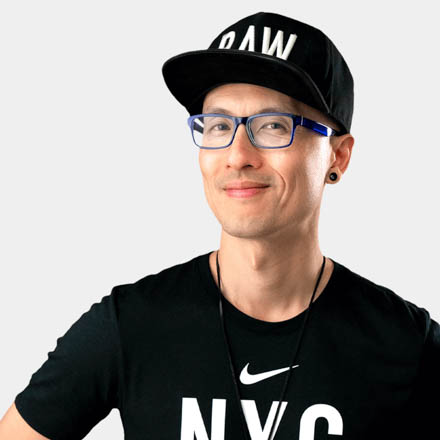
Being able to run every part of a company does not mean being the right person to run every part. Competence can conceal a poor division of labor. For Chris Do, the leadership problem begins when a founder treats personal versatility as proof that the business needs no one else.
His distinction is straightforward: some leaders gravitate toward what comes next; others toward making the company work. Neither contribution is sufficient alone. The difficult decision is not which deserves more prestige, but which deserves more of the founder's attention.
The Founder Is Not the Whole Company
Do describes two broad leadership orientations. One concentrates on forecasting, innovation, and long-term vision. The other concentrates on profitability, efficiency, and the practical coordination that allows work to happen.
He associates the first with a CEO type and the second with a COO type. These are working distinctions in his argument, not a requirement that every company distribute its titles the same way. The useful question concerns the work underneath the title.
A leader looking ahead sees possibilities that have not yet taken shape. A leader focused on operations sees the conditions those possibilities require. The business needs a direction worth pursuing and a way of pursuing it that survives contact with everyday responsibilities.
The company needs both strengths, not one person performing both identities.
That distinction changes the meaning of leadership development. The goal is no longer to turn every founder into an equally accomplished strategist, administrator, negotiator, scheduler, and manager. It is to build a company in which the necessary strengths are present and the people responsible for them understand their roles.
Do's argument challenges a flattering picture of entrepreneurship: the founder who can see everything, decide everything, and keep everything moving. He does not deny that unusually versatile leaders exist. He questions whether that is a useful default assumption for everyone else.
The alternative is not a smaller ambition. It is a more precise account of what the founder contributes. A company does not become more complete simply because one person claims ownership of every function.
This is the organizational side of the transition named in The Futur's Moving from Makers to Entrepreneurs. Making something valuable and arranging a business capable of delivering it are related responsibilities, but they are not interchangeable.
Do's own preference is clear. He wants to develop the idea, establish its direction, and work with people who can translate that direction into coordinated action. His account is useful because it does not present the visionary position as a complete package.
It presents it as one contribution.
There is a practical humility in that framing. A leader can be confident about the quality of an idea while recognizing that someone else is better suited to the work of implementation. Confidence in the vision does not require pretending that execution happens automatically.
Equally, operational strength does not need to borrow legitimacy from proximity to the founder. A person who makes the company function is contributing to its ability to produce results, not merely maintaining the scenery around someone else's important work.
The central tension is therefore not vision against execution. It is an organization's actual needs against a leader's preferred self-image. The more tightly those become confused, the harder it becomes to assign responsibility honestly.
Do's starting point is a division of contribution rather than a division of status. Before a company can give both kinds of work their due, its leader has to stop treating the need for a counterpart as evidence of personal insufficiency.
The Work That Keeps Intentions Intact
The operational failures Do describes are ordinary enough to escape the language of leadership. A contract fails to reflect what the company intended. People are not hired appropriately. Scheduling and bringing people onto a team happen in ways that interfere with the work.
None requires a shortage of ideas.
They require a shortage of sustained attention to how the company functions. That makes them especially important to his argument: an ambitious direction can remain intact in the founder's mind while the arrangements needed to deliver it deteriorate.
Do warns that “work starts to fall through the cracks.” The phrase describes more than administrative untidiness. It marks the point at which the company's intention and its actual behavior begin to diverge.
- Contracts must reflect intentions. An agreement needs to represent what the company means to undertake.
- Staffing must support the work. Hiring, scheduling, and bringing people onto the team affect the conditions for delivery.
- Meetings and spreadsheets belong to execution. They help turn a direction into coordinated activity.
These are not decorative details added after the meaningful decisions have been made. In Do's account, they are part of what makes the best work possible. Operational leadership protects the relationship between a promise and the company's ability to fulfill it.
Consider the contract example on its own terms. A leader can understand the intended relationship perfectly and still sign an agreement that does not represent it. The gap is not necessarily conceptual. It lies in the translation from intention into a document that governs the work.
Staffing creates a similar distinction. Wanting excellent people on a project does not settle who joins, when they join, or whether the arrangement is conducive to doing excellent work. Those decisions require attention to the company's actual activity, not only its desired outcome.
Efficiency, then, is not the enemy of creative quality in this argument. Appropriate coordination is one of its conditions. The work suffers when the business cannot arrange the people and commitments needed to support it.
That connection gives this leadership discussion a natural companion in Crafting a Great Client Experience: From Mediocre to Memorable. The relevant concern here is how a company's internal arrangements support what it intends to deliver externally.
Do describes the operational leader as someone comfortable with optimization, meetings, and the discipline of making the numbers work. The description is deliberately unromantic. Its force comes from refusing to confuse unromantic work with unimportant work.
A spreadsheet does not replace a direction. A direction does not replace a spreadsheet.
There is also a limit to what enthusiasm can solve. A compelling explanation of the future does not itself correct an unsuitable agreement or make a staffing arrangement more appropriate. Those problems call for a different kind of attention.
For the founder who gravitates toward ideas, recognizing that difference is not enough. The company needs a strong person carrying the operational responsibility, rather than a vague expectation that someone will eventually handle the details. Execution needs an owner, not an audience.
Two Orientations, Not Two Closed Categories
Do draws a firm distinction and then immediately qualifies it. A visionary can perform operational work. An operational leader can have good ideas. The categories describe a preference and a concentration of strength, not a prohibition against crossing the line.
This qualification prevents the argument from becoming a personality contest. It also stops either side from using a label to avoid responsibility. Vision does not grant immunity from detail, and operational discipline does not disqualify someone from shaping the future.
Do characterizes the visionary perspective as the “30,000-foot view from a plane.” The metaphor describes distance from the immediate particulars. At that altitude, the leader is looking for direction, possibility, and the longer pattern.
Closer to the ground, the work changes. Someone has to determine how the organization runs profitably and efficiently. That perspective involves the arrangements through which people, time, and commitments become an operating company.
- Visionary leadership looks ahead. Its emphasis is forecasting, innovation, and long-term direction.
- Operational leadership makes work function. Its emphasis is optimization, coordination, profitability, and efficiency.
- Neither orientation excludes the other. The distinction concerns where a leader naturally gravitates.
Do brings Steve Jobs and Tim Cook into the conversation to complicate the neatness of those categories. He presents Jobs as an example of someone associated with long-range vision who also cared intensely about particulars. He presents Cook as an operationally oriented leader who also has ideas.
The useful contrast is not a scorecard between two executives. It is a reminder that strength in one orientation does not imply absence of the other. The point is to identify the dominant contribution without reducing the person to it.
Do's comparison also contains an important distinction between attention to detail and responsibility for operations. A leader can care deeply about the exact expression of an idea and still need someone else to ensure that everything gets done.
Precision of taste is not identical to coordination of a company.
In his description of the unusually versatile leader, an operational counterpart remains relevant. The person with both high-level vision and exacting attention to detail does not automatically make an execution partner redundant. There is still work involved in turning decisions into completed activity.
That matters because the founder's objection often begins with evidence of range. Someone who can identify a minute problem in the work assumes that this demonstrates equal suitability for running the entire operational system. Do's distinction gives that assumption less room to hide.
The same caution runs in the other direction. Someone who enjoys improving how the business functions should not have to prove a lack of imagination before being recognized as operationally strong. Good ideas and operational discipline can coexist.
The leadership choice is therefore less restrictive than its labels initially suggest. It asks where a person's strongest contribution belongs, not which abilities must be surrendered. Specialization of responsibility does not require narrowing a person's intelligence.
For Do, the company performs well when strong people occupy both roles and understand what each role entails. The arrangement needs clarity without caricature: enough distinction to assign the work, enough flexibility to recognize the full capabilities of the people doing it.
Capability Can Be a Habit of Necessity
The most uncomfortable part of Do's argument is reserved for the founder who accepts the distinction but claims exemption from it. That person believes both orientations fit equally well. There is no need to choose because there is no meaningful difference in ability.
Do is skeptical. His explanation is less flattering and more useful: people often develop the second skill because nobody else is doing the work. What looks like a balanced natural preference can be a record of repeated necessity.
Being able to do the work is not the same as being best placed to own it.
This is not an argument against developing range. The ability is real even when necessity helped produce it. The mistake is treating the existence of that ability as a permanent instruction about how leadership attention should be allocated.
A founder who has learned to run meetings, review agreements, and manage schedules has gained useful competence. That does not settle whether those responsibilities remain the best use of that person's time once a complementary leader can take them on.
Similarly, an operationally inclined founder can develop the capacity to set direction because the company needs someone to do it. Acquiring that capacity does not erase a stronger preference for making the business run well.
Do's challenge is to separate three things that are easy to collapse into one another:
- The work a leader can perform.
- The work a leader has learned because nobody else performed it.
- The work toward which that leader naturally gravitates.
Those distinctions are an interpretation of his argument, not a formal assessment system. Their purpose is to expose the weak inference at the heart of the all-purpose founder's defense: continued personal involvement is not justified solely by a history of personal involvement.
The company needed the work done. The founder did it. Neither fact, by itself, establishes that the arrangement should remain unchanged.
Do makes the point through a deliberately narrow hypothetical. Even if the preference is only 51 percent toward one orientation, he asks what becomes possible when the leader concentrates on that slightly stronger side and finds someone else to handle the other work.
The percentage is a thought experiment, not a measurement tool. It removes the excuse that a preference must be overwhelming before it deserves attention. A leader does not need to dislike half the business before making a different division of responsibility.
This focus on the allocation of attention sits beside The Futur's If You're Still Broke as an Entrepreneur, Watch This!, a related conversation with Dan Martell. Here, the specific issue is whether a founder's demonstrated range has become a reason to keep every responsibility.
Do describes the desired result as being “more in your zone of genius.” In context, the phrase means spending more attention on the contribution that feels most natural and distinctive. It is not a claim that the remaining responsibilities become unnecessary.
Someone still has to do them well. The change is that necessity stops assigning the same person both jobs by default.
A Complement Is More Than Extra Help
Once a leader acknowledges a stronger orientation, the staffing problem becomes more specific. The company does not simply need another capable person. It needs strength where the current leader is less naturally inclined to concentrate.
That is why Do emphasizes a complement. The counterpart is valuable not because they resemble the founder, but because they make the leadership arrangement more complete. The relevant fit is between responsibilities and strengths.
In Do's description of his own preferred arrangement, other people understand the concept and then “marshal the forces.” The phrase suggests active coordination. The operational contribution involves getting people and activity organized so that the vision can be executed.
It is not passive agreement with the person who had the idea.
That difference matters to the level of responsibility being discussed. Someone can approve of a direction without knowing how to make it happen. A strong operational counterpart contributes the ability to arrange the work, not merely enthusiasm for its destination.
The visionary also has a responsibility in that relationship. Do describes people understanding the big idea conceptually before organizing around it. His preferred arrangement depends on a direction that can be understood by others, rather than one that exists only in the originator's head.
The partnership therefore cannot be reduced to a founder generating ideas while everyone else guesses at their meaning. The connection between concept and execution has to remain intact. Different roles do not remove their dependence on one another.
Do's advice supports a practical sequence, although he does not present it as a named framework:
- Identify the orientation that fits more naturally: long-term vision or profitable, efficient operation.
- Distinguish that preference from skills developed because the work had no other owner.
- Find a strong counterpart for the other set of responsibilities.
- Clarify what each person contributes so that both roles are genuinely covered.
Nothing in that sequence requires declaring one person the source of all good ideas. Nor does it require assuming that the operational leader should never participate in strategic thought. The arrangement is about primary responsibility, not exclusive intellectual territory.
For a creative business, this is a useful question to place alongside How to Grow a Small Creative Agency. The issue is not simply whether the team becomes larger, but whether the company gains a capability that its current leadership needs.
That distinction also guards against treating delegation as the disposal of unwanted work. The responsibilities Do names have consequences for contracts, people, efficiency, and quality. They deserve a person whose strength fits them, not whoever happens to be available.
His recommendation is demanding precisely because it gives both sides weight. A weak operational arrangement does not become adequate because the vision is compelling. A well-organized company does not make the question of future direction disappear.
The practical resolution is a leadership team that covers both needs without requiring either person to pretend to be equally drawn to everything. Each can retain range while concentrating responsibility. The company gains a more deliberate division of work, and the founder loses a convenient reason to remain involved in every detail.
Stop Defending the Wrong Job
The final obstacle is not understanding the distinction. It is accepting what the distinction implies about the founder's current role. A person can agree that complementary leadership is sensible and still insist that their own circumstances require permanent personal control of both sides.
Do pushes against that exception. The claim to be equally suited to vision and operations deserves scrutiny, particularly when one side was learned because no alternative existed. An absence of alternatives explains the past; it does not automatically prescribe the future.
Play to strengths without leaving the other work uncovered.
Both halves of that statement matter. Concentrating on vision without operational strength leaves the company exposed to the failures Do describes. Concentrating on operations without anyone carrying the longer view leaves his leadership model incomplete in a different way.
The solution is not for every leader to choose the more glamorous identity. It is for each to identify the work that fits, acknowledge the work the company still needs, and make a credible arrangement for both.
That is a more exacting standard than confidence alone. A founder's assertion of versatility says little about whether contracts reflect intentions or staffing supports the best work. Those responsibilities do not disappear because the person at the top believes they can handle them.
Nor does a preference for operations represent a failure of ambition. In Do's argument, understanding how to make a company profitable and efficient is a substantial leadership contribution. The operationally inclined founder does not need to imitate a visionary personality to justify leading.
The same honesty is required of the idea-oriented founder. Disliking follow-up is information about a preference, not a plan for getting follow-up done. The company needs an arrangement that takes the responsibility seriously after its founder steps away from it.
Do's proposed freedom comes from that arrangement. The leader can spend more attention doing what they do distinctively well because another strong person is handling the complementary work. Freedom is the consequence of coverage, not a substitute for it.
This is why the closing decision should remain concrete. The relevant evidence is the work: forecasting, innovation, contracts, meetings, hiring, scheduling, profitability, and delivery. A preferred label is useful only if it leads to a clearer assignment of those responsibilities.
A founder who enjoys seeing the future should be able to name who makes the company function. A founder who excels at making it function should be able to identify who carries its longer-term direction. If both answers remain the same person, Do's challenge is to examine whether that reflects genuine fit or simply an inherited arrangement.
No elaborate identity change is required. The leader does not have to become less capable, less ambitious, or less interested in the other side of the business. The change is in what they continue to own and what another strong person can own better.
The tactical choice is small enough to state plainly: identify the stronger inclination, give the complementary work a capable owner, and make the division explicit.
The company needs the work done well. It does not need the founder to prove they can do it all.
TRANSCRIPT
Enjoyed this? There’s more where it came from.
Get insights on running and growing a creative business.
You can unsubscribe anytime. By submitting, you agree to receive communications and to our Privacy Policy.
“A company that is going to perform really well needs to have strong players in both of those roles”
— Chris Do
Key Takeaways
Subscribe
Details
- Topic
- BUSINESS