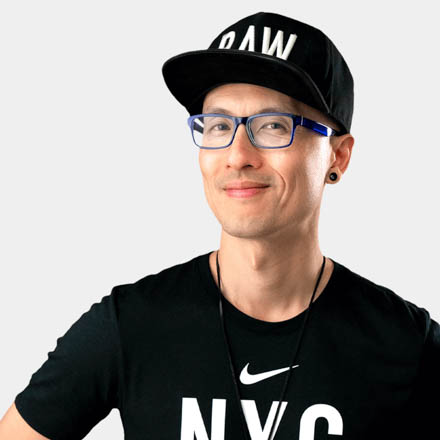
I believe this, if I'm not mistaken, is our first ever successful funded Shark Tank person ever. My guest today is Wambi. He is the co -founder and the CEO of a company called Love Pop.
And if that name rings a bell, you may have seen this episode on Shark Tank, which I'm going to talk to him about. And he makes, I think, a very novel product. And I have some in hand.
For context and for information, everybody, we did meet IRL, one of my favorite places, Earth Cafe. And he was just showing me all these little cards. And it's something to see.
And then it's something else to hold in your hand and see how light plays off of it. The different areas in which they spend love and attention and putting into the crafting of these cards. I don't think pop -up cards are new, but I think the way they execute it is really fun.
And I understand why they're so super successful. And I want to take you to the whole origin story. And I think there's three or four things I took notes during our call where I want to really dig into it.
So if you want to learn about how to grow a business and some of the setbacks that one has and how you scale up to the levels in which few people have been able to do, you're going to want to stick around. My name is Wambi Rose, and you are listening to The Future. First of all, Wambi, welcome to the show.
Please introduce yourself to the good people. Tell them a little bit of your story and we're going to dive in. Amazing.
Well, thank you so much for having me, Chris. As you mentioned, I'm Wambi. I'm a co -founder and CEO at LovePop, where our mission is to create one billion magical moments.
And of course, we do that through making beautiful, intricate paper art. Here's the sister to the design. You were just looking at the cherry blossom, one of our absolute favorites.
And really, in the world today, it's very hectic. There's a lot of noise. We believe in that personal connection, in that personal touch.
And we try to bring it to life with this art meets engineering approach, where you have the seemingly flat card that turns into a beautiful piece of art that you can give to someone and send a special message. So that's really the core of LovePop. We were founded in 2014.
as you mentioned, really, really lucky to be on Shark Tank a year later and have really grown the business from then. We're at 66 million magical moments to date. So we've really touched a lot of lives, but we're also just kind of at the beginning of our journey.
I asked my friend Drigo, how much money do you think these guys have sold in the cards? He guessed the number. And it's almost embarrassing the number he guessed.
He said, no, that's too low. He guessed another one. I'm like, no, that's too low.
Okay, I want you to think in your mind right now, everybody. These guys have started this company, I guess, 12 years ago. And they've sold cards.
These are greeting cards. They're a little bit special, a little bit different. I want you to guess, how much have they grossed since starting the company?
Give you a second to think about this. Think of a high number. Okay, drum roll.
To date, how much have you grossed in lifetime sales? Yeah, we're getting close to 400 million in lifetime sales at retail. That's with a core product that our standard price point on these is $13.
So lots of people making a lot of magical moments. That's dope. Congratulations.
First of all, they're approaching half a billion in sales. This is incredible. And their mission, I mean, to create one billion magical moments for people.
And I'll tell you a little story and I want to get right into the Shark Tank. Back when I was young and much more romantic and thoughtful, I'm not, I'm an old geezer now, so I don't care about this stuff anymore. million in lifetime sales at retail.
That's with a core product that our standard price point on these is $13. So lots of people making a lot of magical moments. That's dope.
Congratulations. First of all, they're approaching half a billion in sales. This is incredible.
And their mission, I mean, to create 1 billion magical moments for people. And I'll tell you a little story and I want to get right into the shark tank. Back when I was young and much more romantic and thoughtful, I'm not, I'm an old geezer now, so I don't care about this stuff anymore.
I used to go to like a Hallmark store or a stationery store to buy the card that could express something that I didn't know how to say. And I think there was a time and place when this was really like a big deal. I remember getting it for my girlfriend or for my mom or my dad for mother's day, father's day, birthday card.
And I was like, that's funny. And you're finding the card that has your sense of humor, that has your aesthetic, and it nails the sentiment exactly. Back when I was younger, I didn't have to deal with like bereavement cards or anything like that.
But it's like, it's really cool that you can find something that can say what's inside your heart that you can't put out. And then you've added this additional dimension of three -dimensional space and special effects. Some of them have sounds and lights and other things.
But it's really neat that you're to do that. So what does it mean to create a magical moment? Can you describe that?
Yeah, well, we really think about it as a magical moment. There's kind of at least two of them in every card that gets sent, one for the giver and one for the receiver, because it's really meaningful, not just for the person getting the card, but really for the person sending the card. And that's one of the real interesting learnings as we've gone through building the business is just how much joy people get from sending cards.
So we call our customers enthusiastic givers, because that really kind of encapsulates the mentality of who loves to send our cards. And what we've found is that kind of the more you do it, the more you get the thank you, you get that reaction, and the more you're building and nurturing your relationships. And those are, of course, the most important thing.
And without them, life is not the same. And so when we take the time, and we reach out, then that's what creates that connection. So for us, that's really the magical moment.
I think what love pop does that really makes it special is we bring it to life in a new way. And so that experience you were talking about going to the Hallmark store and like picking out going through that giant rack, and it's a little bit of a multiple choice selection process. But with a love pop, we actually keep the words to a minimum, we do love our puns, and we have a lot of them.
But we also have a lot of blank cards. And even kind of the sentiments we put are relatively universal. So that it's really more about what is that recipient into?
Can we find some really fun subject matter or really beautiful subject matter that can tell the story of our relationship that can create a moment of connection that can make them smile, make them laugh. That's something that they can put out on the bedside table or on the mantle or in the living room. And when they see it, then they think of you.
So that's really how we think about the magical moment and kind of how what we do is special. There's an expression and it's a cliche at this point that a picture is worth a thousand words. So sometimes having the right piece of art to color, textures, materials says it.
You have literally added another dimension to this when the reveal of it itself creates a little moment of aha, surprise and delight. We're not quite sure what we get and you open it up and that that's a moment there that they express. They feel that they can express to whoever gave them the card.
That was really neat. That was different. That was unusual.
And I think especially with everything that's going on, a little bit of like novelty and thoughtfulness goes a long way. And I can imagine like people receiving this and having that expression. But look, we're not here to talk about hallmark moments.
We're not here to talk even about warm and fuzzy feelings. We might get there somehow, but I want to talk real business with you because that's what our audience is really into. Let's do it.
I want to take you back to Shark Tank. I rewatched it yesterday. Oh.
That's a moment there that they express, they feel that they can express to whoever gave them the card. That was really neat. That was different.
That was unusual. And I think, especially with everything that's going on, a little bit of like novelty and thoughtfulness goes a long way. And I can imagine like people receiving this and having that expression.
But look, we're not here to talk about Hallmark moments. We're not here to talk even about warm and fuzzy feelings. We might get there somehow.
But I want to talk real business with you because that's what our audience is really into. Let's do it. I want to take you back to Shark Tank.
I rewatched it yesterday. Oh, awesome. Yes.
I have a lot of questions for you. I was a bit younger then, yeah. A little bit.
You look a little different back then, but you still have no wrinkles today. So you're still a relatively young man. What I'm surprised to discover is Wambi and his co -founder are highly educated people with a lot of different skills.
You yourself went to like boat engineering design school or something. What did you go to? Yeah, my co -founder and I went to Webb Institute, which is a school for ship design, naval architecture, and marine engineering.
So you learn how to do everything from layout and engine room to design a hall. So there's that part. And then he's like bored.
So he's like, I'll go to MIT. I'll just do that. Oh, I'm bored with that.
I'll just go to Harvard and go to a Harvard business school and get his MBA. It's like, this is not just the guy who likes cool cutout things. There's like a lot of brain power behind all this.
I don't say that to intimidate our audience, but I just want to give that context. Like these are not just like happy -go -lucky guys who just bumped into a business. There's a lot of brain power here.
But okay, you guys walk into that room. It's pretty intimidating, I imagine. And you have this valuation that you are going to offer them 10 % of your company for $300 ,000.
Here's the first question for you. That valuation, was it a negotiation tactic or were you set on getting that value? When we went into the tank, we prepared a lot.
Kind of way more than you could imagine. Even the five days before the show, we watched like every episode of Shark Tank. We asked ourselves every hard question that we saw on there.
Who was going to answer it? How are they going to answer it? And of course, one of the most important ones is what do you walk in terms of your offer.
But also, we were really clear on what would we be comfortable accepting if it was offered to us. And we came in with that offer of 10 % of the business, essentially. And we were willing to accept 15.
And so when we got the first offer at 20, it was not in our kind of in our zone yet. And we were able to get it to 15. And at that point, we had hit kind of the threshold we were willing to accept.
Okay. So if they didn't agree to lower the equity that they wanted, would you have walked out? If we hadn't been able to get to 15, yeah, we would have walked out because really, that's the only way that philosophy would have worked for us.
And John and I had to both be on the same page coming into it. And there's no opportunity to really kind of discuss it live on set. So we walked in with our parameters and that was what we were going to do.
Okay. The business lesson here really quickly just to point out to people is when you go into negotiation, you need to know what your hard line is and that way you're not waffling and then they could exploit that. You knew beforehand because you also knew there isn't a lot of room for you to negotiate in front of them because if you did, they'd tear you apart.
We've seen that happen. Like if you don't make your mind in 3, 2, 1, I'm out. That kind of stuff, right?
Next question for you is you came in with this idea when you had this kiosk and it was going to be about $20 ,000 to set up each kiosk and Barbara, to my surprise, was the first one to go out because I consider like one of the most stable, consistent investors in that show who believes in people and their ideas. Was the kiosk a bad idea? Well, I don't believe that kiosks themselves were a bad idea or a good idea in and of themselves, but certainly we made a fairly large mistake early on in our history by...
when you had these kiosks and it was going to be about $20 ,000 to set up each kiosk. And Barbos, to my surprise, was the first one to go out because I consider like one of the most stable, consistent investors on that show who believes in people and their ideas. Was the kiosk a bad idea?
Well, I don't believe that kiosks themselves were a bad idea or a good idea in and of themselves. But certainly we made a fairly large mistake early on in our history by expanding that model too quickly. And interestingly, Barbara was right on in kind of her assessment there, which is like, I don't know that you've proven this out enough.
I mean, she said it in different words. And that is ultimately exactly what happened. We did expand the kiosk model.
We hired a really fantastic leader who had a lot of experience building out retail models. He opened the next four locations for us. And when we got the numbers back from the first few days, it was about 25 % of what we're expecting to see.
And that moment was like being punched in the gut because you're like, I don't know how we get back from this, but we've just committed a couple hundred thousand dollars on this strategy between hiring the leader, building out the kiosks, hiring the team, putting the inventory in. And I represented most of the money that we had at that time. And there was really not enough of a path to be able to get those into a profitable zone.
And we ended up having to shut all of those down. And we ended up losing a few hundred thousand dollars, ending up with no money in the bank at the end of that. And the biggest lesson I took away from it is just there's false positives and there's false negatives.
And it's really hard to tell in the moment exactly what you're looking at. And so just gave us this really healthy respect for what does that data point really mean? And how open we need to continue to keep our minds for the information that's coming in, especially when we're making big decisions that have an impact on the company.
And that was one. And it created a lot of stress and challenge for us. We had to dig out from, but it also gave us this incredible story that we still use to this day for all of our decision -making.
I want to follow up later with how you make decisions based on data, like how data -driven are you? But I want to get back to that because I just watched it again. Maybe it's a distant memory for you, but she said, and it was a weird word that she used.
Because she's like, you guys are like, I think she said too fancy. That's right. That's like, what?
That was a weird word she would use. And I consider her very shrewd. And probably of all the sharks, she's probably my favorite.
She really is. And so when she was like out, I'm like, oh no, that's the one shark I really want. Because she seems like she's going to do the work with you and get involved in whatever you want from a partner.
But she said too fancy. And she was right. I didn't love the word, but she mentioned the kiosk.
She goes, I like my businesses to do basic, not fancy things. I know I can invest and it can work, right? I think she was right about that.
The exact business strategy that we were pursuing at that time didn't end up being the right one. However, and this is where I think Kevin and Robert, who ultimately did make offers to us, they were seeing something different. They were seeing something bigger, which was kind of the underlying concept, the underlying product, the skills that John and I had to bring to the table to build the business.
And I think that bigger vision ultimately prevailed. We had to do some iteration on how we were going to get there. But I think that is the interesting piece is you can be right on this piece of it.
But if you're not ready to take the risk on the big picture of where you're trying to go, then you also, you can't get there. So we're really lucky that Kevin came in to the business and he's really lucky. He's been a part of growing this business.
Okay. There's Kevin. There's Robert.
They're both basically matching each other. It's kind of interesting. And I think that bigger vision ultimately prevailed.
We had to do some iteration on how we were going to get there. But I think that is the interesting piece is you can be right on this piece of it. But if you're not ready to take the risk on the big picture of where you're trying to go, then you also you can't get there.
So we're really lucky that Kevin came in to the business and he's really lucky. He's been a part of growing this business. OK, there's Kevin, there's Robert.
They're both basically matching each other. It's kind of interesting. Robert lowers Kevin follows suit.
I'm like, what is going on here? I know why you said it on the show. But Mr.
Wonderful doesn't exactly have a wonderful reputation. He's all about the money. He's pretty transactional when it comes to stuff.
He's Mr. Royalty licensing fee and you pay me back something in perpetuity. It's like, oh, my gosh.
In that moment, all things being the same, why did you choose Kevin over Robert? We chose Kevin really simply based on our intuition in the moment of how they were interacting with us. Kevin put himself forward and said, here's how I can help you.
I have these other businesses. I'd love to figure out how we can partner up. I love what you're doing.
And he was really trying to sell himself kind of from the first moment. You could see he was in love with the product. And everything that he was putting forward was felt like, here's someone who really wants to get engaged and help.
And not that that wasn't necessarily true of Robert. I don't know. But the comments he was making were more kind of snide and, you know, like, oh, you know, I went on a cruise in Boston.
When Kevin mentioned I'm in Boston, like we can get together. And Kevin's like, oh, you know, I went on a cruise in Boston. I was like, OK, well, here's a guy who's kind of pitching himself to help us.
And here's a guy who's kind of like poking fun at it. And that was it. was super simple.
There wasn't a lot of analysis. It was just both John and I looked at each other for a second and we're like, yeah, I think we have the same idea here. And and so that was an easy one.
And it turns out Kevin really spends a lot of time on helping Shark Tank companies get more awareness and exposure. And for a product like Love Pop, that was exactly what we needed. Yeah.
Of the sharks outside of maybe Mark Cuban, I think he gets the most PR press time because I don't see many of the other sharks on other like a normal like cable network. News or whatever it is. And I see Kevin a lot.
He's always opining about something. And so he has a pretty big platform in terms of like talking about the companies he works with. When you guys looked at each other, according to the edit, it looked like telepathy.
How did you like let's go with what was the secret signal? How did you know? Like, let's go with Kevin.
And he's like, no, I meant Robert. Sorry. No, we literally looked at each other.
I, I can't remember. I think I think I might have said Kevin. Right.
But it might have been John. I can't remember. But just one of us said Kevin.
Right. And the other one just nodded. And we said, all right, let's do it.
I think when I watched the episode and I think about the experience we had on Shark Tank, it really was exactly what we experienced on the show. Obviously, we edited it down to to a certain time frame, but very much felt exactly like what it felt like on set. OK, that's good.
So here's another thing maybe we can learn from in the creative entrepreneur space where you're showing up and you think you're auditioning. They're auditioning you. You're auditioning them.
It's two ways. So I think you just touched on that where you're in theory auditioning for the Sharks. But you can tell the way that Kevin was asking questions or talking about certain things, he was also auditioning for you.
So when it came down to the end and who got the deal, the person that you feel most connected to was the one you ultimately chose because they offered you the exact same financial deal. So outside of what you already said. So this is where I want our listeners to kind of understand this.
So when you show up for a pitch meeting, you're pitching. you're auditioning them. It's two ways.
So I think you just touched on that where you're in theory auditioning for the Sharks, but you can tell the way that Kevin was asking questions or talking about certain things, he was also auditioning for you. So when it came down to the end and who got the deal, the person that you feel most connected to was the one you ultimately chose because they offered you the exact same financial deal. So outside of what you already said, so this is where I want our listeners to kind of understand this.
So when you show up for a pitch meeting, you're pitching to them. Yeah. Arguably who you choose as your investor or partner or who you get involved in the business is a higher stakes decision for you than it is for the investor, right?
The investor is talking to thousands of companies every year and makes a few choices, but they are spending a very small amount of their time on what you're doing. But your livelihood is very closely connected to how that investor will work with you and partner with you and make decisions with you. So I would argue that it's even more important the other way around.
That may not be how it feels in the moment, for sure doesn't, but I think that's really the reality of it. And in this particular case, there's one other thing that Kevin did that was really interesting is he was talking about his other businesses in a way that you could tell, oh, he just mentioned Wicked Good Cupcakes. And now everyone who's watching this episode is going to remember Wicked Good Cupcakes.
And it's like, if he invests, he'll do the same with Love Pop. So there was also that element of seeing kind of some concrete value, that choice. Right.
What I wanted to say to reinforce the idea is like you audition for them, but you should be auditioning them too. Like who's a good fit for you? So even a client service space, you need to know, I can only do good work for people who allow me to do good work.
Otherwise, you're setting yourself up for failure. So it works both ways. Sometimes we seed our power in the relationship and actually doesn't help us to make the deal.
So just remember that everybody, you have something unique to offer and make sure you're as careful as who you choose as a client as they choose a vendor. Amazing analogy. Totally agree with that.
I want to talk about the Shark Tech effect, but I want to talk about this idea that I think you shared with me off air was you got this money, you got the presumably the $300 ,000 and you go and go to market with your strategy with building the kiosk. You're getting about 25 % of the anticipated sales and it turned out to be not such a great idea. You just got this money and then you just lost the money.
Almost instantly seems like, right? If I'm following the narrative, how do you not let that break the whole business? How does that not torpedo the whole thing?
Well, the short answer is grit and perseverance. And when faced with those obstacles running out of money, in this case, having the core business strategy fall apart in front of your eyes, those are real setbacks and the only way out is through. And so we just buckled down.
At that point, we knew we needed to raise some additional capital to keep our operations going. So we did that and that wasn't easy, but we got it done. And then we focused on building the online part of the business out and lovepop .com.
And ultimately that turned out to be a much more scalable business and forms the core of our business today. So if it hadn't been for that signal, honestly, it could have been worse if we had got 75 % and then we tried to keep going. Like sometimes it's better to fail and learn from that and then move on in a way that makes more sense.
I would say, even though it did cost us a lot in terms of cash, in terms of equity, and it forced some really quick work to recover from, it did ultimately put us on a better path. Real quickly, how much more money do you need to raise and how much more equity do you have to give up for that costly endeavor? Yeah, well, in that case...
95%. And then we tried to keep going. Like sometimes it's better to fail and learn from that and then move on in a way that makes more sense.
I would say, even though it did cost us a lot in terms of cash, in terms of equity, and it forced some really quick work to recover from, it did ultimately put us on a better path. Real quickly, how much more money do you need to raise and how much more equity do you have to give up for that costly endeavor? Yeah.
Well, in that case, we pretty much lost the money and the equity from the Shark Tank investment. And ultimately we ended up raising at that point, a few million dollars to continue building the business out. And really that was more about the bigger idea of where we could get to.
And I think the other piece, and you mentioned choosing your investor, your investors are along for the ride with you, but they didn't invest in exactly your business plan. They invested in you and they invested in you to keep figuring it out no matter what is thrown at you. And I think that has been true for everyone who's been a part of the low pop business.
Sometimes it's better to fail spectacularly than to have moderate success because that will give you false hope. You keep dumping more time and energy to it, right? That's what you're saying.
It's better like, yo, that was bad. Totally. Much better.
Much, much better. I think that idea, I have the same conversation often with people who are starting a business for the first time and not just about the actual business, but about what are you choosing to do with your life? I almost think starting a business and having a moderate level of success in something that you're not truly passionate about is a much worse outcome than failing or not starting it at all.
Because no matter what business you're in and no matter what you're trying to do, at some point, it's going to get really hard. And when that happens, you got to love it. And like, I love this product.
I love what we do. It's so fun. And yet some days it's so hard and the responsibilities are enormous.
And if I didn't love it this much, there's no way I could sustain that pace, energy, mental load. And so I think that's where I really believe it's, yeah, it is better to, to fail quickly and make sure what you're doing is like something you really love. Maybe a quick insight here for the entrepreneurs who are listening.
It's got to be pretty tough to like have this idea and think this is it. I'm going to do it. And then the data is telling you everything, but how do you make that hard decision of like closing down a business or shutting down a new business model or something?
Like, was it easy for you to make this decision or, you're like, you know, my business brain says, we got to stop. This is nonsense. Well, I truly believe that the customer always tells you what they want, kind of as a group, you will always learn really quickly when you put something in front of the customer, how they react to it.
And even today, after launching 2000 plus products, we still don't know exactly which ones are going to work. And we've had to shut down a lot of different businesses that kiosk expansion strategy. We had to pair that back, come back.
We ultimately ended up rolling out a totally different type of store format. That's been much more successful, but that was years later. We had to shut down our wedding invitation business, which was super cool.
And we were making incredibly special product, but we hadn't really figured out kind of how difficult it would be to work with a couple and the family in some cases on the super special event and how much time that pair that back, come back. We ultimately ended up rolling out a totally different type of store format that's been much more successful, but that was years later. We had to shut down our wedding invitation business, which was super cool.
And we were making incredibly special product, but we hadn't really figured out kind of how difficult it would be to work with a couple and the family in some cases on the super special event and how much time that would take and economically kind of what that would mean. And those are just a couple examples, but this has happened over and over and over again. And so what I really believe about business is you have to have these quick feedback loops and the faster you have the loop, the faster you can learn and the quicker you'll get towards the right direction.
And that doesn't mean that the vision isn't important because you have to have somewhere that you're going, but I do believe in a certain amount of flexibility on how you get there. So when the episode airs, what kind of lift do you see in the business? I've talked to a lot of different companies that have gone through that experience and it really depends.
There's a huge variance, big range and kind of how much impact a Shark Tank episode airing has on either immediate performance or leads or whatever the metric is for the business. I think for Love Pop, it was really strong. And I believe that's because what we do is so universal.
Everyone has a special person in their life that they should be recognizing and can. There's birthdays all the time. There's just so much opportunity and it's accessible.
So for us, it was really big. We had 33 ,000 people on the website, the moment that it aired. And we were really lucky to have another Shark Tank company in Boston that actually came to our office, helped us get like all the tech set up and ready for it.
We had all of our friends and family and on the phone lines. And so kind of, we were able to go pretty deep and we still spent a month digging out from kind of that initial demand. But you know, after that, it's really, it's back to business as usual.
So it's up to you to, to build the business. Without prying here. So you get the money, you start rolling out the kiosk, finding out that doesn't work and then reinvesting in the .com part of your business, right?
The online part, which you talked about in the show. Had that already transition already happened by the time you get this 33 ,000 new eyeballs on your site? Well, yeah, we were prepared at that point.
Okay, cool. All right, let's move on. Let's transition to this other part where you talk about the market or the customer always tells you what they want and you can't always predict.
Earlier in this episode, I held up the opossum card and it's like two things that look like rats with their tails, making a heart shape out of a garbage can saying life without you is trash. You know, once you talk about it, how can it not? Yeah.
It's kind of adorable in a weird dorky way that if somebody gets that, you kind of know your soulmates. I think, I think somebody who's prim and proper and very certain way, you know, high maintenance would look at them like we're breaking up over this. So, you know, you got the right one when they respond to it.
Okay. Probably I would have not predicted that would be your best. You can lay out a hundred of them in front of me.
I'd probably pick every other one besides that one to go and say, that's going to be your best seller. I think you, you shared this with me where you think it's really important. Like you got to go fast.
You're going to try lots of things. You're okay with failure because you just can't predict what will and will not work in the marketplace, which is almost the opposite of how creative entrepreneurs are. They're like, I can't release it.
It's not perfect. Oh, you know, the spot varnish on this and I got to work at the mouse type and they never ship anything. They put so much into that or they put so much effort into it and they ship it and it bombs and it's heartbreaking.
It's so devastating. They don't even try it again. They don't even try to fix it.
So this is going to be medicine for some people. Can you expand? you got to go fast.
You got to try lots of things. You're okay with failure because you just can't predict what will and will not work in the marketplace, which is almost the opposite of how creative entrepreneurs are. They're like, I can't release it.
It's not perfect. Oh, you know, the spot varnish on this and I got to work out the mouse type and they never ship anything. They put so much into that or they put so much effort into it and they ship it and it bombs and it's heartbreaking.
It's so devastating. They don't even try it again. They don't even try to fix it.
So this is going to be medicine for some people. Can you expand on this idea about like why iterating and doing lots of things allows you to get to that thing that's your best sellers? Yeah, I really truly believe this, right?
We've, again, we've launched so many new designs and we have so much experience with that and we still can't predict it. Every, we go into season, we tear it out. Like what's a tier one, tier two, tier three product in terms of demand and it's never right.
And my takeaway is just that humans are complicated and that's great. And there's no perfect formula for it. And you probably see this every day in terms of like which piece of content takes off and which one doesn't, you don't know.
But in hindsight, it's super clear. Well, that one did and that one didn't. And so in a world where that's the reality, I believe the only way that you can operate is with a portfolio approach.
Like you have to do different things and you have to see what's working. And there's certainly things, then you want to pull it apart and try to figure out what was it about that, that made it so special. And can we replicate that?
Or can we put a twist on that and bring it over here in some different way? And maybe that works and maybe that doesn't work. And I'm like, you mentioned like very precious.
Like I care about every detail of what we're doing. I want it to be perfect. And I have to pull myself back because if we wait for that, we won't get it out there and it won't hit the light of day and then you won't know.
And so I really believe and I have strengthened my conviction over the years that it's about getting it out there. And that can be uncomfortable, very uncomfortable. But if you don't have that feedback loop, you're not going to learn.
And the world is moving so quick and the pace of learning is adapting. And now we have AI that is just exponentially working on top of itself. So I think that's the only way.
Move, you Muppet! Alexa, traffic has me famished and furious. Remain calm and think of sushi.
I can book a table nearby. Thanks, Alexa. Move!
Shall I play that Hangar Management podcast again? Good idea, you cheeky... The all new Alexa Plus gets you and gets things done.
Could you share with us maybe an idea that you thought, oh, this one's going to be the one and it bombs. It does the exact opposite. Is there a funny story there that you have?
The wedding business that we were talking about earlier. I mean, the product was amazing, but we were unable to scale that business and we spent a full year and over a million dollars of building that business. And if I could go back to the beginning of that, it's not that I don't believe we could build a really amazing, successful wedding invitation business.
It's just that the way we approached it was, here's the end state of where we want to go. Let's build everything towards that. And ironically, we were on a path kind of at the beginning of building that business that I think would have worked if we had stayed with it.
So basically what we were doing in the beginning was we were just individually working with customers and we had our happiness team talking to customers and then we would make a special wedding invitation for them. And it was not a super scalable approach, but we were learning a ton and we were iterating on it. And I think if we had kind of continued that, we would have continued that kind of pace of learning.
But instead we took it out and we said, okay, we have an initial proof point that says people. basically what we were doing in the beginning was we were just individually working with customers and we had our happiness team talking to customers and then we would make a special wedding invitation for them. And it was not a super scalable approach, but we were learning a ton and we were iterating on it.
And I think if we had kind of continued that, we would have continued that kind of pace of learning. But instead we took it out and we said, okay, we have an initial proof point that says people want to buy wedding invitations. Let's build out the entire flow where we do this process where we ask you about your colors and your theme and all these things.
And then we 3D render together this perfect invitation for you. And then, okay, well that maybe wasn't perfect. So now we'll 3D render three perfect invitations for you.
And we created that whole thing, but the in between that point and when we had that ready to launch, our customer feedback was some surveys and conversations, but not real and not iterative. And so I think that's a great example where again, false positives, false negatives. It's not that wedding invitations should or shouldn't work, but I think there's a real difference in kind of how you go through the process.
Yeah. Okay. You just pointed something out.
Sometimes we ask people hypothetical, if I launched this, would you buy this? And all your friends and say, oh yeah, let's do it. It should be even more money.
And then you finally release it at their recommendation and none of them show up to buy. So until you actually get people to pull out their credit card to act on their intention, it's all theoretical and it's dangerous data to really build anything off of. Yeah.
And we've seen that. We've had wait lists for a new product that is in the kind of 6 ,000s and then we get 50 people that actually follow through when we launch it. And so there's no substitute for the actual sale.
I'll talk about growth strategy. So I watched the follow -up episode to your Shark Tank thing. I don't remember the exact numbers, but I think it was something like in the two years in which we've been doing this, we had a million dollars worth of sales and we've done X millions of dollars in two months.
That would be a dream come true for people. Like you're doing more in two months than you did up to date. What are your insights into how one acquires more customers in the growth strategy?
Because I'm sure you've tried lots of things, things have worked and things that have been not so good. What can we learn from your experience there? The biggest thing that I believe when it comes to, especially direct to consumer business, and every business is very different.
Our business, this is the core product here, really amazing piece of art. It doesn't work that well in the retail channel because it takes up the space of five or six cards in the greeting card rack. It costs an order of magnitude more to produce than a printed folded piece of paper.
And it also has a lot of possibility of being damaged. So for us, that channel is not as interesting as it might be for a lot of other consumer products. So I just want to put that out there as a disclaimer that Lovehop is kind of unique.
And for other businesses that are in kind of a consumer product area, there may be more opportunity in the channel than for us. But from the direct to consumer and the online growth, I really believe that it's kind of a stair step where you figure something out and it unlocks another kind of chunk of growth. And then you have to, then you hit a plateau and you have to figure out the next thing.
One of the absolute biggest unlocks for us was back in 2017. We were talking about this before the show. We figured out with an agency that was in your building, how to unlock UGC on Facebook, UGC content on Facebook.
This was back in 2017. So a long time ago, but that really took the scale with which we were able to bring the product to the world. It almost tripled the plateau and you have to figure out the next thing.
One of the absolute biggest unlocks for us was back in 2017. We were talking about this before the show. We figured out with an agency that was in your building how to unlock UGC on Facebook, UGC content on Facebook.
This was back in 2017, so a long time ago. But that really took the scale with which we were able to bring the product to the world. It almost tripled the business at that point in time.
And there's been a handful of times where you have that moment where your testing breaks through and then you unlock this new area of growth. And so for me, it's a lot of time banging your head into the wall and trying new things. And then you unlock it, you scale to the next level, and then you're back at that point.
And the number one kind of grounding thing for me in an e -commerce business is lifetime value to cost of customer acquisition. So really having a great handle on that. And the interesting thing is the lifetime value is where your exponential growth really lives.
So more time figuring out how you create an amazing product that people want to come back for over and over again, because that actually gives you the ability to bring it to more people better than kind of linearly pulling down your cost to acquire a customer. So for people who don't know, UGC stands for user -generated content. Correct.
For us, just to make it super simple, it's someone in a very kind of authentic way, just opening. I love that. That's a good one.
And just quick videos of that on Facebook was really powerful for us. So it has the feeling that someone made it, but when you're working with this media marketing agency, they're the ones making the UGC. It's the agency that makes it, right?
Yeah. Over the years, we have had a lot of different approaches to making creative. And similarly to what I was talking about in terms of experimentation in a portfolio, I believe that you really want to have different sources of how you're making your content and your creative.
In our case, a lot of it is product specific, but there's also other pieces that are just telling the story of our mission and what we're trying to do. But either way, I think many different approaches make sense. In this case, we started with one agency that kind of figured out how to unlock that particular angle.
At this point, we have individual kind of brand ambassadors working on creative like that. We do some in -house and we work with other agencies as well. And so it's just kind of whatever wins, wins, because we'll put it all out there and we'll see what's winning.
I'm going to assume you still use UGC content. It's in -house now and you're still running ads to those UGC? Like I said, yes, we are definitely still using UGC content.
In fact, I think it's grown in terms of how much of our advertising it is. But the way that we're making it, we have multiple different sources, right? So we work with independent creators who we send cards and they get to use them, experience it, make content with it.
We use that. We do some in -house with our own team. And then we also work with different agencies.
So it's just really trying to get a variety because everyone has their own style. Everyone has their own kind of approach to it. And you never know exactly what's going to take off.
A slight detour. So the next part I want to talk to you a little bit. I mentioned this at the beginning.
You're a highly educated person. You're very smart. How much of your education plays into what you do in this company?
Because that's always the big question. Everybody hears about getting your master's degree in business, getting your master's degree from Harvard. Just like that's a big accomplishment.
From a practical point of view, how much of what you learned in business school do you apply or feel like is attributed to you running a successful company? I think the education where the actual education has the most. So the next part, I want to talk to you a little bit.
I mentioned this at the beginning. You're a highly educated person. You're very smart.
How much of your education plays into what you do in this company? Because that's always the big question. Everybody hears about getting your master's degree in business, getting your master's degree from Harvard.
Just like that's a big accomplishment. From a practical point of view, how much of what you learned in business school do you apply or feel like is attributed to you running a successful company? I think the education where the actual education has the most impact was from my undergrad at Webb Institute.
And we were a class of 18 people and we worked incredibly hard. Basically, the part of the philosophy there is to give you so much incredibly difficult work that you really have to figure out how to manage. And that instilled in me and in John and in all of our classmates, just a work ethic that I don't remember much of the actual content of what I learned.
I could not design a machine room in a ship today. I could not do the thermodynamic calculations or set up a large three -phase generator. But I can work really hard.
And I think that is the number one thing from school that I took away. The second thing, which actually came from a couple of years that I spent in consulting, that I really think has been very helpful is communication and how to take complicated ideas and break them down into something that you can quickly share and get alignment around within the team or with your investors. And that has been incredibly helpful.
And then, for example, at business school, we just have incredible classmates who are doing incredible things. So there's a lot of inspiration and there's some really great connections that can be really helpful in opening opportunities. I think you echo a lot of the sentiment that people who have had some success or seem to share the same opinion in that if you go to college or university, it's a very rigorous program.
It's not so much that you're learning this, but you're just learning what you're made of and you're becoming really resourceful and you grow a lot and you kind of develop that framework and at least in your mind to be able to solve problems. And that gives you the confidence to move forward. I agree with that.
And I would go a step further to say most of the actual kind of day -to -day skills that you need for building a business, like how to run a great meeting, how to put together a good strategic plan, how to hire people, how to source for hiring, how to interview, how to evaluate, how to make that decision. Those are not things that we ever learned in any school program, not even in business school. Those were all things that we had to learn on our own from mentors, from books, from trial and error.
So I don't think school is about learning the specific subject matter that you're going to end up doing. I think it's about learning how to learn. I think it's about developing, like you said, confidence and understanding of just how to approach problems.
Maybe you're listening to this and you're not seeing the visuals. You don't understand this thing. And I think it's one thing to see it and you'll know right away.
But you're probably sitting there thinking, hmm, pop -up cards. We've seen this. We pop -up art.
It's not new pop -up books or nothing new there. Okay, okay. I guess I have a two -part question and I hate it when people throw me a two -part question, but I'm going to do it to you because you can handle it.
I know you can handle it. It's all good. So number one, I think when I've seen like in the Museum of Modern Art and I'm buying a card or something and I see this like beautiful, like white on white, three -dimensional thing, I'm like, wow, that's just super artistic.
Okay, that's one thing. Is that something that you guys think, you know, we try that, doesn't really sell to the masses. It's like cute, fun, emotional, or is it like this high art wind in this space?
That would be the first question. Here's what I believe. Because you can handle it.
I know you can handle it. It's all good. So number one, I think when I've seen like in the Museum of Modern Art and I'm buying a card or something and I see this like beautiful, like white on white, three dimensional thing, I'm like, wow, that's just super artistic.
Okay, that's one thing. Is that something that you guys think, you know, we try that, that doesn't really sell to the masses. It's like cute, fun, emotional, or is it like this high art wind in this space?
That'll be the first question. Here's what I believe. that our mission is about having something for you to make whatever moment that you want to be making.
And that's this big intersection of recipient, occasion, theme, style. What are you into? And so not everyone, high art is not going to win for everyone, but like some really artistic pieces and options are absolutely part of what a portfolio of product looks like.
And so even what I was just showing you is definitely more in that direction right here where it's like a really, really special thing. And that's a sneak peek. Like no one, no one's seen that.
So you're the first. Exclusive. Yeah.
As designers, like we love that space and we would love to do even more in it. But really our muse is what do people really want to express themselves to other people? And so that's really where we focus.
And that means there will always be a place for it. And it's really fun and exciting when we get to work on it. And, you know, when we just met in LA, it's because of the Grammys and we were really lucky to work on this project with OK Go and we're nominated for Best Recording Package.
That is definitely in the art zone. And so I think it's really important for Love Hop to express ourselves in that way. But it's also never going to be everything that we do because we really want to help you with whatever magical moment you want to create.
So different art, different styles for the very broad group of people you serve. Yeah. And everybody likes something different.
And that's the fun thing. So even though the possum that you're holding is the number one Valentine's Day card, this one, the anglerfish is also big. And you know what?
Somebody looked at the possum and decided to buy the anglerfish and someone else decided to buy the rollercoaster. of Love. This is a great one.
And someone else decided to buy the cherry blossom. And they're super different. And you know what?
There's something great for everyone. So even though something is kind of the most popular, it definitely doesn't mean that that's the thing everybody wants. So we can't own the idea of pop -up cards.
We can own the mindshare, I believe. But how do you create a moat so that someone else is like, oh, I see what they're doing. great.
Let's go do this. Because sometimes I watch the sharks and they do this like it's not defensible. It's like, but there's something else bigger.
There's a brand play. There's a first to market or biggest in the market that then wins. But they don't usually see that.
So how do you create a moat around your business so that you reduce competition? When we think about Love Hop, the most important thing is the mission. That is the most important thing.
And you can't copy the mission. Our mission is create one billion magical moments. The way we do it is combining art and engineering.
We really live that. We breathe that. We do it every day in every product we make, in the way we make the product, in the way we bring it to market, kind of like all across the board.
And so sure, you can do one piece or another piece, but you can't copy the whole system. And our belief is that as we keep building this, it just gets stronger and stronger. I'll give you a couple of examples.
We do all of our own production. Very, very few companies in the consumer product space in general, but certainly not in our space, do their own production. We own all of our laser cutters.
We wholly own our subsidiary in Vietnam where we do all the production. We have 40 designers there who are working every day on making Love Pop product only. or another piece, but you can't copy the whole system.
And our belief is that as we keep building this, it just gets stronger and stronger. I'll give you a couple of examples. We do all of our own production.
Very, very few companies in the consumer product space in general, but certainly not in our space, do their own production. We own all of our laser cutters. We wholly own our subsidiary in Vietnam where we do all the production.
We have 40 designers there who are working every day on making Love Pop product only. And we ship every day from that facility to our 3PL so that we can get it out to our customers in the US. And that allows us to be super fast, like really, really, really fast compared to what would be normally possible in a space.
And that's just one little example of Love Pop taking a unique approach. to building this kind of business. But when I come back to like the bigger picture, it's really just about what we're trying to do.
We're trying to help our customers make that magical moment. And as long as we're doing that in a really great way, I think it just builds on itself. And if other companies in our space are successful too, that's fantastic.
Like that's exciting because our whole point is just that we need to be sending more cards. I want to say this because I got a little more of a preview of what's going on behind the scenes, which is when you think of a pop card, you think it's pretty analog, archaic technology here. Cut pieces of paper, some glue, and that's what you got.
But Wambi showed me his factory in Vietnam, which almost looks, I mean, I'm exaggerating a little bit here, but you remember many years ago when Apple made their first silicone? They showed these guys in the white suits in a clean room and they're moving wafers of silicone around. It is an impressive operation.
They're robotic arms, everybody. Robotic arms, moving parts and pieces from very complicated machinery. I'm looking at this, almost looks like a little automotive plant just shrunk down.
You could see the level of intricacy that's happening here and the assembly that's required. If this were all done by humans, I mean, this would be ridiculous. It'd be a $70 card, I think.
But there's a lot of infrastructure that you've invested in over time and built up. Well, you can see our kind of ship design engineering background at work there. Well, it's art and engineering.
So there's a human element to every. Every love pop is assembled by hand ultimately, but it's also designed in 3D software. It's nested with all kinds of interesting algorithms.
It is put through state -of -the -art laser cutters and other machines that kind of pull the different pieces together. So it's a combination. And I think that's really how we do almost everything is there's that combination.
Similarly, when we're talking about the advertising and the creative, it's like there has to be that human spark and the creativity. But then there's also going to be a whole lot of math and variations in different ways to get it out there. So yes, that is part of the secret sauce for sure.
You had mentioned something too off air that you had said something about how you're able, because you own the production, that you can get cards out really fast and you don't want to overproduce and sit there with inventory like that nobody wants. So you can respond to spikes in demand or, hey, that didn't work. Let's not do that anymore.
So I think that's another moat that you've been able to build. Totally. And I think that's the thing where in this world where the feedback loops are so fast and everything is changing.
If you don't have a physical product, that's fine. No problem. But if you're actually making a physical product that you have to stock, then it really matters that you're reflecting the demand in your production decisions.
Otherwise, you will end up with a lot of inventory that you struggle to move. And I think that's a core challenge for a lot of retail. And I'm really curious what models people come up with to keep managing that, especially as the world just keeps accelerating.
When I ran into you in LA, you had a tote bag next to you and you're just, it's like Willy Wonga just pulling things out of that bag. I was like... If you're actually making a physical product that you have to stock, then it really matters that you're reflecting the demand in your production decisions.
Otherwise, you will end up with a lot of inventory that you struggle to move. And I think that's a core challenge for a lot of retail. And I'm really curious what models people come up with to keep managing that, especially as the world just keeps accelerating.
When I ran into you in L .A., you had a tote bag next to you, and it's like Willy Wonka just pulling things out of that bag. I was like, how big is that bag? And he's like, I love my job, and I could just tell you love it.
Look, I could just carry everything I need to show you here in this bag because everything collapses down to really small dimensions. And I'm thinking, what if there's somebody out there who's a young person or, you know, they're looking for a little secondary income, and they want to sell the cards on your behalf and make a little bit of money? Do you have a program already set up like that?
Tell me more. I'm curious. Oh, okay.
So here's the funny weird thing. So when I was younger, we grew up pretty poor, lower middle class, and I wanted to make money. So one of these programs that they had with school was to sell Christmas cards.
And I was not a good salesperson. I'm not an extrovert, so what I would do is I'd bring home the catalog and basically give it to my mom, who then sold to her co -workers, and she would give it to my aunt, and she would sell it to her co -workers, and I would collect the points and get a little toy car or something like that. And I don't know why we're just talking.
It just brought me back to when I was like 11 years old trying to sell these things. And I was sitting there thinking, I wish I had cooler cards to sell than generic cards for Christmas. And my friend Johnny Cupcakes does this.
He has cake dealers. They sell t -shirts, right? Yeah, he calls them cake dealers, right?
So they go around selling the line, and then he's able to have a way that he can make money, they can make money, so the fans themselves can kind of help contribute to the growth and your billion mission of magical moments. That's a super interesting idea. Yeah, the short answer is we don't have a program like that in place, but I'm intrigued, so I'm going to learn more about...
You understand the concept, right? Yeah, stay tuned. Yeah, because if you say we're willing to break even on the first purchase, you can give them 50 % of the sale, and then additional bookings or purchases you get to keep.
That's a really good incentive. That's pretty interesting, and that is a great way to share a love pop, like in person. It's really fun, so I'm very intrigued.
Yeah, I think of a lot of wambis running around with a little tote bag of seasonal bestsellers, a couple evergreen things, and a couple of weird things in there that you just drop and try this. We'll try this in California. We'll try this in New Mexico.
We'll try this in Florida. We'll just try different ideas and see how, and you get real feedback from them, like what is the greatest delight? You know, what's happening?
I mean, that sounds super fun. I don't know. That's just me spitballing some ideas.
Okay, we're going to do something fun. We're going to end this. There's so many things to unpack here, but at some point, the episodes do have to end, everybody.
Sorry. I want you to talk about QVC, because you'll be the first person on our podcast. We're over 400 episodes deep here.
First person who pitched on Shark Tank and got a deal funded. And first person, if I can recall, that's been on QVC and has done this, and you were talking to me like, it's exciting. It's like, I'd be scared out of my mind.
So this is a more personal interest story. Just tell me what it's like to go into the building, which we've been on the other side. We've watched people pitch things.
What's it like to be there? Just more of a personal story than anything else. Yeah.
No, I mean, I love going to QVC because there's so much energy there. You walk into the building and there's, I don't know how many TV screens around that are showing, you know, like QVC, QVC2, QVC in Germany, QVC in, you know, all the different countries. And everywhere there's people talking excitedly about what the product is and how to use it.
And I think conceptually, the thing that I love is it's totally unscripted and it's just a conversation. Yeah, no, I mean, I love going to QVC because there's so much energy there. You walk into the building and there's, I don't know how many TV screens around that are showing, you know, like QVC, QVC2, QVC in Germany, QVC in, you know, all the different countries and everywhere there's people talking excitedly about what the product is and how to use it.
And I think conceptually, the thing that I love is it's totally unscripted and it's just a conversation. And the conversation is very much about the product in real life and what are you going to do with it and how are you going to use it? And so when we get to go and talk about Love Pop, it's, you know, we often do these 12 packs of cards for every occasion or all the holiday cards you'll need or a set of birthday cards.
And then we can talk about not only like every card and what's the story behind it and why is it so exciting, but also who are you going to give it to and really help people kind of think through that. And that's super fun. And then, you know, you've got the host and you've got all the different cameras.
And so it's also very kind of mentally challenging to balance the conversation you're having, where you need to look, what product you need to demo, what's coming up next. And so I don't know, for whatever reason, I just, I love it. It's such a blast.
And you get to know the host and over time and work with them over and over again. And it's just a lot of fun. As a first timer, the first time, take yourself back to the first time you went there.
Did you feel overwhelmed or did they take you through the whole process, this rehearsals, everything? The first time recently. So we were on QVC over 10 years ago, right after Shark Tank.
And then we were on a long hiatus and then came back recently again. The first time last year when I came back on, I didn't remember anything from the, you know, six or seven minutes that I was on. I totally blanked because there was just so much going on.
It was really hard to keep track of it all. And so I do think there was a kind of learning curve of just getting comfortable with it. But yeah, I mean, I feel like every time you do something like that new, at least me, I definitely get nervous and just have to do it more.
Wild. It's wild. I guess it's my goal in all these conversations to share with our audience the wonderful conversations I get to have with interesting, creative, successful entrepreneurs or people are just doing weird, fun, wild things that just don't fit within the norm.
And it's been a real blast talking to you. But I, I just also want to let people know, I don't always meet our guests in person in real life. And it was just really neat.
I got a sense of energy as we're walking away. You gave me a hug. I'm like, this is a good guy.
It's just like he's just beaming with positive energy. And it just makes sense that his company is called Love Pop. He wants to create a billion magical moments.
And he's just been so, I don't know, it feels like super transparent by everything that you're doing. And what you see is what you get. And I just like that about you.
And I wanted to make sure enough people heard this story, found out about you. And if you are looking to create one of those magical moments, go check it out. So where can people find more about you, Wambi?
Best place to go is lovepop .com. That's where we have the whole product catalog. And if you don't find what you're looking for, then send us a note.
But lovepop .com is the best place to go. And then if you happen to be in New York, Boston, LA, or Orlando, Florida, then we have physical retail stores in those locations as well, which are super fun. And you can see so much lovepop product in person as well.
What about social? What are you guys on social? So Instagram, Facebook are kind of the biggest platforms that we're on.
So you can find us on either one. Okay. Oh, lovepop?
Yep. Perfect. Well, thanks very much for doing the show with me.
Thank you, Chris. This is so fun. I hope it was not as painful as QVC is.
Or I know you have fun there too. Seems like there's no place you don't have fun. But for me...
We have physical retail stores in those locations as well, which are super fun. And you can see so much LovePop product in person as well. What about social?
What are you guys on social? So Instagram, Facebook are kind of the biggest platforms that we're on. So you can find us on either one.
Okay. All at LovePop? Yep.
Perfect. Well, thanks very much for doing the show with me. Thank you, Chris.
This is so fun. I hope it was not as painful as QVC is. I know you have fun there too.
It seems like there's no place you don't have fun. But for me, I'm like, it's going to take a year off my life just doing something like that. All right.
Well, I don't want that. All right. Thanks, man.