The One Thing LinkedIn Doesn’t Reward (But You Should Do Anyway) w/ Jodie Cook
with Jodie Cook
Chris Do and Jodie Cook argue that a distinctive personal brand needs real opinions and visible sources.
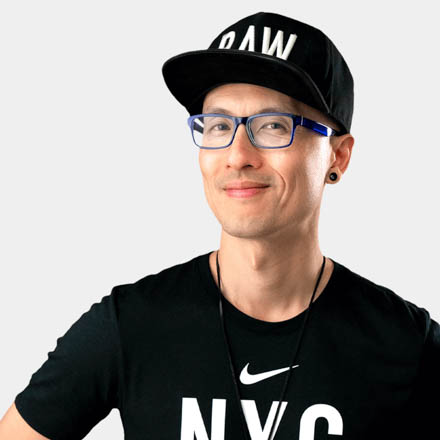
Chris Do
Founder, The Futur™ · July 19, 2025
The professional voice that says nothing
A professional voice can become so polished that nobody remains inside it. The sentences work; the person disappears. Jodie Cook, who has created an AI version of herself and competes in a drug-tested powerlifting federation, brings both experiences to a conversation with Chris Do about what a public persona reveals and conceals.
Her complaint begins on LinkedIn. Cook sees posts and comments becoming increasingly generic, with AI adding more language without necessarily adding more perspective. Her answer is not another publishing formula. It is a demand for people to let more of their peculiarities show.
Do agrees with the diagnosis but disputes its starting point. Professional conformity did not arrive with ChatGPT. In his account, people already treated LinkedIn as a place where an unusual opinion could damage a career, cost an opportunity, or make a prospective employer hesitate.
AI enters a room where everyone has already learned to lower their voice.
Professional polish is not a substitute for a point of view. That is the problem beneath their argument about weirdness. The issue is not whether every post sounds informal or every creator behaves provocatively. It is whether any identifiable judgment survives the effort to sound professionally acceptable.
Cook describes several pressures converging on the same result:
- Career stakes encourage people to avoid saying anything too controversial.
- AI writing can produce generic language when the author supplies little direction.
- Advice about posting more and organizing content into pillars can become another template.
None of those pressures requires a person to publish something empty. Together, in Cook's telling, they make emptiness easy to repeat. The writer has a format, a production tool, and a reason not to offend. What remains uncertain is whether the writer has something to say.
Do encounters the problem in his comments. He describes replies that seem to follow the same pattern: recap the post, then ask a question. When he challenges an account about whether the response came from AI and receives no answer, he blocks it.
The repetitive structure is his warning sign, not proof of how any particular comment was produced. His deeper objection is relational. Someone is ostensibly showing interest while delegating the expression of that interest to a machine.
That tension belongs alongside the trust-building concerns signaled by The Futur's Demystifying LinkedIn. A comment occupies the space where a relationship could begin. Filling that space is not the same as participating in it.
The conversation does not establish that LinkedIn's algorithm penalizes authenticity, nor does it offer platform data about the reach of unusual posts. Its argument concerns the professional culture surrounding publication: people want to be noticed without risking being seen too clearly.
Cook and Do are interested in the cost of that compromise. A profile can remain impeccably respectable while offering almost no reason to remember the person behind it. Their proposed alternative begins with a word neither can quite agree how to define.
Weirdness is not a volume setting
For Cook, becoming weirder means turning up the characteristics that already make a person recognizable. She describes personality as a lighthouse: a stronger signal helps people with compatible values locate its source. The point is not universal approval. It is recognition among people who have been waiting for someone else to say the thing first.
Her experiment begins in an unexpected place: the instructions for her AI counterpart. The original personality description emphasizes directness, firm advice, tough questions, and support without fluff. Cook asks the system to keep the description the same length while making its personality three times more extreme.
The revision trades firmness for aggression. It introduces question bullets, truth bombs, and a demand for immediate results. What had sounded like a direct adviser begins to resemble a relentless drill instructor.
Cook enjoys the transformation. Do catches the contradiction: a conversation about standing apart from generic AI writing has arrived at an AI prompt. But the contradiction is useful because it separates the tool from the intention behind it.
Cook is not asking a machine to decide what matters to her. She is experimenting with how strongly an existing personality can be expressed. The system changes the delivery, while the original description supplies the direction.
Do proposes a different starting point. His version of weirdness is to "remove the layers" hiding the person underneath. Where Cook imagines amplification, he imagines subtraction.
Distinctiveness can come from removing restraint, not adding performance. This is an important distinction for anyone tempted to turn authenticity into another costume. A louder persona is not necessarily a more truthful one. Aggression can be manufactured as easily as blandness.
Their two approaches expose different obstacles:
- Amplify what already belongs to the person. Cook wants recognizable traits expressed with greater intensity.
- Remove what conceals the person. Do wants learned restrictions examined before another layer of presentation is added.
Do locates those restrictions in social conditioning. He argues that education and years of learning to fit in can suppress individual expression. In his account, people do not always need to discover an eccentric identity. They need evidence that showing an existing one will not automatically lead to rejection.
That makes permission more important than instruction. Being around someone who behaves differently can change what feels safe. Do wants his own conduct to give other people a reason to test boundaries they have treated as fixed.
The question of inherited expectations also connects naturally with Living in the Dogma of your Parents. Here, the immediate concern is how old expectations continue editing a public voice long after the person has gained the freedom to speak.
Neither approach requires social isolation. Cook explicitly separates weirdness from social awkwardness. A person can be strange, maintain friendships, and function within a group. The desired audience is not necessarily everyone. It includes people who share the unusual trait and people who simply appreciate it.
That is where the lighthouse image becomes practical. A distinctive signal is useful because it lets others make a more informed choice. A polished imitation of distinctiveness only gives them a different kind of disguise.
Normal depends on who is looking
Cook and Do's disagreement becomes sharper when they discuss their mutual friend Daniel Priestley. Cook sees a person willing to put himself forward, make predictions, build businesses, and withstand criticism. Do sees confidence and pattern recognition, neither of which automatically qualifies as weird in his definition.
The difference is not merely semantic. Cook treats deviation from common behavior as evidence of unusualness. Do wants a more substantial departure, something that unsettles expectations or challenges the status quo enough to make observers uncomfortable.
A competent entrepreneur can look unusual against the general population and entirely conventional inside a room of entrepreneurs. For Do, standing apart requires attention to the actual reference group, not just a flattering comparison with an imagined average person.
Their discussion of Priestley sits beside The Futur's Personal Branding Masterclass with Daniel Priestley, but here his role is especially revealing. Two people who know the same person cannot agree on whether he represents the ordinary or the exceptional.
Cook initially doubts that anyone would willingly describe themselves as normal. She expects people to name some pursuit or characteristic that distinguishes them, even if it is a race they have entered or a physical challenge they have taken on.
Do disagrees. He believes members of his own family would readily accept the description. For them, normal is not necessarily an insult or evidence of an undeveloped identity. It can simply describe how they understand themselves.
The conversation becomes more useful when it moves away from assigning labels and toward examining their origins. Cook recalls a short podcast series in which she interviewed entrepreneurs and business leaders about their childhoods. Their accounts differed considerably, yet she remembers the participants repeatedly describing their childhoods as fairly normal.
That is a reported observation from her interviews, not a population study. Its significance lies in the mismatch between the variety of experiences and the consistency of the label. Each speaker had a different baseline but reached for similar language.
Do's explanation is that familiar circumstances become the benchmark. The household a person grows up in supplies an early model of how life works. Other arrangements can initially register as deviations from that model rather than equally familiar realities for someone else.
Context determines what counts as unusual. Applied to a personal brand, this prevents an easy mistake: assuming that a characteristic feels distinctive to an audience simply because it feels central to its owner. Confidence, entrepreneurship, and strong opinions do not carry the same meaning in every professional circle.
It also complicates the demand to become weirder. A creator can seek difference endlessly without clarifying who is meant to recognize it. The relevant question is not how far a person can depart from convention in the abstract, but which conventions are suppressing something meaningful.
Do's standard is therefore more demanding than a quirky wardrobe or a provocative sentence. The difference has to register against a real expectation. Cook's standard adds another consideration: it should help compatible people recognize one another.
Together, those ideas move the discussion away from eccentricity as decoration. The useful departure is one that communicates something, not simply one that earns a second look.
A strong opinion must survive resistance
Cook's argument for stronger opinions gets an immediate test when Do asks for one of hers. She offers a sweeping conviction: getting into exceptional physical shape can accelerate progress toward goals across life. Fitness, in her view, improves far more than the body.
Do does not let the claim pass as an inspirational slogan. He recalls former employees who were already in excellent shape, including a former athlete. His advice to one was to put down the barbell and pick up a book.
The example challenges the assumption that physical discipline automatically produces intellectual range. Do says the former employee eventually began reading more, and the substance of what he could discuss changed. He also recalls that person's successful TikTok content drawing on what he had read and learned.
This is an anecdote, not evidence that reading and training compete for a fixed share of personal development. Its role in the exchange is narrower. Cook has proposed fitness as a broad accelerator; Do supplies a case where another form of development was missing.
Cook responds by describing the person she wants to follow. Business achievement alone is not enough if the visible cost appears to be poor health or an unsatisfying life. She is drawn to people who combine intelligence and commercial success with physical health, happiness, and involvement in family life.
Her language becomes deliberately ambitious. She imagines future personal brands needing to resemble demigods: people whose appeal comes from an unusually complete combination of qualities rather than excellence in one isolated category.
That is Cook's preference and prediction, not a demonstrated requirement for building an audience. It also introduces an exacting standard, one Do probes rather than simply endorsing. The important development is that her original assertion becomes more specific under pressure.
She is not only praising exercise. She is rejecting a model of achievement that asks the audience to admire an outcome while ignoring its sacrifices.
Do then identifies a version of weirdness both can recognize: unexpected combinations. The stereotype of the intellectual and the stereotype of the heavily muscled athlete are familiar. A person who convincingly crosses those expectations creates a different impression.
The combination matters more than either isolated trait:
- Physical strength does not remove the need for ideas worth discussing.
- Intellectual ability does not have to arrive in an expected physical package.
- Commercial achievement can be considered alongside health and family life.
- A public identity becomes more specific when its qualities resist a familiar stereotype.
There is a useful connection here to How to Stay Curious: a recognizable identity need not reduce a person to one repeatable characteristic. In this conversation, the interest comes from refusing to let one category explain the whole person.
The exchange also demonstrates what generic content often avoids. A substantive position creates the possibility of substantive disagreement. Do pushes, Cook clarifies, and the claim gains definition instead of collapsing into mutual approval.
An opinion becomes more credible when its owner can explain what it includes, what it leaves out, and why it still matters after someone challenges it.
The missing source changes the story
Cook sees physical training as evidence of commitment because no one else can perform the work on a person's behalf. Posts can be ghostwritten. Tasks can be delegated. Training appears, in her argument, to offer a more direct connection between the visible result and the person claiming it.
Do challenges the completeness of that account. He raises the role of substances that can affect physical development and recalls an acquaintance who described an impressive physique through a long account of training before acknowledging testosterone use when asked directly.
The relevant issue is the disclosure, not a diagnosis based on appearance. The conversation provides no basis for deciding whether a particular physique proves substance use. What matters in Do's anecdote is that the person's first explanation omitted something the person later acknowledged.
Cook distinguishes between assistance and dishonesty. She says she competes in a drug-tested powerlifting federation and appreciates the existence of separate competitive settings with different rules. Her objection is to people concealing relevant information or violating the terms under which others believe they are competing.
Both speakers resist turning the exchange into a blanket judgment about what adults choose to do. Their shared concern is the gap between an actual process and the public explanation of that process.
Transparency means disclosing what produced the result. This is where the fitness argument returns directly to LinkedIn. The same problem appears when an audience is invited to copy a success story without being told about the support, time, or circumstances that made it possible.
Cook's closing phrase is "disclose the source." It brings several seemingly separate disputes under one standard. A result does not have to be unaided to be real. But its explanation becomes misleading when the assistance is essential and invisible.
She names several omissions that distort the account:
- Engagement groups presented as if an audience response arose without coordination.
- Ten hours of daily work sold as a result available in twenty minutes.
- A tactic that worked in an earlier period presented as if its conditions still apply.
- Outside assistance omitted from the explanation of a visible achievement.
These are examples she offers, not allegations established against named creators. Their common feature is a missing input. The audience sees an output, hears a simplified explanation, and is left with an incomplete model of how to reproduce it.
That gives transparency an educational purpose as well as an ethical one. Cook argues that disclosure helps other people take what is useful and make their own success from it. Without the source, the audience cannot distinguish transferable practice from a result dependent on concealed conditions.
Her position also challenges the fear that admitting help automatically reduces authority. If the aim is to teach something usable, identifying the help improves the explanation. It replaces an impressive but opaque achievement with a more intelligible one.
Do draws the same line around AI. He does not object categorically to using it for writing or prompts. He wants the resulting content to retain the author's actual opinions.
The standard is not purity. It is an honest account of authorship, assistance, and effort.
The person behind the post must be present
Do offers a practical test for the difference between an assisted voice and an outsourced identity. Imagine the author of polished online posts being invited onto a panel and asked an unscripted question. Without the production system, can that person articulate a position?
The test does not require identical fluency onstage and on the page. Writing allows revision; conversation does not. The issue is whether there is an underlying view to express, or whether the apparent authority exists only in the finished text.
He describes a related frustration in team brainstorming sessions. People reach for their phones while ideas are still forming. What should be a shared encounter among different minds starts to resemble a race to retrieve an answer from elsewhere.
Cook recognizes the pattern. The activity becomes a second, parallel brainstorm, with participants searching or prompting instead of contributing directly to the room. The technology supplies responses, but the original opportunity was to discover what the people present could produce together.
Human judgment should lead the tools. Do condenses the distinction into a short statement: "Humans should do the thinking." His objection is to reversing that arrangement, leaving people to carry out work while the machine supplies the ideas they no longer practice developing.
This is not a call to abandon AI. Cook's personality experiment already demonstrates a deliberate use of it. She starts with traits she can identify, sets a constraint, requests a transformation, and evaluates the result. The machine assists an act of judgment rather than eliminating the need for one.
The closing implications are concrete, although the speakers do not present them as a formal framework. Their examples establish a set of editorial checks that can happen before publication:
- Confirm that the opinion belongs to the person whose name appears above it.
- Notice whether professional restraint is concealing something the person actually believes.
- Include material assistance and effort when explaining how a result happened.
- Keep enough ownership of the idea to discuss it without a generated script.
Do also recommends moving beyond the current comfort zone of disclosure. He suggests an extra ten percent of transparency, a conversational challenge rather than a measured formula. The point is to test whether the feared cost of greater openness actually appears.
That does not turn every private fact into publishable material. His qualification remains important: transparency begins with what a person is comfortable sharing. The challenge concerns the unnecessary distance between the public explanation and the reality it claims to describe.
Cook arrives at a similar conclusion through her desire for weirder people and stronger signals. The unusual story, the unpolished conviction, and the admitted source all give an audience more information about the person seeking its attention.
That is the transformation this conversation ultimately demands. Not a stranger persona engineered to interrupt the feed. A more accountable public voice, one that can explain its convictions, acknowledge its inputs, and remain recognizable when the writing tools are gone.
The next post does not need an invented eccentricity. It needs an opinion its author can defend and an explanation that does not conceal the work.
A public voice should still exist when the screen goes dark.
TRANSCRIPT
Enjoyed this? There’s more where it came from.
Get insights on creativity, business, and design from The Futur.
You can unsubscribe anytime. By submitting, you agree to receive communications and to our Privacy Policy.