Who Is Chris Do & The Futur? Origin story
Chris Do shares his origin story, from an 'unemployable' designer to the accidental entrepreneur who founded The Futur.
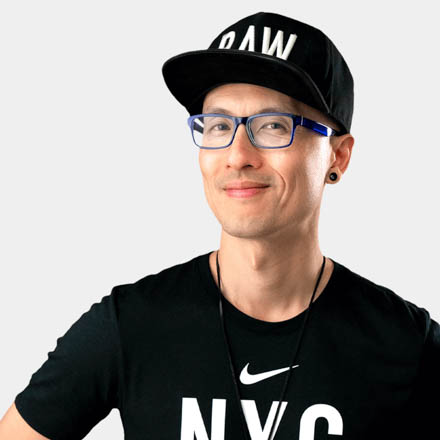
Chris Do
Founder, The Futur™ · February 24, 2024
An Act of Insubordination
It was a simple request from a new boss, and it was met with five words that ended a career before it truly began. “I respectfully decline.”
Chris Do, a young designer barely out of school, looked his superior in the eye and walked out of the corner office. He knew what he’d just done. It was an act of insubordination. A high-paying job at a prestigious Seattle ad agency, Cole & Weber, was about to go up in flames. He walked the 300 feet back to his own small office, a dingy closet next to the bathroom, and awaited the inevitable. The phone rang.
It was his real boss, Kevin Jones, a man Do describes as “the world’s best boss.” He had heard what happened. But instead of firing him, Jones told him to go home and take a break. The next day, he offered to move Do to a different account.
This was the golden opportunity, the escape hatch. But Do had realized something fundamental. “Kevin, I just realized something,” Do recalls saying. “In this world, I am not appreciated and I will never feel like I belong.”
He quit. A job that paid $85,000 a year in 1995, a staggering sum for a new graduate, was gone. He walked away from the superstar trajectory, the expense account, and the security. It was a decision rooted not in arrogance, but in a profound self-awareness that had been building since childhood. It was the moment he confirmed a core truth about himself.
He was unemployable.
The Engineer and The Artist
To understand the 'why' behind that decision, you have to go back to San Jose, California. You have to understand the two worlds that created Chris Do.
He is the middle child of Vietnamese immigrants who fled the fall of Saigon when he was just three years old. Sponsored by a Catholic church, his family landed in Kansas City before eventually regrouping with extended family in Silicon Valley. It was a classic immigrant story defined by a relentless pursuit of the American dream.
Do’s family was a study in contrasts. His father was an engineer, surrounded by siblings who all worked in technical, stable jobs in Silicon Valley. They were the embodiment of logic and security. His mother’s side was the opposite. They were, as Do puts it, “super like emotional, beautiful, artistic people. Photographer, painter, artists. All broke.”
This duality defined his upbringing. He had an older brother who became a software engineer with a Master’s degree from Stanford, and a younger brother who became a free-form artist with no college degree. Do landed squarely in the middle.
The expectation from his parents, particularly his father, was clear. Education was the only path. “When you have nothing,” Do explains, “what is the way that you can move up? And the only path that was clear at that time was through education.”
The pressure was immense. Straight A’s were not a goal; they were the baseline. A ‘B’ was a problem. A ‘C’ was a catastrophe. Do recalls the time he knew a C was coming on his report card. Every day after school, he raced home to intercept the mail before his parents returned from work. It was his first lesson in high-stakes creative problem-solving.
When the perforated, carbon-copy report card arrived, he put his mother’s design tools to work. Using her electric eraser, a professional drafting tool, he meticulously removed the offending grade. “I’m like, what should I give myself?” he remembers. “‘A’ is too much. I’m going to give myself a ‘B’.”
He dulled a number two pencil to match the monospaced typeface, practiced drawing the letter, and carefully forged the new grade. For good measure, he smudged it with a bit of carbon to give it “war damage.” The GPA total was off, but his parents never noticed. It was a pre-Photoshop act of forgery born from a desperate need to survive a rigid system.
The Call of the Crest
While his family pushed academics, Do was quietly developing an obsession. He didn’t have a name for it at the time, but he was fascinated by emblems, logos, and crests. He later learned the term was heraldry. He was drawn to fashion brands with crests and Ivy League schools not for their prestige, but for their cool shield emblems.
His true entry point into the world of design, however, came from an unlikely source: skateboarding.
- Powell-Peralta
- Santa Cruz Skateboards
- Dogtown
- Santa Monica Airlines
These weren't just skateboard companies; they were brands with powerful visual identities. “The companies I found the greatest connection with had the best graphics,” he says. This connection between art, identity, and culture was a revelation, linking him to a whole generation of artists like Mark Gonzales and Ed Templeton who found their creative voice through skate culture.
But when it came time for college, he still tried to play the game. He applied to UCLA, UC San Diego, and Cal Poly San Luis Obispo, listing “Art” as his major only because he thought it would be an easier back door into a good school. He was wrong. The request for a portfolio shocked him. Unsurprisingly, he was rejected by all three.
He held onto the rejection letter from UCLA. “You demonstrate potential, but you’re not ready,” it read. The words stung. For an Asian kid from an immigrant family, landing in community college felt like purgatory. “You’re not alive, you’re not dead, you’re just somewhere in between.”
The turning point came from a former boss at a screen-printing shop. The boss, a burly rugby player named Brad, gave him a blunt piece of advice. “He goes, ‘Well, you need to go to ArtCenter in LA. There’s all these cocky bastards just like you. You’ll fit right in’,” Do recounts. The name “ArtCenter” sounded generic, but it was a lead.
In his first community college class, an instructor named Candace Lopez told the students to write down their goals. Do wrote that he wanted to build a portfolio to get into ArtCenter. Seeing his clarity of vision, she vowed to help him. For two semesters, he focused on a single goal: get into ArtCenter College of Design in Pasadena. He didn't know it then, but he was aiming for one of the best and most demanding design schools in the world. He got in.
The Failure of the Ivory Tower
ArtCenter delivered on its promise of rigor, but it also delivered a dose of harsh reality. The tuition was a shock to his father, matching the cost of Stanford. As Do progressed, he grew disillusioned. He saw a system churning out graduates saddled with immense debt and questionable skills. He wasn't just learning design; he was learning about the flawed business of education, a theme he explores in his content like Personal Brand vs Business Brand Strategy.
The most heartbreaking moment came when he ran into a graduate from the year before. “I go to a Blockbuster, I see him working behind the counter, and it broke my heart,” Do says. “This person is saddled with so much debt and they would never be able to pay it back.”
He saw the problem clearly. When education is a product you pay for, the school has a responsibility to deliver value. He felt there was a shortage of high-quality teachers, and the institution itself was failing its students. This critique of the educational-industrial complex would become a cornerstone of his future work. A degree is a poor estimation of a person's knowledge and skills that can be applied.
Yet, amidst this disillusionment, he found what he was truly looking for: real masters. While freelancing to pay for school, he worked for Kyle Cooper and Garson Yu at RGA, who would later found the legendary motion design studio Imaginary Forces. These were not just designers; they were scholars of the craft.
They had studied at Yale under the design legend Paul Rand. They had attended lectures by Armin Hofmann. Their knowledge was deep, their eye for detail was unparalleled, and their standards were ferocious. This was a different kind of education.
“When Garson told me to typeset it in Bembo, but not Adobe Bembo,” Do recalls, “he wanted that cut of... holy crap, you’re that specific.” Yu would pull out an old book to show the original letterforms and instruct Do to redraw the characters, not to use the “junk font that everybody’s using.”
This was the authority he could respect. This was true mentorship. He says, “I will go into shark-infested waters with you because you know what you’re doing. I’m going to learn a lot.” The contrast was stark. The institution offered a piece of paper. The masters offered a lineage.
The Accidental Entrepreneur
After walking away from the $85,000 ad agency job, Do was adrift. He had skipped all the on-campus interviews and portfolio reviews, convinced he was set. Now he had no job and no prospects. He freelanced around Los Angeles, including a short stint at the punk rock label Epitaph Records during the meteoric rise of The Offspring.
Then came the call that changed everything. It was from his uncle, Michael.
“I know since you were a kid you've always wanted to start a business,” his uncle said. “Are you still interested?”
Do’s answer was an emphatic yes. His uncle and his business partner, who ran boutique hotels, wanted to finance a design company. They tasked him with writing a business proposal.
The meeting took place over dinner. Do handed over what he calls a “piece of crap” 14-page business plan with phantom financial projections. His uncle’s partner, Bob, barely glanced at it. He reached into his pocket, pulled out a checkbook, and wrote a check for $5,000.
“This is a good faith gesture,” Bob said, handing it to the stunned 20-something-year-old. “It looks like you’re asking for 100 grand. Consider that an early deposit.”
Do was off to the races. He had $5,000 in hand, which felt like a fortune to someone with maxed-out credit cards from school. He immediately quit his freelance gig. This was the birth of his company, Blind. It was pure accidental entrepreneurship.
But there was a catch. In his excitement, Do had given away 51% of his company for a mere $5,000 promise. He quickly realized his mistake, thinking, “I’m already profitable... I only got 5,000 bucks and I gave away 51% of my company. World’s dumbest business investment.”
Fortune, however, intervened. His partners ran into financial trouble with an overseas hotel development and couldn’t focus on the new design venture. They defaulted on their agreement. Do kept the $5,000, closed the business, and immediately started a new one with the same name. He was once again a free man, and this time, he owned 100% of his future. The failed partnership became his greatest stroke of luck, a lesson in how constraints can become opportunities, a topic often discussed in creative business circles like in How He Went from Freelancing Into a 7-Figure Agency.
Blind would go on to run successfully for over two decades, becoming a powerhouse in the motion design industry. Do never had to crawl back for a job. He proved that being unemployable wasn't a liability. It was a prerequisite for the path he was meant to walk.
Live a Life First
Today, Chris Do is no longer just the founder of a design agency. He is the founder of The Futur, an education platform built on the very principles he discovered through his own tumultuous journey. His critique of the traditional education system is not just an opinion; it is his company’s mission.
He sees a system that creates a dangerous paradox for students:
- Guaranteed Debt: School is one of the only places a person with no credit can get a massive, government-backed loan.
- Inescapable Burden: Student loan debt is one of the only forms of debt that cannot be discharged through bankruptcy.
- Misaligned Incentives: He argues that institutions can feel more like front-of-house for banks than centers for learning, with boards that are structured to kill innovative ideas rather than embrace risk.
This system, he believes, is failing young, optimistic people who do everything they’re told, only to end up in their mid-20s with a mortgage-sized debt and no career. It’s why he champions alternative models and believes new leaders will step in to create better systems, much like the advice shared for entrepreneurs in Your Dream Doesn't Need Money, It Needs This.
His philosophy is most clearly seen in the advice he gives his own children. When his oldest son wanted to go to Columbia University, Do supported him, recognizing his son’s need for structure and his connection to brand names. But for his younger son, who wants to pursue art, the advice is radically different.
“I’m going to go to art school,” his son declared.
“No, you’re not,” Do responded.
Instead of another four years in a classroom, Do is prescribing a different kind of education. A gap year dedicated to life itself. Live life first.
“I want you to study humanities, I want you to study art and history, and you can live wherever you want in the world,” Do told him. “You want to live in Paris and throw pots? Do that. If you want to go paint with people in Spain, go do that. Just do something with your life first before you go to an art school.”
The reasoning is simple and profound. You cannot create from a vacuum.
“You’ve lived nothing. You have nothing to reflect into the world,” Do explains. Without real-world experience, culture, sociology, and philosophy, an artist is left with nothing but imitation. “You’re going to regurgitate all that garbage that people are doing online right now.”
This is the culmination of his entire origin story. The son of an engineer and an artist. The kid who forged a report card. The designer who respected masters over institutions. The employee who was too stubborn to follow orders. The founder who built a company by accident.
Every step was a rejection of the predetermined path. Every act of defiance was a step toward a more authentic identity.
The lesson is not to avoid education. It is to redefine it.
It's a call to build a life rich enough to be worthy of your art. Because in the end, your portfolio is not just the work you’ve done. It’s the life you’ve lived.
TRANSCRIPT
Enjoyed this? There’s more where it came from.
Get insights on creativity, business, and design from The Futur.
You can unsubscribe anytime. By submitting, you agree to receive communications and to our Privacy Policy.
“Live some life before you go there.”
— Chris Do
Key Takeaways
Subscribe
Details
- Length
- 1h 15m
- Views
- 26,792
- Topic
- ENTREPRENEURSHIP