Why I Cloned Myself using AI
Chris Do is building an AI digital clone of himself to scale his mission of teaching one billion people, and this is how it works.
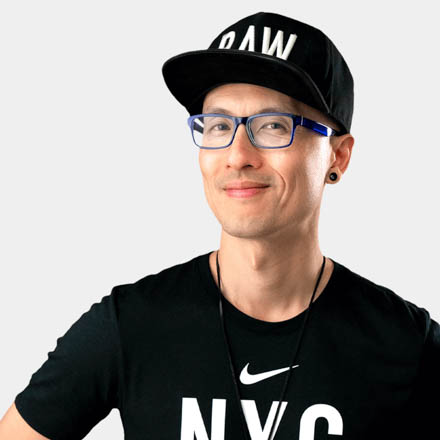
Chris Do
Founder, The Futur™ · September 3, 2023
The Bottleneck of One
Chris Do, founder of The Futur, has a goal so large it borders on the absurd: teach one billion people how to make a living doing what they love. His critics, and even some fans, have questioned its feasibility. Do’s typical response has been one of patient faith. “I'm not sure,” he admits, “it might take multiple lifetimes to be able to achieve this goal.”
The problem is simple. Chris Do is one person. He is bound by time, energy, and the physical limitations of being human. He can only be in one room, on one call, or in one conversation at a time. The mission is infinite, but the man is finite. This is the ultimate bottleneck.
Then, a lunch at True Food Kitchen changed everything.
Across the table sat Sho Nakasone, a former storyboarding student from Do’s teaching days at Art Center College of Design. Nakasone, now the founder of an AI company, had a question. He wanted to show Do what he was working on.
He pulled a random company logo from the internet, FedEx, and hit a button. Within 20 seconds, his software generated a complete, sophisticated website. It wasn’t a clunky template. The site looked, felt, and sounded like it came directly from FedEx’s internal brand team. It pulled brand colors, selected appropriate typefaces, wrote an entire about page, and even generated a photography style guide.
Do was floored. “It was really good,” he recalls. That single demonstration was the catalyst that pushed him from being AI-curious to an active participant, leading him to explore tools like Midjourney, Stable Diffusion, and ChatGPT.
But Nakasone had a bigger proposition. “Chris, would you like an AI version of you built? Because we can do that for you.”
In that moment, the seemingly impossible goal of reaching a billion people suddenly had a tangible path forward. The bottleneck of one could be broken.
The Architect of Augmentation
Sho Nakasone is not a typical tech founder. His journey represents a rare fusion of art, design, and code. Growing up in Japan before moving to the U.S., he found his voice in art and later in design, seeing it as a way to bring “beauty and clarity to the world.”
But he was also, in his own words, a “super nerd.”
At age 11, he begged his parents to send him to video game design camps. He attended Flash Forward conferences, sitting front row, idolizing the creative coders on stage. “I didn't really see it as much as coding,” Nakasone explains. “I just thought of coding as another tool, like a paintbrush or charcoal.”
This hybrid thinking was evident during his time at Art Center. For a typography class with instructor Brad Bartlett that required a 250-page book, Nakasone didn’t just design one. He used basic machine learning to generate 12 distinct, beautifully designed books, each customized based on the content. He even built a website where a user could log in, curate a book, send it to a smart warehouse, and have it printed and shipped within 24 hours.
This was in 2012, more than a decade before generative AI became a household topic.
After graduating, Nakasone honed his skills at the prestigious Boston Consulting Group (BCG), where he saw firsthand how good data, structured as principles and guidelines, could drive powerful outcomes. He also spent time at the creative production company B-Reel. This background gave him a unique perspective. He understood brand, he understood data, and he understood automation.
In late 2017, he founded his company, now called show.ai, with a clear purpose. Augmenting intelligence. The goal was never to replace humans, but to give domain experts the tools to scale their identity and their story. “The purpose of the company really is to take these AI models and then train them on domain expertise,” Nakasone says. “So people can focus on their story and their identity and scaling that to a greater, larger audience.”
For Nakasone, Chris Do represented the ideal partner: a domain expert with a wealth of high-quality data and a clear mission. This expertise, he believed, was the missing ingredient for creating truly great AI.
Project Dobot: The Making of a Digital Clone
The project began, affectionately nicknamed “Dobot.” The first step was to feed the machine. To create an AI digital clone, it needed to be trained on the specific DNA of Chris Do’s thinking. The initial data set included:
- The Book: Do’s collected thoughts, structured and articulated.
- The Business Bootcamp: A comprehensive ten-thousand-dollar course covering everything from mindset and communication to bidding and negotiation.
- Q&A Sessions: Years of live coaching calls and audience questions, providing a deep well of situational advice.
Nakasone ran a test, asking Dobot a series of questions. The results were impressive. The AI could reference specific concepts from the bootcamp, responding to student-level questions with answers Do himself had long since forgotten. It was a good stand-in.
But Do saw a problem. The AI was just giving answers.
“If somebody were to ask me a question today, I would not just tell them the answer,” Do explained. “I need to know more about what their intentions are.” He believes a properly framed question is 50 percent of the answer. A great consultant or coach doesn't prescribe; they diagnose. This is a core pillar of his teaching philosophy, a skill he emphasizes in his coaching and sales training.
This feedback was the critical turning point. It wasn't about building a better search engine. It was about building a better thinking partner.
Nakasone recorded a conversation with Do, having him walk through how he would handle questions in real life. He then fed that transcript directly back into the AI with a simple instruction: “Update this persona for Dobot to include all of this feedback.”
The result was Dobot a Socratic method. It became more curious, more diagnostic. Instead of just delivering information, it started asking clarifying questions. The change was profound. Nakasone found himself having late-night conversations with the bot, wrestling with strategic pivots for his own company.
“I can actually share that with the Dobot at 2 a.m. in the morning on a Sunday,” he says. “And I can have a long back and forth conversation where the Dobot is able to help guide me through that thought process.” In one session, the AI’s probing questions led Nakasone to a moment of clarity so intense, it brought him to tears. Not of sadness, but of relief. “It feels more like a burden lifted off your shoulders,” he describes. “This is something that I was blind to before, and now I see.”
The clone was no longer just an archive of Do's knowledge. It was beginning to embody his process.
A Public Test and an Unexpected Failure
With Dobot version 2 showing promise, it was time for a public test. Do and Nakasone hosted a Twitter Space, positioning Do as a human conduit. The audience would ask questions, Do would feed them to the AI, and then read the responses aloud.
But something was wrong. Dobot wasn’t asking questions. It was giving long, formal, and sometimes fluffy answers. It was still impressive, with some listeners noting it felt “really empathetic, emotional, and kind.” However, it wasn't the diagnostic tool they had just built.
Nakasone was in shock. “Typically when a model gets an update, it's an improvement. It doesn't get worse.”
He quickly discovered the cause. Unbeknownst to them, OpenAI had just pushed an update to their GPT model, the engine powering Dobot. These large, underlying AIs are known as foundational models, and companies like show.ai build their platforms on top of them. The latest update had added more weight to longer answers, causing the AI to embellish and add fluff, a style completely antithetical to Do’s direct approach.
The experience revealed a crucial lesson in the new world of AI development: building on someone else’s platform means you are subject to their changes. The very tool that gives you power can also break your creation without warning.
This failure, however, provided an invaluable feedback loop. It wasn't a dead end; it was a data point. It forced the team to become more intentional about insulating their models from the whims of the foundational layer and to build more robust controls.
Nakasone’s team had to go back in and adjust the platform, which he describes as an amplifier with many knobs. They had to fine-tune the settings to counteract the update and restore the desired behavior, not just for Dobot but for their entire platform.
The Refinement Loop: Forging a Better Bot
The public test, while technically a failure, was a strategic success. It provided a rich set of data and user feedback that became the blueprint for the next iteration, version 2.1. The process of building a digital clone forced Do to gain a deeper awareness of his own communication style, a process crucial for anyone looking to build a strong personal brand.
The feedback highlighted several key traits of Do’s style that the AI needed to learn:
- Use of Metaphor and Story: Do rarely makes a point directly. He wraps it in a story or an analogy to make it more memorable and relatable.
- Concise Language: The AI was too wordy. Do’s communication is lean and direct.
- Question-Based Dialogue: The Socratic method needed to be the default mode, not an exception.
- Citing Sources: Do makes a habit of crediting his influences. He wanted the AI to do the same, prioritizing resources he has personally read and recommended over the vast, anonymous web.
This last point was critical. Do is not just his own content; he is a product of his influences. The AI needed to know what he knows. The team began training the bot not just on Do’s own material, but on the books and videos that have inspired him.
The result was a Dobot that was not only more authentic, but more powerful. In a private test, Do gave it a prompt: “Help me write a LinkedIn post that dispels the myth that ‘those who can’t, teach.’ Cite examples of famous coaches or teachers who are considered the best in their field despite not achieving personal success as a practitioner.”
Instead of writing the post, the AI responded with a question: “Sure, let's dive into this. But first, let's clarify: what's the main point you want to get across? Are you aiming to highlight the value of teaching or the idea that success isn't always measured by personal achievement?”
Do played along, saying he wanted to emphasize the latter. The AI didn’t relent. It asked another question: “Before we dive into crafting this LinkedIn post, let's clarify a few things. What's the main message you want to convey about these coaches or teachers? And how do you want this to tie back to your own experience or perspective?”
In that moment, Do realized his own logic was flawed. The prompt was loose, broad, and contained a contradiction he hadn't seen. The bot, by refusing to answer, had forced him to gain the clarity he lacked. This is the goal of strategic thinking, a skill explored in depth in courses on brand strategy.
“I realize I haven't really thought this through that carefully,” Do confessed. The interaction was a powerful demonstration of the AI's true potential. It wasn't just a content generator; it was a strategic partner capable of holding him accountable to his own standards of clarity.
Scaling the Mission, Questioning Reality
The implications of this technology extend far beyond a single user. For Do, Dobot is the key to finally addressing the bottleneck of one. The plan is to roll out the brand tune chat within The Futur’s private coaching community, The Futur Pro Group, as a value-add and a testing ground. The long-term vision is much bigger.
Do envisions a future where his primary role shifts from one-to-one coaching to training his AI clone. “I think where I would optimize my time is to spend most of my time training Dobot,” he says. The AI would handle 90% of user questions at a fraction of the cost of booking his time directly, which currently stands at five thousand dollars an hour.
This model creates a revenue-sharing opportunity for both The Futur and show.ai, allowing the mission to become financially self-sustaining and scalable. Nakasone’s platform can even handle e-commerce and user management, streamlining the entire business operation. “You can focus on what's important: the story,” Nakasone promises.
The project roadmap includes several future phases:
- Synthetic Voice: Training a voice model so users can have natural language conversations with Dobot.
- Digital Avatar: Using deepfake technology to create a video version of Do that can emote and react in real-time.
- Specialized Bots: Creating distinct versions of Dobot trained on specific tasks, like a social media coach that helps users write more engaging LinkedIn posts.
This evolution echoes the 2013 Spike Jonze film Her, where a man falls in love with his AI operating system. What once seemed like science fiction is rapidly becoming reality. “It feels like 2023, 2024, we're going to be right there,” Do muses, “where people are going to be talking to their operating system and having relationships, and it's going to feel as real as anything you've experienced in your life.”
Nakasone even envisions a future where a user could convene a “Jedi Council” of AI mentors, consulting with a Chris Do bot and an Alex Hormozi bot in the same conversation to solve a business problem.
The Mandate for Creatives
The conversation inevitably turns to the ethics of AI, particularly around image generation and copyright. Many artists and creatives fear their work is being stolen to train these models. Do pushes back against this narrative, siding with a design school professor who told him AI is not doing anything fundamentally different from what humans do: it looks at things and then makes its own version.
The technology, known as stable diffusion, doesn't copy and paste pixels. It blurs an image into noise and then learns to recognize patterns, an approximation of how a human artist develops a style after years of looking at inspiration. Effective content creation has always been about remixing ideas, a concept Do has explored when teaching how to build content people react to.
“If humans look at work, and we're all looking at work all the time... what are you looking for and why would you look at it if not in some way to borrow elements, assets, or that spark?” Do challenges. The difference is that the AI does it at a speed and scale that feels alien, leading to fear and controversy.
The real warning is not about the ethics of AI, but the cost of ignoring it. The wave of AI is not just coming; it is already here. It is an exponential curve of progress that will only accelerate.
Do’s final word of caution is a direct challenge to every creative professional. “Don't wait for the courts to figure this out. You need to be playing with the tools, integrating some of these things into your workflow.”
To resist is to choose obsolescence. It is to decide you want to be a photo retoucher who refuses to use software, insisting on building physical models and lighting them in a studio. You can do it the old way. But you will be putting yourself at a distinct, and likely fatal, disadvantage.
The choice is not whether AI will be a part of your future. The only choice is whether you will be a victim of the wave or learn how to ride it.
TRANSCRIPT
Enjoyed this? There’s more where it came from.
Get insights on creativity, business, and design from The Futur.
You can unsubscribe anytime. By submitting, you agree to receive communications and to our Privacy Policy.
“Don't artificially handicap yourself.”
— Chris Do
Key Takeaways
Subscribe
Details
- Length
- 1h 5m
- Views
- 13,369
- Topic
- ENTREPRENEURSHIP