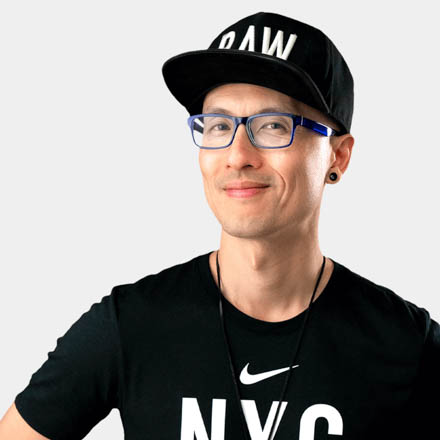
Hey guys, today on this episode of the pod, we're talking to Sun Yi. You may know him as a person where when you watch his content, you come to this conclusion. I never thought of this way.
Now, when you watch this episode, you're going to know where that comes from and why he's known for that. Hey, I'm Sun Yi and you're listening to the future. In case you guys can't tell, we're in a totally different location, a beautiful home here in Orange County.
We could not ask for a better set. So thanks to the entire team for making this happen. The man who's sitting in front of me, his name is Sun Yi, and you probably have seen some of his posts on social.
chances are you love him or you were triggered by him, or maybe you're both. Son and I met in person recently at South by Southwest in Austin. He's a globetrotter.
He's been zipping around all over the world at Atomicon, and then he was just at Con, and then he came back here for VidCon. So he may be running on fumes, so we'll get the most out of the situation. But Son, thanks for being a part of the podcast.
Thank you so much, Chris. Yeah, so here's the first thing. I just want to throw it off just to break the ice a little bit.
I know there's just a distinct difference between what I perceive your online personality as and the person that I met in real life. And I'll describe this and tell me if it's a fair characterization. On the internet, you give a lot of hot takes, go on rants and you say, stop doing this.
And you use semi-violent language, I think on purpose. And I can tell you know how to write because you use words very effectively to get people to have a feeling or sharpen their thing. And I think for a while now you've been using the whole, I never thought of it like that, right?
So there's a couple of things there. But when I meet you in person, you're like the sweetest, softest, like, hey, how's it going? Is everything cool?
No rants and very humble and kind and generous. And first, is that an accurate portrayal to the two sons? I mean, I don't know if it's two different sons, but I, most of the videos that I post are from either Zoom calls where I'm teaching or like I'm on a podcast or something like that.
And I think when I'm talking to somebody, sometimes I can get a little heated or like I could get a little passionate, especially if I'm teaching or something like that. And those usually happens to be the best parts, most interesting parts. So, but I don't think all my videos are like that.
I think the ones that get a lot of views happen to be like that. So they probably get on your radar more. Yeah.
But I have, most of our videos are not. Not that fast. Well, it's not that it's good or bad.
I'm not here to judge, but I'm just trying to figure out. And maybe I'm asking more for me understanding how people perceive me as well, because depending on which moment in what circumstance you catch somebody in, you form an opinion about that person really fast. And that's both the good and the bad of social.
So if the algorithm is serving up this hot take that you have, where you're coming from a place of high emotion, peak emotional energy, then they're like, oh, that's son, that must be him. And they're not checking in all the time to see what is the range. Plus somebody will say he's a lovely human or he's a jerk, he's a D-bag.
And then everything else they see in their mind now supports that narrative, whether it's true or not. So So let's talk a little bit about the evolution of your online persona and kind of then maybe before I do that, I want to get into your background, like what you do for a living kind of thing before you start making all this content. Got it.
Yeah. So I started as a web designer. I transitioned from freelancing to starting my agency, which is called Night Owls.
We used to work at corporate brands. We had some clients like American Red Cross, pretty much most of the hospitals in New York, NYU, Columbia University Medical Center. we work with spotify like pretty much corporate brands but now we mostly work with personal brands so people who want for authors motivational speakers that want to build their personal brands we help them with their website messaging their stories and things like that how does a freelance designer get from starting from not a lot to being able to work with large multi-billion dollar companies how does that work i think For us, at least.
Once we got one big client, it became super easy to get the next client. So I always tell people, no matter what it takes, get that one client. Because once I say we've worked with American Red Cross, pretty much all the hospitals just came after that.
And they didn't even really question us after that. Yeah. Okay.
So it was American Red Cross. Yeah, that was like one big client. I want to peel away for our audience here, whether you're listening to this or watching this is we'll call that the prison yard rule.
They say, if you go to prison and I hope you never do anything to get yourself into a situation where you're in the prison, but they say you go after the biggest, toughest person, because then you set the tone and we can understand the logic behind that because otherwise you're going to be somebody's girlfriend in the prison cell, right? You are sorry. We're going to just go there.
But if you go on and take on the biggest client in that sector, that vertical, pretty much that's the best social proof you're going to get. And then by virtue of how we work and how we're hardwired as human beings, we really, really heavily on social proof. Well, if someone was good enough for American Red Cross, he must be more than good enough.
Maybe you're even overqualified to work with us, right? So can you take me through the process that as far as you can tell how you got American Red Cross from your previous next biggest thing? So I'll kind of go over the whole story from my mom always told me son, don't start a business because you're going to lose money and you're just not cut out to be a businessman.
And it's because when I was young, my dad paid us, me and my sister, $5 to wash the car. And I ended up, my sister, after like 20 minutes, she was done. She was out of there.
But I spent another two hours just cleaning every detail, like with the little Q-tip. And then I spent the $5 my dad gave me. Plus I added my own $5 to go buy some air freshener and things for the car.
So my mom was like, oh, son, you're just not, if you start a business, you're just going to lose money, right? Okay. And that has been the pattern for me throughout.
And you know, when I started freelancing, my first client paid me $1,700 and this website took me nine months to build like full time. So I quit my, my a hundred thousand dollars a year job. Now I got paid $1,700 for nine months.
Exactly. Okay. At first I thought it was going to take like three weeks, but I wanted to make it perfect.
And then from there, then my next project was like $3,000. and it only took me three months so it's still bad but hey that's a lot of fire so almost double the money the one third of the time yeah pretty good and around there so i made five thousand dollars in a year so i was about to like i ran out of my savings and i was like okay i'm gonna go get a job but then we got are you still single at this point yeah because at this time so at this time We got one, I got one email from this client who was like, we'll pay you $10,000 to do a website. This was a WordPress website that I could have finished in four weeks.
And I actually did finish it in four weeks. And then it just kept going up from there. So we had a lot of these smaller local companies in New York.
So not like big companies, but American Red Cross was like That one actually came as an inquiry inbound lead. And at that time we had this rockstar salesperson who was just so good at selling. So he kind of cultivated their relationship.
Okay. But I realized that to work with bigger clients, it's mostly about the relationship and it's less about, I guess, the work or something like that. Yeah.
So yeah, that was a huge lesson that I learned actually working from him. I got lots of questions, man. First of all, let's put this on dates and timeline.
So how old are you at this point when you've got this rockstar salesperson? That was probably, so I, I started, so the first year was me just freelancing. The second year was also just me freelancing.
And then I went back. So I guess around then I was about 25, 26. Yeah.
and then i went what year is this this was 2006. okay around there all right now we know how old you are so i did that for a couple years and then i had a friend who actually was running an agency and he asked me to kind of come and partner with him yeah so i actually kind of pause my freelancing business, took all my clients from the freelancing business and brought it to this agency. This is an agency called Wevio, and it was a small agency in New York that I wanted to help build.
Long story short, I was there for two years. It didn't really work out because he and I just didn't align at all in terms of the vision. You know, I can tell.
I already knew it didn't work out, but I didn't want to let my instincts lead the conversation because of the way you said it. Like I pride myself on being able to see small micro expressions and the way you said it. And I'll just give our audience a clue here.
So you, if you're listening to the pod, make sure you check out the YouTube channel as well. So you can see this. When the son said this small agency, he said it like it was like disgusting in his mouth.
Did you guys feel that or was it just me? You saw that, right? I was like, he didn't like them at all.
So I already know how it turns out. It wasn't like, yeah, it was this really small agency. So we didn't tell.
Okay. So it didn't work out for certain. Our agency is small too.
But with this agency, it wasn't really about the agency. It was about the guy. We just didn't work out.
So three years later, I actually left to start my agency, Nite Owl. And... What year is that?
This was 2010. Thank you. Someone's got to hold him accountable.
Thank you. 2010. So at that time, so Gigi is my wife and my business partner.
It was two of us. So somewhere while struggling to build a business, making $5,000 a year, and then struggling to work out a relationship with another business owner that didn't work, you found time to find romance and get married. We didn't get married at this time.
We weren't married. Okay. And actually when we started Night Out, we were struggling so hard for two years, like to a point where we were homeless basically, because we had to rent out our apartment in Airbnb.
So then we can use that money. Oh, I see what you're saying. Okay.
For like our, we're subsidizing a bad business with renting out your space. And we were sleeping in the office in the air mattress for like six months. I see.
And that's the moment I knew like, okay, she's the one because I'm like, okay, nobody else would have. wait i don't care about marketing or business or personas i'm going to talk about the relationship right now the conversation is going to take a hard turn who's going to jump the tracks if you guys don't like this part hit fast forward and skip to this next part okay but You're like, she's the one, but I'm curious from what you think her perspective, because we can't hear her right now. Why were you the one for her?
Because it's like, okay, here's a guy, he's going to be homeless. He made $5,000 a year. His last business relationship didn't work out.
What did she see in you from your perspective? We'll confirm later if it's true or not. I have no idea.
Come on, you have to have some makeup. Sorry. She must have seen something in me.
What do you think it was? I mean, it's also, are you Korean too? You're trying to eat your cream, right?
Yeah. Yeah. So it's hard for Asian women to bring home a man who's like, bro, it is very difficult.
You understand how much heat she's going to have to take. And when she's like, I'm dating this guy, he's got ambition. Just watch him.
He's going to make a Ben's out of that Dotson kind of situation. That doesn't usually, that's not a rhyme that's repeated in Asian communities. It's like, oh, he's not a doctor or a lawyer.
He's not living with this whole plan and this everything's worked out. Yeah. So just give us some best guess and we'll find out.
What she saw for me that she actually liked that I'm not just the standard, just 9 to 5. The fact that I wanted more than that is I think what she liked me. But you're absolutely right.
Cause at that time we actually borrowed money from our family. Oh, the VATS, you were absolutely right. So he was, yeah.
But I was so ashamed because. Okay. I'm giving you a hard time, sort of, but I was the same way.
I'm going to confess right now. The way we were able to buy our first house in Venice is because my wife's girlfriend's mom at that time, she sent us basically the down payment, 20% for this house. And then I called my mom.
I was like, mom, can you help us out? My mom gave us one fifth of what her mom gave. I'm like, God, we broke.
How is it? So that's a different story. And then I asked her years later after we got married, why would you ask your mom to give us a hundred thousand dollars to a guy who you're not married to?
do you even understand what's going on she goes no because i trust you i'm like how would you do never trust another guy after me because that's not the answer you have to be way more critical than that but here we are she's stressing you loaning you money and she she's watching that ambition yeah vision in your eyes i mean it worked out but it could have also for sure or you could have just been a really bad business person as foretold by your mom that's true once she came into the business that's the moment we actually started making money because in the beginning days god ever like gg you have a sister you got a whole dynasty here what do we do there's there's more chinese women out there you guys yeah and i have to say on behalf of my taiwanese wife who's ethically i guess chinese uh you gotta find a good one one of believes in you who supports your work and can see that and i say behind every good man is an even greater woman because the single most important decision you're gonna make in your life is who you're in partner up with. Whether it's man or woman, it doesn't really matter because you have to want the same thing. And not just for a little bit, because we all know it's not that easy.
Yeah. All right. So actually to that point in the beginning, what happened was I was what my mom said.
So when, uh, if clients don't pay, like I wouldn't like chase them down. Right. Or if we go over scope, I wouldn't like invoice them for the extra work.
And I wouldn't like rate, like we, we had our rate at 150 an hour for the longest time. And we didn't raise our rates for the long time. And when that's when we were struggling, we were like, we owed money to our family and we were like in the minus.
But I was so busy. I was just focused on working on the projects, which is my, I guess my talent is in doing the work. And she just took over the business side and I just didn't even pay attention for like a few months.
Yeah. And not because I didn't want to, but I just didn't have the time. And then six months later, I look at the bank account and there's like $200,000 in there.
I'm like, what happened? And so it turned out she raised the price. GG happened.
This is what happened. Actually, when she raised the price, I'm like, why did you do that? Now all our clients are going to get mad at us.
But then she was like, actually, no, I raised it three months ago. They've been paying their head with it. Yeah.
Cool. You're like, yeah, exactly. Yeah.
So she was the type of person that will chase down the client. Of course. So once all of, once that side was kind of fixed, that's when we really started making money.
Cause I think the work that I was doing was good. Yeah. but money was leaking so that balanced out really well even now if i'm doing a workshop or i'm on a coaching call or something like that i go over the hour she'll remind me so so i think that that's the balance really worked out we have the total opposite personality yeah when you said she's the type of person would you need to say she's a responsible business owner yeah that's what you mean yeah that type of person like the one that my mom would like yeah yeah for sure and I have to tell you that your relationship is, I think, pretty typical of business relationships that actually do work.
Why don't we talk about the ones that don't work where there's a person and you have a strength and the other person has a complimentary but equal and opposite strength. And so you make beautiful music together. So if you're both creative, maybe your previous partner would where you guys just jam and you have two different visions and you're battling over vision where this is, I believe the divide and conquer strategy where you can focus on being the best you, which is a creative person who over delivers and doesn't really care about money, but is about the relationship, which is necessary for front of house.
She's back at house, making sure tickets are moving, customers are happy and invoices are being paid and you can have good prices on the produce or whatever it is that you buy. And without that, that then your brain wouldn't be free to think about what you do. And it would be dragged into paperwork, negative feelings.
And that's not, people don't understand this. As much as we say we're going to be professional creative people, we're humans and we have emotional side. So when you're, oh, that client's not paying me, and you bring that hostility and the bitterness into the work, then the work sucks and they're not happy and you don't get referrals and we're not how that goes.
So it's better that you are able to compartmentalize and say, front of the house, back of the house, you guys made it work. So congratulations to both of you. We call it good cop, bad cop.
Yeah. So like, we love you. They don't like her as much.
So once it gets to the part where it, client does get annoyed, then I'll jump in. I'll kind of like, I'll make them happy. Now, let me ask you this question.
Have you ever worked with a business coach? No, I haven't. No.
Okay. Because, and I want to say that on behalf of Gigi, who's just off camera here, I had to realize this through my business coach. And he said, and he helped me understand this.
I want you to understand what your wife has to do. And that she has to do all the ugly work, the work that you may not want to do or not capable of doing. And it's not the fun work.
She's the one who makes this work and she gets none of the glory, all the blame. And it's a tough situation to be in. It doesn't matter if the husband or the wife is doing that or whatever relationship is your partner.
We have to understand that, acknowledge that, that they don't have a lot of power to control what's happening. But they're dealt, they're left with the responsibility. That's a, that's a heavy burden to carry.
So he's like to me, and I'll say this to share this wisdom with you is take good care of that person. I didn't have a business coach, but I did have a moment where I had that realization. It's actually when I saw the bank account and it went from like red to black.
Yeah. And what I realized is that she's literally the only person that could have, I have a huge ego and I'm pretty stubborn. Yeah.
And I see this with other creatives too, because a lot of people will tell me, son, I need somebody who can take care of the finance and things like that. And I'm usually like, you already have somebody like that in your life. You just don't listen to them.
And cause that's kind of what happened to me. I didn't listen to her and I would be like, no, you can't raise the clients. No.
If you do that, the client's going to go away. So I didn't, I knew that that was her strength, but I didn't let her use her superpower. So, so that was actually the game changing moment where I actually, even though I didn't agree a hundred percent with her, I had to let her do her thing.
We don't agree. We don't see eye to eye on everything. We actually disagree on a lot of things, but I think that that balance is good.
If I had it my way every time it wouldn't work. And I think if she had it her way every time it wouldn't work. So there's a lot of times when I'm like, I don't fully agree with that, but I'm gonna let you do that because this is how it has worked out for years for us.
And does she say the same thing back to you? I don't fully agree with that, but I'm gonna let you do that. Yeah.
She's much better at than me at that. And that's where I like what your business coach said, I think resonates with me deeply. I was like, there's nobody who's gonna put up with me the way she has.
Cause every time I do something crazy that doesn't make sense or something like that, she not only She would kind of fight back a little bit, but ultimately she'll let me do it. And not only that, she would support me fully. And even if I repeatedly fail, she still will the next time.
And I think only, you can only do that with somebody you love. I don't think you can do that with just an employee or something like that. And that repeated repetition kind of made me go, oh my gosh.
The reason why she was the best person for me is because I'm so stubborn that nobody can tell me that I'm doing something wrong. And maybe that's why business quotes might not really work for me because I want to be like, oh, you're not good. Because she was so supportive, she pretty much put a mirror in front of my face.
And I let you do it your way all the time. And it fails all the time. And I don't say anything about it.
And at some point I start to see it for myself. I'm like, oh my gosh. Okay.
I'm such a loser. And that's kind of like what makes me say, okay, maybe I need to change. What is the craziest idea you've had that has not worked out?
Because you say I have all these crazy ideas and they don't always work out. It has a lot to do with like hiring people. Yeah.
That we don't need. Okay. Give me one like very concrete example.
So we know that we hire. Rarity of your mind. Yeah.
We hire like three video editors. So yeah, you don't need them. And I'm like, ah, we ended up getting rid of two.
The first in our agency, we had a guy that liked him so much. I couldn't fire him for years, for years. And she's just like, I'll do it.
Like, if you don't want to fire him, I'll do it. She has no problem with confrontation. Things like that.
Okay. And so who fired him? I fired him at the end.
And did you argue back? Like if someone's gonna do it, it's gotta be me. No, I think it's gotten to a point At first, yes.
I think that's why we kept them for a year. So every year we have, we have like a six figure expense going out without like getting anything from it. And at some point, because she would just let me do it, even though that's such a crazy thing, she would put up with it.
I started to see how crazy I am. But if somebody sat there and argue with me, I think I would have just fought back. Do you know what I mean?
Yeah. She figured out a way to handle you and your stubbornness and your ego so that you would arrive at the conclusion in due time. But it takes a while apparently.
Yeah. Okay. This actually turned into a GG Appreciation podcast.
Welcome to that pod and happy Mother's Day to everybody. I know it's not Mother's Day, but I just want everybody to know it's not always the person that you see. There's always people behind the scenes in the back of the house operations that are underappreciated, that aren't acknowledged.
And so I just want to use the opportunity to talk about that because I do know both of you, although not deeply. It's great to have this kind of conversation. In all honesty and transparency, I've had many of these kind of moments myself with my wife.
And that's why I recognize the patterns immediately. Yes. I've just sought a different direction than the one you have.
So let's get back into your story. A couple of years in, you were able to afford a Cracker Jack salesperson who then pursues this client and is on it building relationships and then eventually gets you the opportunity. I assume you had to bid on it.
Yeah. And then you won that bid. Yeah.
And then you did the work and then that became the thing that changes everything, right? Yeah. Okay.
So once we had that, after that, this guy would keep going to reach out to these pharmaceutical hospitals. And at that time we were mainly going after med tech pharmaceuticals. When you've got a job to do, Lowe's knows how to help you keep it moving.
My Lowe's Pro Rewards members save more with member volume discounts on eligible orders through a quote of $2,000 or more. Plus, save time with job site delivery on select purchases. Not a member?
Join for free today. Exclusions, more terms, and restrictions apply. Can't be combined with any other discount.
Including but not limited to contract and or special pricing. Loyalty programs subject to terms and conditions. Details at Lowes.com slash terms.
Subject to change. Um... because that's one of the most profitable projects.
So he would set up meetings and pitches with them. And then, yeah, as soon as we say we work with American Red Cross, you can literally in the meeting, you can see their face change. So yeah, I knew that that was a huge part of why before that, a lot of clients i feel like felt like they don't want to be the guinea pig they don't want to be the first one to take a chance once like they see that we work with a big client they're like okay so what's ever become of this crackerjack salesperson on yours he's not with us anymore but he's so we had a developer in our company for a long time i mean he's been with us for like six seven years he left to start his own kind of development agency and this guy Well, now it works with him, not like directly after, but we're, we're still all friends.
Well, the ride to the party together and like, no. Okay. So you're also good.
And I like that about the relationship because this is another lesson for entrepreneurs is relationships are about mutual benefit and convenience. And if it's not beneficial or convenient for either of you, you should both have the freedom to leave. Oftentimes entrepreneurs, what they do is they always feel like everybody is owed, they're owed some kind of dying loyalty and you're allowed to, you're not supposed to pursue anything.
You can't look at anything, but they can fire you whenever they want. So somehow we're double standard. So my whole feeling is if it's good for me, it's good for you.
We should continue to work together. And if you ever have a better opportunity, I want you to pursue that because I never want to be the reason that you wind up not liking your life and your career. So pursue it.
If you make good decisions, fantastic. If it doesn't work, call me. Maybe there's still opportunity.
I've always like had these difficult conversations with people when they come into my office and I can tell they're all choked up and they're like, I don't know how to say this. Like, I already know what you're going to say. Spit it out, put it on the table.
I'm going to give you a hug and congratulate you. And then they start crying. And I just, I wish the very best for you.
And whenever you're through this emotionally, even though they just quit on me, I'm like, let's have lunch. I'm good. And that's how we should aspire to run companies and inspire people to do that because all Otherwise, it's some kind of weird one-sided loyalty, lifetimes sentence.
And it feels really awkward to me. Were you always like that? Cause for me, I did learn that still over time, but in the beginning it felt like somebody's breaking up.
It felt like a betrayal or something like that. Yeah. So it was more of an emotional thing, but after a while, if it happens a lot, you get used to it.
So you're like, okay. Yeah. I'm probably less heart-centered than you.
I'm less emotional in that way. So I understand. I try to practice this word I learned later, some form of stoicism.
Things are what they are. It's all the stories that we tell ourselves that change the objective thing. The objective thing is you have a good opportunity.
If I cared about you and I do, why would I prevent you from doing that? And if I had a good opportunity and you're no longer a good fit, I have to tell you there's a better opportunity for me. And hopefully you don't hold that feeling.
I don't want them to get bitter if I have to let them go. And so I can't be bitter. I try and practice that symmetry of logic, you know?
Yeah. I definitely have a little bit of emotion when it comes to that. I try to be more stoic, but yeah, cause that it happened not just in my agency, but once I started my community and things like that, I see that people that I'm coaching or in the community leave and they go to, you know, somebody else, but after a while I'm just like good for them.
Yeah. So. I think probably what makes you a better artist than myself is because good art comes from strong emotions.
That sense of vulnerability and being in touch with that makes you a better artist, I think. So for me, I try to practice some form of passionate detachment where I'm very passionate about doing the work, but as soon as the work is done, I I'm completely detached from the outcome and I can see things objectively. So when a client's like that sucks, I'm like, I guess it does suck.
What are we gonna do about it? What do you see? What do you need to change?
This is how I try and help my friends, like the people around us right now, when they're dealing with a tough, they say tough, but tough client situation where somebody's not happy. Like what do you do? I'm like, it's just work, man.
This is what you're paid to do. You show up and you do the work and, and no matter what you feel, that's not about this. Cause we don't get paid for our feelings.
We have paid to do the work and if they're upset, First ask yourself, what did I do to contribute to this and work through that? And if you don't want to work with them again, don't work with them, but always be professional and do the best that you can to serve the clients that you have. It seems like that's a part of your winning formula.
You care, you over deliver and you want it to work well, right? Despite your own financial misadventure. I am emotional.
I don't know if I would call myself an artist. My dad used to always say, son, you're, you're just not creative. And it's because even though I'm a designer.
Yeah. That's because when I was young, I would draw these things, but I would look at photos and I could make it look identical, but it was never my own work. You know what I mean?
It was always a copy of something. And when I started making websites, it was the same thing. I would literally take a screenshot of somebody's design.
I would pixel by pixel copy it. And then I'll try to change it a little bit. And then I just figured out, I learned how to design like that.
And after a while, when I ask artists like musicians or writers or whatever, how did you come up with that idea? They're usually always like, oh, it just came out of me. I don't, I don't know.
It just came out of me. Right. Yeah.
I also see this when I go to these events where people just move and dance and I can never do that. I'm like, what am I supposed to do? Or when they say just write on a paper, I'm like, no, I can't just write.
I need, I need like structure and I need to, I need somebody to tell me what to write. And even storytelling, the way I did storytelling was also like that, like design. Once I Once I started copying designs, at some point I started realizing, okay, if I use this kind of color with this color, it has this kind of feeling.
If I make the font like this small person, if I have this proportion in font, this proportion. So it was, I kind of reverse engineered like certain patterns and that's how I learned design. And I think storytelling is the same thing.
I started noticing that, okay, every story has this and then all the stories that I, I put out that does well, that has to happen these patterns and I just reverse engineer everything. And so I never consider myself like a creative person. I attack every problem like it's a science problem.
Okay. Lots of things for us to unpack here. You are not helping the Asian stereotype right now.
You're like, I'm good at math and science, bro. I'm not an artist or a designer. Don't call me that kind of thing.
And then two supportive parents, like you're not good at business and you're not an artist. Like, is there love in this family? I mean, how do Asian parents raise children that wind up to be semi-okay?
How does this even work? I think my parents are pretty loving, but they're Asian. You got to unpack that for the non-Asians that are listening.
What does it even mean? I mean, I think Asian parents are a little more strict. Maybe they set a pretty high standard.
Like my sister went to Juilliard, for example. My parents are not the typical Asian in the sense that like, oh, you have to be a doctor or a lawyer. They weren't like that, but they did expect like excellence.
Let's try this, son. We're going to talk about storytelling. You have a gift for it, but why don't you tell us a story about what it means to grow up in an Asian household with Korean American parents in New York?
You know, you're Asian when you say in New York, you know, this happens. Fill in the rest of that for me. I'll tell a very short story to kind of give you time to think about this.
Is I remember in our house, it was very clear. A's are what the standard is. B's are tolerable.
C's are you're dead. I never knew what that was because we could never even know what that grade was. And I remember one time, I think his name was David, David Clay would tell me, and we're pretty young here.
He's like, yeah, man, I just got my report card and I got like a C average. I'm like, oh my God, you must've got a whoop. And he goes, no, I got a new BMX bike.
I was like, so you know, you're Asian when your white Caucasian friends are rewarded with the dream bicycle that you would have to give straight A's for multiple years in a row to even be considered for. So that's a story. Yeah.
You know what? I don't have a story like that because my parents weren't like that. Okay.
Yeah. They didn't really expect high grades from me. or my sister or anything like that.
What's the strict part? You said they're very strict. Yeah.
They won't let me go out partying or you know, so. That's not even a part of the conversation, man. Are you the parents who let their kids go out and party?
Forget about that. Give me something a little harder than they didn't let you party. I mean, not just party, but they wouldn't even let me go out and go to the park with my friends.
Okay. You know. Why?
They, they wanted me to, I guess, stay home and do what? Not make art, not make money. Yeah.
I mean, they don't want me to, I guess, for my parents, they don't want me to hang out with the wrong crowd. I, I kind of hung out with some bad kids. Oh, you did?
Yeah. So every time I go out, they thought I was going to do something, I would get into trouble. So, so, okay.
Okay. I'm going to rewind the tape here in my mind. I use my language to describe your world, but now I understand your world a little bit better.
I think your parents aren't bad parents. I think your parents are, they just understand their child really well. Yeah.
Your mom's saying you suck at business. It's like, cause you kind of suck at business. It's just that objective thing that she's saying from the first time I heard it, it's like super judgy, like back off.
You don't know that. And then your dad saying you're not an artist and son, you're not an artist. Like what?
Don't clam on the boy's dream. And you know what? Don't go hang out with friends because your friends are garbage.
And it turns out your friends are not a good influence on you. So they seem to know a lot about you. So this is just really thoughtful, caring parents who understand the nature of their child.
Right? Yeah. Okay.
So now they're not bad parents. Wow. This is, I was different.
I needed a little bit of discipline in my life. So I think, yeah. And in Korea, it's not like here in Korea.
They're very straightforward with their, if you're my parents will tell me if I'm gaining a little weight, they're gonna call, yeah. I'll just say right. They're like, you know, maybe you should cut that out on the, yeah.
On the sugar a little bit. They're just straight up. So I think that's kind of our culture.
Okay. In Korea. So you grew up in Korea.
I grew up till I was 11 in Korea. Okay. And then, but I mean, even here, if you grew up in Torrance, California, which is where I grew up.
Yeah. It's a lot of Korean influence. Okay.
So it still feels like Korea. Yeah, pretty much. Okay.
Let's go to storytelling. You were at Atomicon as a speaker and you were at Cannes speaking, you're here at VidCon speaking. What are you talking about?
Yeah, mostly storytelling. Sometimes personal branding, but mostly storytelling. How you should tell stories at brand.
There's two types of storytelling that I teach. So one is kind of to tell your personal stories. And the second is tell a story that makes people say, I never thought of it that way.
Let's go with the second of the two. Okay. Let's go with, how do you tell a story where people come to the conclusion, never thought of it that way?
It's a reframe. It's making the familiar unfamiliar, the unfamiliar familiar. Yeah.
How do you teach people to do that? So I've been having a lot of trouble getting to teach people to do that. I've been reverse engineering, breaking the duct.
There's a few different things. One of them is there are two contradicting truths that everybody believes in. And if you can point them out and show example of how they're contradicting, then usually that'll get people to say, I never thought of it that way.
For example, a lot of freelancers will say, I can't charge that much. Like there's so many designers who do what I do. Right.
On the other hand, they also say, if I'll tell them like, oh, you should outsource that. Like, no, I can't, I can't outsource this because nobody can do it like the way I do it. So that's, those are two contradicting statements.
When I was freelancing, I was like, oh, I can't charge that much, raise my prices, something like that. But when, as an agency owner, when I started hiring people, I'm like, oh my gosh, where can I find talent? If somebody walked in that was like, they can do what I do, I would just pay them this much, right?
Right. So that's when I started seeing like, oh, I wonder if my clients feel that way too, because they're shopping around, obviously in the same marketplace that I'm shopping around. So that's kind of when I started raising prices.
So usually I think we all hold these two contradicting truths. Yeah. And we don't know that we are until you point it out to them.
And then once you point out to them, usually they'll go, oh, I never thought of it that way. Okay. Let's focus on that for a second.
So you're talking about logical fallacies. Yeah. And it's because we're looking at the problem in one direction.
We don't look both sides so hence the symmetry of logic if you think this and the equal and opposite must be untrue and when you find out the equal and opposite is still true one of these is true and the other one is false so that's what we're talking about right so if you say like in your example there about pricing uh like everybody does what i do but i can't find anybody that does what i do one of those can be true because there are opposing ideas and you help people understand that i understand from a coaching point of view but now how to turn that into a story So that's the second part. I don't call it a story. Everybody else calls it a story.
So I just say story. I call that in my book, I call it myth, truth sandwich. Myth, truth sandwich.
Sandwich. Because basically it's like a myth and truth with the contradicting example sandwich in between. So this is the thing, right?
When I started putting out those carousels on Instagram, where basically I'm doing, showing two different contradictions or breaking myths or something. There's actually that, the example I gave is just one of the examples. There are other ways you can do this.
But when I started doing that, people will like DM me or comment and say, "San, can you teach me how to tell stories? You're such a great storyteller." I'm like, "What do you mean? I'm not telling any stories." You know what I mean?
And then Domestika even came to me and said, "Can you create a storytelling course for us?" And I'm like, "Okay, sure." So I did all of that. I personally don't think it's a storytelling, but that's what everybody else seems to call it. So therefore I just call it a storyteller, but usually it's just an example.
It's not like... I just give them an example of a situation. It's kind of like when a standard comedian tells a joke.
It's like, you ever noticed how people in the subway do this? Right. So it's not a story, but it's example of a scenario or something that people will get.
Yeah. And that's kind of how I do most of them, you know? Okay.
Well, not to split words with you, but when a comedian does a joke, that is a story, the good comedians the best comedians the ones that are most loved today are storytellers they're highlighting i know we can get into that later the old jokes is like set up punchline set up punchline they're not so much stories they're more misdirections and then when we we see the misdirection we laugh well we don't right but in your case i might not call it storytelling either it's kind of fascinating how people see things and then they call it the closest thing that they understand I think what you're really doing is teaching people how to write their thoughts. So it's more of a critical thinking writing course and writing for social media. So it's, it's a like, like maybe copywriting for social isn't sexy at all.
So we'll call that story, right? Maybe that's what that is because you, you, you have a sharp intellect and ways of simplifying complicated ideas down into very polarizing statements. And you're asking each person that reads your content, in my opinion, Only one of these two things can be true and you have to pick.
So in a way, I think that's just one part. There are other cases where you have a truth and then you have an opposite truth. And then the real truth is somewhere in between.
Like for example, it's all about quantity, right? And then somebody might say it's all about quality, right? But the truth is on some level, it's about quality because you have from zero to more sushi.
Like yes, his quality, because he only serves 10 people a night. He only serves these dishes. So in that sense, he's focusing on quality, but he's been doing the same thing for 60 years.
So in that sense, he's doing quantity, right? Because he's doing the same thing every day for 60 years. Sometimes I'm pointing out that, okay, it's not this or this, the real truth is sometimes it's this and sometimes it's this.
Okay. I'll give you a really good one. Okay.
Okay. No one I don't agree with, but keep going. Okay.
I'll tell you why. So somebody had said in our pod comment the other day, it's like, oh, America's not allowed to disagree with each other. I'm like, no, we can do whatever we want.
So we'll. So I believe Jiro was 1000% all about quality. And what you're talking about is repetition and not quantity.
You're using an interesting term quantity to describe a period of time. He's focused on doing the very best quality. for the longest period of time possible.
Whereas people normally associate quantity with instead of serving 10 clients, the very best, they serve a thousand clients every single day, which is like some of those boats, sushi boat places where they just hump out stuff and you hit a robot and things come out. Those people are not even trained. They'd have a machine in the back.
It shapes the rice. So I really believe that when He is the standard bearer for the ultimate pursuit of perfection. Very Japanese, right?
So yeah, if you want to get technical. Yes. Sometimes I read your post.
I'm like, no, I'm going to get technical on you. I think that every, every post that I do, somebody can disagree with me and it'll be true. So you're saying even in that there's a truth between my truth and it's like, not just this, it's hybrid.
It's like, sometimes it's just a play on words. So, but you still get people to say, I never thought of it that way because that's still true. Yeah.
Yes. But go into like this other example you have. So this other example is people talk about niching down, which I believe in.
From my experience in my business, niching down definitely helped. but then there's also people who say, "You are your niche. You don't need a niche." And then there's people who talk about being multi-passionate and all of that, which I also agree with.
And this is a well-known concept of the whole T-shaped expertise. But I'll give an example. And the example that I give is like, if you look at Leonardo da Vinci, he was multi-disciplinary, he had multiple passions.
He was But him being a biologist made him better at drawing like human anatomy studies. Him being a chemist gave him an ability to come up with color, skin tone colors, paint that other painters couldn't. And then finally, he's known actually the most for being a painter.
So yes, he's really great at multiple things. People are only going to know you for one thing because people like to put you in a box. So yes, you can have a lot of talent, but you're still only going to be known for one niche.
So That's kind of, I guess, another way I would do it. Yes. You can, you can, you are your niche, but at the same time, you still need to put yourself in a box.
I like this take, um, because you're making a very nuanced argument. I tend to be like, it's black or white, get off the fence, pick one or the other, and let's move on with our lives. You're making a very nuanced thing.
And so I'm glad people like you exist in the world because I'm not for everybody. You're not for everybody, but now they have choices and this is wonderful. And I applaud you for doing that.
My argument to all that stuff is if you're saying you're one of the most creative minds in the humankind has ever experienced, go ahead. Da Vinci. But if you ain't Da Vinci, you ain't Da Vinci because how many Da Vinci's do we know?
Maybe less than five. In the existence of humanity, we do not know that many people who are good at a lot of different things and can put it together seamlessly. And that's why they will not remember your name.
Da Vinci's name will continue to reverberate throughout the annals of time. And so that's the argument. It's like, are you DaVinci?
What percentage of you DaVinci? 10%, 100%? Tell me where.
Let's have an honest conversation. And so my general argument is people do more harm to themselves going very broad and never deep into anything. You're talking about the packaging event, what people ultimately know you for, because you cannot overcomplicate things for people.
You short circuit their brain. They won't remember you. If they can't remember you, they're not going to hire you.
They can't refer you. They can't do anything for you. And part of branding is creating repeatable stories for people so that when you're not in the room, they're selling you for you.
So I love that you took that approach because that takes that argument, even if You could people even if her dimension is how DaVinci did it. And this is what people see him as. Right.
But I'm just harsh truth. You ain't DaVinci. I'm sorry.
If you were, you wouldn't be watching this. You'd be busy changing the world right now. Quite literally.
You have no time to be spending on YouTube or listening to podcasts. I can't imagine you sitting there with the iPods. Let's go.
What I found is a lot of people think they are DaVinci. That's the thing. I agree with you.
I think 99% of people are never going to be DaVinci. But the thing is. I think a lot of people think they have the talent.
So when I talk to, when I make content, I have to say it as if, okay, yes, you might be that good. But still, this is how you have to do it. Because I think a lot of people just don't know where they are in the level.
Most designers that I see, there are some designers who are awesome, but they think they're average. And there are a lot of designers who I think are not that great, but they actually overvalue themselves. That happens a lot.
Yeah. That is, it's not curse of knowledge, it's a cognitive bias. People who know a lot think they know nothing and people who know nothing think they know a lot.
It's the curse of the ignorant. They think they know more than they do. It makes them kind of dangerous.
Sometimes good, but mostly dangerous sometimes, right? We know a lot of people like that in the media, in, you know, very public spaces. When we get back to this, I love how you're bringing nuance and looking at things very openly.
What I was going to say before was I think you're teaching copywriting, but I think there's a deeper skill that you're sharing with people, which is how to be a critical thinker and how to have a philosophical mindset. Because that's what I see you as. One who thinks about his thoughts and is able to write and share with the world.
so they can have a different point of view. And that's very powerful stuff. It's very hard to do.
I don't even think stories are that effective. I love stories. I love to talk about stories and storytelling.
But what you're doing is on a different level. It's like you're a philosopher who happens to be using social media in a very accessible kind of broad cast kind of way that people can get much deeper thinking. Is that what you're teaching in your domestic?
Well, not in my domestic, of course, but hearing you say that, you just made my day. That's what I've been seeing in the last year is that when I do this exercise, the storytelling exercise in our community, it More than it being content thing or marketing thing, it helps the person who's practicing it more than anything. Like a lot of people say that a lot of the exercise that we do is like therapy.
They say, oh, it makes me learn so much about myself and what I do, the mistakes that I've been making that I didn't realize. things like that. So yeah, I do think it's a lot of critical thinking, personal development thing first, and then marketing and content second.
We're very much aligned there for sure. Okay. I'm feeling the heat of time.
I think this is the beginning of maybe a multi-part conversation. Maybe we'll meet somewhere else in the world that will continue this because I think you've opened doors and I want to pull on more threads with you. I think it's fascinating to be able to have like an intellectual stimulating, yet sometimes tactical and very practical conversation with someone who is a deep thinker such as yourself.
So a couple of things, number one is if people want to learn more about learning about how you think and how they can gain some of these skills, where do we send them? I think right now Instagram is the best place. Sun.yi.
Sun.yi. Okay, go there. I really appreciate that you said that because you're asking me this question as it's actually, because I've been kind of in this place where I'm figuring out what exactly am I doing?
It's not storytelling, but so you're asking me this question and having this conversation is really helping me figure out exactly what is it that I'm doing too, but. Secondly, my website sun.sunyi.co. Sunyi.co.
Okay. So all my other information. Okay.
You guys can go to at sun.yi. That's on Instagram. And you can go to sunyi.co to check out the rest of his offerings and how you might be able to get in touch with him.
I'm going to ask you this one really quick question before we get out of here, which is this. Do you have a strong personal brand? Yes or no and why?
I think so because the number one comment that I get is I never thought of it that way. And that's kind of what people know me for. And even like, even when I talk to people offline and they start saying something, they'll be like, oh, I never thought of it that way.
And that kind of became the running joke in our community. So. Well, it's one of you very carefully engineered though.
As you told me, well, I never thought of it that way. Right. You didn't?
I think because I started seeing it first. Yeah. Oh, I see.
And then I put it as a tech guide. And then now when people like people catch them, I'll have a conversation with somebody and they'll be like, oh, I never thought. And then they'll catch themselves doing it.
Cause you program them. Well, that's where I go. I love it.
Well, you're speaking in my language again, because oftentimes we don't know the gift that we have to share with the world. And it's not until we put our work out there that the world lets us know what was valuable. People will ask me, like, how'd you get that nickname?
How'd you get this? It was like, I didn't get it. They gave it to me.
They just give it to you. So there's yet another reason for people to get into their head and start to learn how to articulate their thoughts in clear ways that help people look at the world a little bit differently. You've done a wonderful job.
And so they've rewarded you with this wonderful expression. And now that's become linked sun and this idea of I've never thought of it that way. So thanks for jumping on the pod.
Thank you for the idea and thank you for having me. My pleasure.