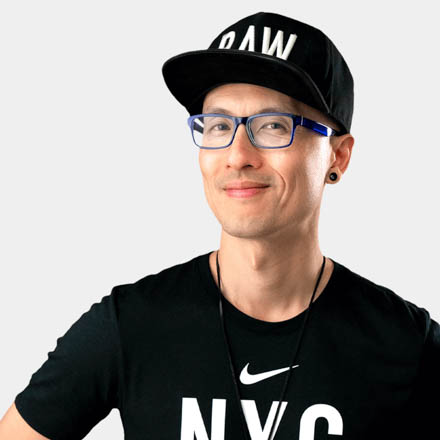
I believe the reason why podcasts are so powerful is because the potential to have real conversations. Oftentimes what I do is I have guests on my show. I ask them questions.
But the surprising thing to me is our most popular episodes are almost always when I'm in dialogue with someone. And I recently met Priscilla at an event in Austin during South by Southwest. And we're having a really engaging conversation.
And I was wishing first it was quieter, but more importantly, that it was recorded so that you all can participate or at least listen in on the kinds of things we're talking about. So we're going to use this episode as a way for us to talk just as two people would. but to have the ability to record and share it with others.
So I am Priscilla Lau and you're listening to the future without any other setup. Let's just get right into it. Sure.
Well, first of all, thanks for having me, Chris. I'm Priscilla Lau. I'm a strategic partner and creator advocate working in the creator economy.
I have a consulting company called Representation Matters where I help creators, founders, and companies build partnerships that grow revenue and relationships. Okay, you're using a lot of terms that people use in different ways. When you say partner and grow revenue, explain to me like I'm a dummy.
Yeah, I mean, my life is very much built around partnerships. I joke that I'm a partnership ninja, but my passion is building community and connection with people. And I know those words are also used a lot.
But I am of the age when you started recording 10 years ago. So that is refreshing for me that there's still opportunities for me to grow here. But I just find a lot of value in getting to know people and finding something that I can help them with.
So you know i graduated a long time ago uh started out my career in sales and where i was able to provide value to make a living was to understand the adwords market and be an account manager at google building ad campaigns and project managing different projects and so for me it started out with figuring out how to do something well that people needed and then finding the needs of you know i'll always remember one of my managers and colleagues evan who mentioned just trying to find the flat tire in people's businesses and you know at the time he worked with tech and finance clients and uh yeah for me partnerships is just connecting with someone understanding what value you can bring from a professional standpoint personal is different um but yeah so for me it's like amassing the X years of experience that I have in sales and working at YouTube, building, you know, channels for news companies or media companies or creators and figure out how to like help them with analytics and to grow their channel and subsequently revenue. Okay, you worked on the Google YouTube side, helping their quote unquote partners run more ads and get results. Yeah, run more ads, get results, build the campaigns, like keywords back in the day.
This is like 2010. Oh, let's get into it. So the idea is I don't want to start this conversation cold.
Our audience is not cold. You and I are not cold. Let's just get into the things that we should be talking about, but we often don't talk about because we're afraid of asking or we don't want to be perceived as being impolite.
But let's just go right into it. Where do we begin this conversation? Well, I really like to understand people's why.
I know that you have this 1 billion mission. I think for me, I'm still developing my mission. I think I worked at Google and YouTube for so long because I really believed in their mission.
Still do. and happy to give people a refresher, but it's just, there's like meaning and service for me. And I sense that from you too, when I hear your interviews and when I talk to you and when I hear about giving back and providing value and sure you have a business helping other people create a business, but I just really would like to know what your why.
My why? I know it's a big question. Yeah, that's okay.
It's something I've had enough time to think about. I often will tell people that the first phase of their life is about making money, making a living, probably proving their parents right or wrong, depending on which side of that equation you land on. And then the second part of your life, after you've made enough money or achieved the acclaim that you sought after, then you have to start thinking, okay, now what do I do with the rest of my life?
If the need to make money is removed, the reason why you exist beyond making money What is that? What happens? And so I'm in that state.
I found out that I can retire comfortably with my wife and my kids. Everybody's looked after. What do I do with myself?
And then that became so much bigger, possibly existential crisis or question that you're asking. And I love teaching very much. I just didn't find it to be terribly lucrative nor efficient use of my time.
It's a one to few and it's not scalable. I don't create any IP. I don't get paid for all the thinking before and after the class.
I literally get paid by the hour. And you know, if you watch a channel, it's something I'm not a big fan of. But the system's in place to treat you as an employee.
You punch in, you punch out, fill out paperwork, and that's how it's set up. So I'm not mad at the system. I just don't like it.
And so I'd rather create a different system. And if I have to remove my need to make money, what is it I want to do? I want to teach and serve and help other people in a non-religious context.
I also want to do in a way that's sustainable, that's fulfilling to me, that helps me to grow in every dimension, except for my waistline, then I'm good. And I think I'm on that journey right now and I'm enjoying every minute of it. Yeah.
Well, that makes sense. I think one of the questions I saw exchanged between us was, something I read or saw recently that resonates. And I just finished from South by Southwest too.
Thank you, Female Quotient. This Chelsea Handler, I'll have what she's having, which I've never seen her shows. Not a huge fan, but like really enjoyed this book.
And she said, And I'll explain why I think about death and these things, but she says in one of the pages, I want to be sitting on my deathbed knowing that I went for it. I'm going to get sick and die at some point. And I would like in that moment to smile at the life I've lived that had guts, that had standards, that I love people intensely.
She also says that I lived in a loud, brave way. I'm not a loud person. I think I'm brave in little things that mean something to me, but Yeah, what you said kind of makes me think about this quote because, yeah, I think about that sometime, like what I want to like leave my kids with.
One thing I've noticed that I wanted to ask you too is sometimes I see on your Instagram, you're in a table and you're like the only Asian American. And I don't know if you ever pause and think about that. That's a great question.
And I'm glad that you're asking that. Let's talk about that. Okay.
I think for a long time, especially up until about 18 years old, I did not enjoy being Asian American at all. It was a source of a lot of emotional, physical pain too, because I'd get into fights, people would pick on me. They'd say, they'd throw racial slurs.
You know, they'd grab their fingers across their eyes and make their eyes slantier. And I'm like, God, especially as an awkward, self-conscious person, person trying to just fit in. That's all I wanted to do.
I just didn't want to be called out for all this stuff. And they'd be yelling out across the playground, "Rice eater!" I'm like, I didn't know how to respond to that. Is that an insult or I don't even, I'm still comprehending that, right?
And I remember there was a very kind white guy who turned to me. He's like, "I don't know what's wrong with him saying that. I love rice.
When my mom says we're having rice, I'm so excited. It's like, this is what I have every day, but okay." And so I, I, I start to kind of lose my sense of self and start thinking that I want to be white. I want to be accepted.
I want to be okay. And I worked through this eventually. And then arrive at this place where I'm in LA working in a very competitive market, doing something new called motion graphics back then.
And of course, when I'm in school, the only Asians in school were, were Japanese Americans or Japanese. There are a handful of Taiwanese, but not a lot else. There was one other woman that I met who was Vietnamese.
I was so excited. I'm like, you exist. You know, there are Vietnamese people at this school.
One. Okay. And female.
Female. There are very few Latinos, even fewer black that are in art school. Now that's changed quite a bit, but mostly white American and Europeans were there.
So I'm like, this is what I'm used to. This is who I'm competing with and against. And I'm okay with that.
So when we go out and we're competing, A lot of times we're sending storyboards and we're getting on a call. This is pre-Zoom. The internet's kind of barely there.
So it's just like on a traditional landline Polycom conference phone. We're chatting with agency owners, creative directors, associate creative directors, group creative directors, and we're just in the battle for ideas. Is your idea good?
Did you see an angle on this that we didn't think of? Do we like the way that you're engaged in the conversation? And we would win or lose.
Oftentimes at the beginning we would lose, but eventually I figured it out and we won a lot of the jobs. Our close ratio once I learned how to sell was north of 70%. And in the glass ceilings that I felt before, I never attributed to being Asian or Vietnamese.
I attributed to, I don't know what I'm doing. what can I do? So I hired coaches or a coach and I worked on just being better at figuring out what they wanted and giving it to them.
So they will award jobs to me. So through that process, I went from doing jobs, which blew my mind at the time for tens of thousands of dollars. I remember getting the first check for 50% upfront for the complete thing.
I can't remember for a Buick job that worked on. I just put some random number together. They just approved it.
I think it was like 60 or $70,000. And so when we got the check, I handed it to my girlfriend, not my wife. I said, look at this check.
I didn't think I'd make that in a year, let alone one check. So we went from that to a hundred to $200,000 to four or five, six, seven, into a million dollars plus. And I can win them.
If it's a job that's winnable, we will win it. Wow. Yeah.
So I don't really think about that. But okay. So let's go back a little more than growing up.
I think you grew up in San Jose. Yes. Were your friends mostly Asian, mixed, white?
What was that? Most of my true friends, people I can semi count on were Asian of one sort or the other, Korean American, Vietnamese American, Chinese American. And my other friends, acquaintances were not Asian.
They're white, Latino, black, something else. Yeah. I think it's interesting to reflect on the rooms that you're in and when you stick out, whether you're, for me, I grew up in the Valley in LA, San Fernando one, not the 626.
And most of my friends were white and I had this big breakup when I was in seventh grade with my best friend who was Italian. And then from there, I went from all white friends to all Asian friends and would be like linked arms across eighth grade lawn, all Asian. And I remember just that was the first time where I thought, whoa, this is so weird that I didn't see myself as Asian before.
I didn't see myself anyway. I didn't see myself as white either. I didn't want to be white, but it just happened that most of my friends were white.
And then I became all friends with Asian people. And so even to this day, I'm still very self-aware of, you know, the communities that I'm in, if it's all Asian or if it's mixed or if it's white, or, you know, I have like one black friend that I can talk to about X, Y, Z, or a couple, you know, and just being curious about that. But also when I dive into those type of conversations, it feels, I feel very vulnerable and a little nervous talking about race relations.
And literally like last week, I left a voice memo for my friend talking about like how Chinese Americans view Chinese people and it's a little bit sensitive and dicey to speak on, you know, in this format, but, um, but yeah, it's just interesting to reflect on why, when, when we saw ourselves differently. Yeah, I've, I've run the whole gamut of wanting to be white. You said you didn't want to be white.
I wanted to be white and not because white was better or whatever, but white was what I wasn't going to get picked on or to call extra attention to myself. And if I was in Asia or in Africa, I'd want to be whatever the predominant culture was. And it's because I'm, I'm not assured enough in my own self.
And I don't know who I am, what my identity is that my first identity is just to blend in and just want to hide. And that was how I saw myself for a very long time. Now, when I'm in a room, I'll take note like, well, who's here?
But I'm not running that as some giant calculation. Like there's seven people. Some are short, some are tall, some are lighter, some are darker, some are Asian, some are not.
Some are in marketing, sales and advertising or some other category altogether. And I'm just intrigued by people less so about like, oh, you're Italian-American or Irish. Unless they have some really distinct physical characteristic.
I'm like, oh, that's, I'm noticing that right now. But otherwise, I'm not paying a lot of attention to that. And I think I attribute that mostly towards me finding myself.
It took a little while, but now that I feel like I found myself, I'm very comfortable in my own skin. In fact, I do strange things and I don't even think like, is this bothering you? Cause I'm just going to do me.
And if you don't like it, that's your challenge, not mine. So I will wear, I'll just say it. I have a MRS or a man purse.
And sometimes I wear a long skirt or skirt pants or things that can look like a skirt. And I don't even care. Wait, your audience has seen it and appreciated it.
I know the bag or one of the bags. And I enjoyed looking at your Instagram because I think I don't consciously like if you look at my Instagram, it's not like I'm like, OK, I want people to think this is this about me. But then as looking at other people, fashion, you have a bubble on fashion.
So I did go through those stories. Yes. I mean, do you think you've found yourself or are you continuing to find yourself?
Because I think it's, I think, and I don't know, but even when I'm on my deathbed, I will still have been finding things about myself. Yeah. I think I know who I am.
The expression of myself will continue to change and evolve over time as I'm exposed to new ideas and concepts. It's like to say, look, you found your favorite food, but it doesn't mean you're not going to stop exploring different types of food. And I'm going to do that.
I think for a long time, I needed to give myself permission to do the things that I'm doing today. But at that time, I didn't think that's what I wanted. Meaning I didn't know I needed permission back then.
So I'm not telling you right now, this is the end. I've given myself all the permission slips in the world because two years from now, I'm like, I give myself permission to do this and only looking back and I say, oh, I was holding myself back. So there are looks out there And I have to say something just to be kind of totally transparent about this.
We're all seeing a magazine or a scroll or somewhere on like whatever on the Insta. I'm like, that's a really good look. But there's six foot two models that weigh 112 pounds.
And I'm realistic. I'm five, eight, 142, you know? So I just know proportionately it's not going to look right, but I still dream about being able to do that.
So I have to find my own way of making it work for my body until I do. Then I'm not going to explore that. Give you an example right now.
Yesterday, my wife and I went to go look at some hardware store, whatever. As we're driving through Old Town, there's this man who's walking. It caught the eye of both my wife and I, an older black gentleman walking.
And he looked like the most hip Boy Scout you ever saw. Or yeah, like an Eagle Scout. He had a cool ranger hat.
He had a yellow bandana scarf thing tied here. He had a camouflage jacket that he rolled up the sleeves and he had gloves on, but fingerless. And he's wearing some strange flared up pant that's cropped.
And he's just had the swag. And she's like, pull up to him. I need to take a picture of him.
I say, honey, do you want to walk out and talk to him? Where are we going with this adventure? So we're kind of crazily stalking him from the car, looking at his whole fit.
And in my mind, the calculation that was going on was, what is he doing? How did he pull that out for one of the parts and pieces I need to buy tomorrow so I can try that look too? So we're inspired by the things that we see.
I just want to keep an open mind as to what the limitation to that is. Yeah, no, it's inspiring to hear that you have that ambition to keep leveling up, you know, the style. Cause I feel like I just, I didn't mean to level down, but after becoming a mother kind of leveled down low, let's be real.
Okay. Real, real. Yeah.
So that's really good to know. Um, I, are you leveling down Priscilla? No, I'm trying to like, just not even level up, just like, just stay back to like enjoying clothes.
Like I used to enjoy shopping and things. And so I'm just trying to be i'm in a very i think after becoming a mom i'm just practical like you know i used to joke about my clothes as being like a uniform and this is the very early days my kids are older now thank god but yeah i think it's so i you know and something you said reminded me of one of the takeaways I wanted a group of high school students for a talk I was giving to come away with, which is there is freedom in knowing yourself. But I'm very, I try to be self-aware in the things that I'm saying, because when you're in high school, even now, whenever, whatever age you are, there's words and then there's like action.
And I would like to be a one of action and not just tell you type of thing. Like, you know, the whole show me, don't tell me So, yeah, and there's freedom in knowing yourself. And I'm like, I was thinking, like, overanalyzing myself, like, what are the kids, they're going to be like, I don't need freedom.
Like, you know, I need freedom for my parents or I need money or something. But closely tied to that is this concept of like, loving yourself. And I appreciate how you talk a lot about the coaching that you've gotten, especially because you said early on in your career, I mean, I feel like so many of my friends are coaches now, literally today, or, you know, recently, I was talking to my friend about this zone of genius thing that she was talking about.
And I've, I heard something that you also, you mentioned zone of genius, too. So I was actually And we can close off that thought, but I also want to move on to like zone of genius. But the point is there is so much as you, as you get older and you gain some wisdom, this freedom of going inward and not outward so much and pursuing things inward is very satisfying.
And it's such a mystery, you know, we are a mystery inside us ourselves. Couple things I want to add to that. I think the journey outward is finite.
The journey inward is infinite. And I think I want to go on these infinite paths because one door leads another door leads another door. And there's just no end to that.
I want to also share with our audience who are listening and watching this and how I think about clothes and it's an evolving idea. And I didn't always think of it like this and it's fairly recent to me. So I think of clothes as tools.
Yeah, they're tools. So when you're raising your children, especially when they're all messy and little, The tool that you need to wear is, is this comfortable? Is this washable?
And it's not too precious. It's durable for the job. And we think like if you're going to go change oil filters for people, there's a tool for that.
Usually it's a jumpsuit or something like that. And you wear that and you wear dark shoes that are steel, steel toed because something heavy might fall on your toe and you really need that. And that's a good tool for that job.
Conversely, if you're going to go dancing, you need something that's a little bit looser fitting or form fitting, depending on how you like, but it needs to allow you to move. That's important. And you don't need to have heavy shoes.
And actually the tools from the oil filter guy or gal is going to impede your ability to enjoy you dancing. Vice versa. You know, there are probably different fabrics that are not going to wear well, then they're going to tear easily.
They're not going to protect you in case you catch on fire. So they're tools. So I just want to say that unfortunately, mothers have an unfair burden that their body changes and then they're usually given the responsibility by society, by their partners and everyone else to be the primary caretaker where I get to be free from that.
I just want to acknowledge that real quick. Now I just look at it like, what is the job and what's the tool? So when I'm traveling on an airplane, I want to, I aspire to be in one outfit that from the time in which I leave my house through a 17 hour flight and into the hotel could be the exact same outfit, even if I need to meet somebody.
So that's a tool. It needs to be warm. It needs to be layers and it's got to have pockets where my phone's not going to slip out and fall into the cracks and those little things, right?
It also has to have very little metal because I don't want to get caught in the metal detector. That's a tool. But when we're out on camera, on stage, in an event where there's happening people, what's the job?
Because I will pick the right tool for that job. And so I hope maybe some for some of you who are like can hear this to understand that you're just choosing the right tool for the job. And then the real question is, what's the job?
And do you want to exercise all the tools that you have? Otherwise, just keep doing what you do. For sure.
Or you can just take the practical. I mean, Chris, I think you're a busy guy. So you need to land and go straight somewhere.
So you have to think about the job and the tool. I'm just about functionality and I'll get wherever I need to get to and clean up where there. But yeah, we could like spend the whole session on talking about your fashion.
Cause I'm super, I mean, literally the second or the first day I met you look down at your shoes. I'm like, how do you do that? Like, how do you keep it so clean?
Oh, um, but I admire it. I think it's great. And I like to see it and it takes a lot of boldness to step out.
And would you say that it was a skirt? It's a version of a skirt. Is that the word you used?
Yeah, I was used to skirt. I don't remember exactly the fit, but who knows what I was wearing, but I have so many versions of that. My wife's like, do you like attention though?
Like I don't really like attention. That's a great question. If you ask the old Chris, no, I would do anything I could to be out of the spotlight.
But now it's not so much that I like the tension or I dislike it. It's just, I'm realizing I'm not good at starting conversations. I know this about myself.
And so the way I start conversation is I wear something that somebody will then have a conversation with me. And so what I can do with words and action, the tool is an icebreaker. It's a conversation starter.
And that's an important thing. So that's why I keep talking about tools and jobs, right? So if I'm in Austin at South by Southwest, my job is to meet people, meet people who I can help and meet people who they can help me.
And I don't want there to be a mistake when they see me like, is that that guy? Because look, if I was a woman and I was... curvy or I had red hair or green eyes or purple nose, whatever, it'd be easy to figure it out, right?
But I'm a five foot Asian man with that hair. You can put me in a lineup and people are like, well, where is he? And I want to do everything I can to make sure the silhouette, the profile, whatever features I may have, you can recognize me because I want to talk to you.
I'm in a social setting and I don't want to presumptuous to say like, I'm important enough for you to talk to, but if you want to talk to me, I don't want you to be confused as it's not me. You know, it worked because we're talking because I know, even though I've never met you in person, I knew your look. So when I was in that setting, I knew who you were because of your look.
So it worked. And it goes back to like knowing yourself. Well, when we talk about modern branding, if you design a logo that's Helvetica and you said all caps, you don't do anything kind of generic.
If you go to hospitals and airports throughout most of the world, that's Helvetica. But if you do something interesting with it, you create a mark and you put it in a circle and you make it green and you take a mermaid and you split her tail in half. And it's like, that's a very identifiable mark.
And there's a reason why that is, is because companies, corporations spend all this time and money working on a very specific formula of a product user experience ambiance so that when they want your business, you will not confuse Starbucks for Dunkin'. You will not confuse that with Pete's or the coffee bean and tea company or whatever it is. They have an individual identity that should be highly recognizable, that should be aesthetic and something that people feel like it represents their positioning in the marketplace.
You are now making me wonder what that is going to be for me, because for you, it's the hat, it's the shoes, it's the chains, it's the glasses. And I know you can't tell me what that would be, but I am open to suggestions and I really have no idea what that would be for me. Not that I'm going to follow suit because you know, you and me are different, but to an extent what you're saying is very true.
And I'm still struggling with, do I even want that attention? Like, who am I, you know, You're further along this journey, I think of the inward thing, but I, yeah, I'm just something for me to think about later. Well, ask yourself, what job is it that I want to solve?
What tools solve that job? What are the assets and features that I have that I want to highlight? And what are the ones that I want to minimize that usually will be a good place?
Is there something in my personality that I think is worth highlighting and how do I accentuate that? Right? So like, for example, if you have really long legs, you should accentuate your legs.
Or if you have like a beautiful hair, put your hair out there. You just highlight what you have. That's all.
You just work with that. Okay. You have probably been asked this question, but I still want to ask it anyways, Chris.
And it's if you had to describe your brand, whatever you want to call it, it could be the Chris dad brand or the Chris husband and or just overall Chris. What is it in one word? In one word?
Or a couple words. I like to teach people to use two word combinations that create hybrid meanings, like semiotics, like that word means this, this, and then put them together. It's kind of an interesting, like mind candy.
So the combinations, and they're not all my own invention. Some have just been given to me. I'm a loud introvert.
I'm a charming razor blade. I'm a kind critic, a recovering designer, a serial dreamer. And I'm an above average student, but a first class troublemaker.
Nice. Those are my words. Yeah.
Not your first question rodeo. Well, I teach people this. That's why I have to like, what are my fricking words?
I mean, call me out on that. Yeah, no, I understand. Uh, zone of genius.
Do you, when you teach people, is that your zone of genius? Like what aspects is your genius? And I struggle with this genius concept.
Cause I'm like, there's excellent and there's genius. And I'm like, genius sounds like Albert Einstein genius, you know? So it's a little bit too big of a word for me and maybe I'm limiting self-limiting myself, but yeah, just curious your thoughts on zone of genius.
And I'll explain this came about because I was saying how I appreciate so much the operational people that I work with, cause they're really excellent. And my friend was saying, that's great. You know, you know, your zones of complimenting yourself with other people.
I can do the operational things. It's just not exactly my favorite. And I have other strengths in connection and building community.
And that's my zone of excellence, let's say. So I'm just curious about your world, your everyday, your business. What world do you, what zone are you playing in?
I'm like you, the word genius is used carelessly. And I think there's an objective standard that you must hit when you use that word genius, like Einstein. Like we think of measurable things like IQ or someone who's able to see things really, really fast, process pattern recognition, those kinds of things.
I think the term zone of genius, even though it's using the same root word, means something totally different. It means you're operating in a place where you can play at an advantage without a lot of effort, more so than a lot of other people. And so if you have really big hands, it might be that you're a good arm wrestler or you're the power slap champion of the world.
It could just be that, and that's your zone of genius. And sometimes people will use these two terms together or synonymously where they'll say zone of genius or flow state. It's kind of the things that if you believe in creation or evolution, whatever you were evolved to do or created to do, it's in our lifetime that we should discover what that is.
Some people refer to this as your gift. There's a great Einstein quote. I always mess this part up, but it's something like, the purpose of life is to discover your gift.
The meaning of life is to give it away. So there's two parts to that. Like we, you and I, we're going to spend decades of our lives thinking about what's my gift.
So let's talk about that part because that's your question. What is your zone of genius, right? When I do these things with people, Even though I don't tell them what it is, just the exercise of doing it gives them a lot of pleasure.
And sometimes they're able to see things. So we'll do this together. Now you can literally do it while I was describing, or you could just listen.
And if you're listening to this, I would pause after I tell you what to do and then really do it and then resume the episode. Okay. Don't go away, but just pause.
Here's what I'm gonna do. The first thing is the easiest thing is like, what's your, what are you really skilled at? This usually requires training and practice.
It's usually what your vocation is, like what you do and what you get paid for. So you went to school for accounting, maybe you're an esthetician, maybe you're a lawyer, like you're really well-trained. You've gone to school.
And if you have multiple degrees, you would write many things down. And everything that you write, I would just write an idea and draw a circle around it like a bubble, like it should be bubbling up. And so that's usually the easiest one.
Like, what are you skilled at? The next thing is, what do you do that pays really well. So sometimes the things that you're skilled at don't pay anything.
You can play the harmonica, but you're not a world-class traveling musician. So that doesn't do it. Okay.
So I'm a musician and an artist and these things I'm really skilled at, but by day I'm an engineer working for a semiconductor company. So, and you can make a lot of bubbles around that. And then the next thing is like, what are you passionate about?
And we use the word passion just to mean like you have a deep interest in things. You don't have to be good at it, but you're passionate about it. Like I like comic books.
I can't draw that well, but I really love comic books and I love watching movies. I love reading books. I like talking to people.
That's a passion of mine. I have got world-class, but it don't need to be. And then the last one, the hardest one is what does the world need right now?
What are the trends line pointing towards? We know if you add the word AI, yes. If you add in things like social media, communication, rhetoric, being a persuasive communicator, having good taste, being able to discern fact from fiction, those are all things that are very necessary in 2025.
And then you start to look at all these clusters and bubbles and you try to connect as many of them together as possible. That's your gift. Now it's not easy to do, but it's usually exciting and fun when people are like, oh my God, I'm seeing things.
And oftentimes they can't see what I can see. And I'm not saying I'm a genius, but an objective person who's detached from outcomes and free from your history can look at them like, oh my God, what if he did more of this? So my zone of genius is something like this.
I'm an entrepreneur. I love business concepts. I think I'm a really good communicator.
I make complex things simple to understand. I'm even-keeled or stoic. I don't ride high on emotions, and I can see things for the way they are, not for the way I want to see them.
I can draw. I understand design principles across a variety of disciplines, from photography, cinematography, graphic design, typography, all those agraphies, I suppose. And I love teaching.
I'm good at it. I'm good at thinking on my feet and there's a little kind of mischievous part of me and my personality that I like to push buttons. So when you wrap all that stuff together, you're going to see me in my zone of genius when I'm in a room, 50 ish people with a whiteboard and a live microphone or a marker in my hand, you'll see most of what I have to offer the world come out then.
And people are surprised to see that when they see it for the first time. That's your flow state? Yeah, I think so.
Yeah, I like to teach, but I also like to make fun of people and there's wordplay. So sometimes it's a little bit kind of crowd work or roasting. I don't like to use the word roasting, but crowd work where I take an element and I improvise and exaggerate.
I'm a little bit into like physical comedy where I can mimic what they're doing. There's that playfulness to it that I think I can do better than most people who are trying to teach. I have a question for you too, around 2%.
I think that was the number you and you had another interview with Tom Bilyeu. Yeah. Yeah.
Tom Bilyeu. Yeah. And when you do these classes and I, you know, appreciate the transparency and you know, and you having done the work too, and the coaching, and I think you guys said something around 2% actually like make it or do something.
And what is it about those 2% and you, you are probably a 2%. So It's the habits. You're going to tell me the things that, you know, are in the books maybe, but what is it?
Cause it's so hard to get over that hump of trying something new and just you know, for me, a lot of people would be like, wow, great. Priscilla Bravo, like clap, clap. You're doing, I told you I did two podcasts ahead of this one, cause I was trying to get some reps in.
And so, but that's not enough and it's not my end goal here, but I'm just like, how do you be your best self? Like literally I was talking to some moms yesterday. And I was thinking about like life mission stuff, worried that you were going to ask me about that.
So I was like, I just want to be my best self. And another mom was so kind. She was like, you, she had a whole text of great things that I do, community, all these things.
And yeah, I was just anything, any insight to be the 2%, not for, you know, any, you know, great. If I can fund something extra for my kids because of it, great. But I would like to be the 2% just to be like, I did my best to be the best me.
Is the 2%, because I don't remember the context, the 2% about the 2% of people actually do something? Something like that. Yeah.
Okay. All right. The secret to all of this is a couple of different things.
Number one is to be a cheap bastard. A lot of us get addicted to buying things as signals of progress. We don't actually do anything.
We'll buy a membership to a gym. We won't show up. We'll show up and do the bare minimum and leave so that we tell ourselves we've done something today.
And yes, doing something is better than nothing. I know that, but I like to think of it more like whatever hands fine to do, do with all your might. So I don't do things halfway.
I do things to crush, to kill, to destroy, to win. And the thing I, I, I joke about with some of my friends, like Chris, you want to play this game? When I say yes, I already figured out I'm going to beat you.
Cause I don't want to play to play. I play because I want to be excellent. And the recent example I'm giving to people is I downloaded a game because I saw an ad on another game I was playing.
And I played a game for a couple of different reasons. Number one is it hypnotizes me so I can fall asleep. They're like very redundant actions you just do over and over again and you just fall asleep.
So I had a hard time falling asleep. I'll do that. So I see an ad and I buy, I don't buy it.
I download the game. And as I'm playing the game, it's a very complicated game. And I'm starting to buy like in-game apps.
And now every time Driegel comes by, he's like, what are you doing? Are you slaying dragons? And I'm like, yeah.
He goes, dude, are you addicted to this game? I said, I might be. I think I have an addictive personality, but more so I'm obsessed.
And so he laughs. He's like, ah, I found Chris's weakness. He'll play a game or something.
He doesn't always do important, meaningful things. I said, you're wrong. You're totally wrong.
This is not in defense of playing the game. It's that I want to understand the mechanics of this game. I want to understand how they brought me in, what the user experience is like, and how they keep me on, and what the reward system is like, and how they use community to rile you up or to help you play the game.
It's very interesting to me. And I'll play it, and I've already spent over $100 more than I've ever spent on any game I've bought on the iPhone by orders of magnitude more. And then one day, I'll just put it down.
I'm like, I'm done with the game because I got everything I needed to learn from the game. Now, in my childhood, somebody who didn't understand would say, you're wasting your time doing this. How is this going to lead to anything?
I would not have an answer then, but I have a very clear answer now. I'm exactly where I am because of all those weird things that I took to the nth degree, right? So when I get into fishing, I go to the library I used to, and I would borrow every book and I would look at every magazine for two years.
I have to go to the taco shop. I would talk to the owner. I would look at the lures.
I couldn't afford them, but I just look at them. I would order the catalogs, which were free, send a self-stamped dress envelope. You get the catalogs and just go through it.
Like if I had this equipment, if I had those boots, I would just immerse myself. Now, where does it all come in like to play? Well, here's the thing.
Here's a real story. We're working with Spike TV, the first network for men, I believe. And Spike TV had this program that they're re-airing.
They bought The Shield, which is with Michael Chiklis. And we're working on promos for it. And then I find out they acquired the rights to do a new show called The Ultimate Fighter.
And this is with the UFC. And I find out about this after the first season had aired. And I tell my creative director who was working with them, I want to do the next season of The Ultimate Fighter.
He tells them. They get on the phone with me. And we start talking.
And in a very short amount of time, I knew that they knew I knew way more about this sport than they did. We wound up doing five or six seasons of the ultimate fighter. And I traveled to Las Vegas with those clients twice.
I got to meet some of the people I watched on TV, shook their hands, was in the backstage, press pass and all. I tell people the stories because when you go deeply into something that you're passionate about, don't stop. It's part one or part two, go all the way down.
Immerse yourself in the culture, the game, the mechanics, whatever it is that you want. Because at some point in your life, it will pay you back. Not always obvious when, but it will pay you back.
So when I enter into a general conversation, somebody's asking me a question that I cannot be prepared for. I'm like, wait a minute. I had this experience.
So it's this catalog. It's an aisle four, section three. This is the piece of information.
This is the story. Put them together. Like, how'd you do that?
Well, if we catalog these things while we're going through them deeply, we'll be able to share something with someone that they'll feel like, wow, the way you see the world is fascinating to me. And that's why I do the things that I do. Well, that's a good story.
Thank you. So be a cheap bastard. Be a cheap bastard and go really deep, be obsessed with what you're doing.
Because if you just go to the surface, make the decision that you're not going to waste the money. I think the problem for most people is they don't know, including myself, what, what they want to go deep into. It doesn't matter.
I think the biggest, and I'm not, I don't mean this as an excuse, but I'm like, man, the biggest turtle for mothers, working mothers is time. And I wish I didn't have the limitation of that and the stress of Ubering around the activities and trying to navigate it all. But it's, you know, I'm lucky that I have what I have to do what I can do.
Yeah. Let me ask you this question here. If mothers are burdened with raising their children or given that wonderful responsibility, depending on how you look at it, and they don't get to live their lives and then the children grow up and then they then do the same thing.
And this pattern repeats itself. When do mothers have time for themselves or are they ever stuck in a state of in-betweenness? It's so individual, but like I said, even doing this mother, a mother was like, wow, I was stuck doing potty training with my two-year-old this weekend.
It's just a mindset and recognition of having choices. And also there's just phases in your children's life where you, you can't go out on a Friday to go to someone's film premiere because they're two or three years old and maybe they'll wake up one or two times in the middle of the night. So I think it's just perspective of knowing that this is just one chapter and also that visual of like how much time you have with your kids.
So it's going to be dependent on however people you can do. Things can be true. Like Dr.
Becky says, you can feel the burden and you can be like, this is the greatest blessing and the biggest, most important role that I have in life. This is my purpose. You know, I feel both of those things.
I also feel like being able to do different things and meet different people and do what I love and enjoy that shows my kids a different side too. Like they were watching me watching your interviews and they're like, who is this? You know, not listening, but I, yeah, you know, people again show me and I'm not trying to show them, but they're going to see it because I'm trying to balance the dinner, the activities and listen to some stuff.
you know, all at once. Yeah. Going back to the quote inside Chelsea Handler's book about dying peacefully without the regret of taking your shot and doing all that stuff.
I want to go to my grave with a very specific story for my children that you've got this one precious life, live it to your fullest, live it not in a selfish way, but live it on your own terms, doing the things you want. And I hope that, um, They can get over the part where dad lived to lead an example for you to live, not to be your primary caretaker. I know that's not great because my wife has that responsibility and now she doesn't have anymore.
So she's exploring who she is now. But unfortunately, her best years are behind her because she physically cannot do the things that she used to do when she was 20. And that's a sad thing.
I'm trying to figure that out. Yeah, I get some angry messages from this, but I just want each person to live their best life. I heard this thing from Yogi.
His name is Sadhguru. Sadhguru said, children are born perfect. It's your parenting that's messing them up.
So his whole thing is his, his duty as a parent is to do as little harm to his children as possible. Because a lot of us are living vicariously through our children. We're trying to make amends for the things we did or did not do.
there's no coincidence that people who are kind of like mid-level musicians want their children to be like lead chair it's like the person who didn't go to college wants their children to go to ivy league school it's like then are we ever living our lives and i think if anything i want my children my two boys to have at least some reference point in their life like that person lived on their own terms and to free from free them from this idea of what happens before and after i don't need them to take care of me And if they do have children at some point in their life, they're going to have to make that decision for themselves. Yeah. I think that spirit of living on your own terms and giving back and being your best self.
There's a, there's a verse that I like a lot. There's many parts of the Bible that I could go into, but Luke 12:48 has some, captures some of that essence of, I feel very blessed to be where I am at. And even as a young child, I would think about that like i'm lucky to be it you know as a fifth grader could think this way and i don't know it's just something that's built into the fabric of who i am is wanting to give back and if that's why i truly mean it when i say service for and i ask myself the same reason like why why do i care about helping people and that makes me and you know and i think big important people like Susan, who was the former CEO of YouTube, she passed away suddenly.
Her son unfortunately passed away within the same year. Huge people, you know, that have done impactful things in the business world have passed away. My dad passed away, you know, almost 10 years ago, 10 years this year, 10 years.
I remember waking up, driving on the 405 freeway, seeing the sunrise and feeling so sad that the world wouldn't know him. And so, it's simple for me, you know, like if I die tomorrow, I hope people were, would just remember me as like, oh, she tried to help people and, you know, brought people together and tried to help them be themselves and hopefully try to be my best self and hopefully don't screw my kids up too much with juggling it all. That's all.
Yeah. My perspective on the afterlife has changed a lot in that I have come to some peaceful acceptance that when I die, I'm dead and we're done. And as much as I want to think about what happens after, I have no ability to actually execute on that concept.
So it won't matter. I don't want to leave the world in a terrible place, but if people remember me, not remember me, it won't make a difference because I won't even know because I'll be at that point food for the trees and the worms or whatever else. And so I try to make the most of the time that I have.
I think one of the, one of the, the detrimental things about the afterlife is we don't live our life for the moment. We're always thinking about the future, which hasn't happened or the past, which we cannot take back. So we're never fully a hundred percent here in the time in which we have.
If everyone, if anyone wants to have an adventure, I have a lot of ideas and I'm always finding so much joy and don't get me wrong. I'm like every other human. many flaws and things in that.
But for some reason I'm, I just find so much joy in like taking the Caltrain and going to SF and meeting a friend at, you know, his Opus Clips office and then eating dinner at a restaurant and just the freedom of being a mother again, freedom of being yourself again is quite a journey. Yeah. You taking the Pacific liner or you going up the coast?
I haven't done that. Okay. I haven't done it either, but from the advertisements, that looks pretty cool.
Yeah, there's a lot of things to explore. So that gives me a lot of hope for what's to come. Or the bullet train from Tokyo to Kyoto.
Oh, yeah. Or, you know, Big Sur is one of my favorite places. And there's that Esalen Institute that I would like to go to one day.
Or even there's some sort of hot springs thing for adults only in Carmel that I would like to go to with my husband one day. So yeah, lots of things to explore. Yeah.
Well, thank you.