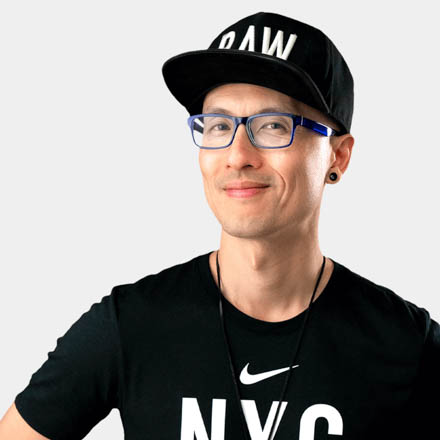
Today I'm joined by Jeff Cook. He's a founder of Base New York. I'm super excited to talk to him because we're going to talk about brand and branding and maybe even like world building.
I'm Jeff Cook. You are listening to the future. Jeff, welcome to the show.
For the people who don't know who you are, can you please introduce yourself and tell us a little bit about your backstory? Thanks so much, Chris. Thrilled to be here.
Backstory. It's the early 90s and I went to work for a little brand called DKNY. And as luck would have it, it became sort of one of the hottest brands on the planet.
And during my tenure there, I learned not only about all things brands, but a lot of adjacent areas like retail experience and product and visual merchandising and so on and so forth. So that by the time LVMH acquired Donna Karan in 99, I sort of was pretty well versed in all things brand and had a couple of really close friends in Brussels that had an agency base that I was always fascinated by. And so I took a plane over and after a few Belgian beers, ended up at the end of the night with an agreement on the back of a napkin to open base in New York.
And that was... right around 2000, right around the turn of the millennium. Wow.
Okay. Some interesting twists and turns here. Are you a traditionally trained designer?
I am not. I am a traditionally trained marketer and strategist. And so when you were out of school and you, of all places, why did you land at DKNY?
I give all credit to my mother who was in fashion and she was sort of a first generation working woman who saw Donna as the apostle for all women. And I learned very early on about her and her eight easy pieces and her luxurious clothing. And it was almost a fed a complete that i would end up there so some influence and introduction from your mom and then you wind up there what was the job process like like how did you get a job like that because now looking back i can think of a lot of people who want to work with like an up-and-coming or an established fashion house it cannot be that easy to get in how did you get in So funny enough, they were, if you can imagine, Donna Karan was at that time a domestic only brand.
And I actually started in international sales. I was hired because I knew about fashion and I spoke multiple languages. But because it was such a fast growing company after nine months, I was, if you can believe, at age 23, promoted to be the director of all of international menswear, which was, as I mentioned, product marketing, sales strategy, and So yeah, imagine your first task is getting on a plane, going to Paris and negotiating with the SVP at Galerie Lafayette for a 3000 square foot shop.
And he's 55 in Parisian and I'm 23. What in your life prepared you for that moment? Not a lot.
I think maybe good parenting, parents that always instilled a certain confidence and trust that nothing was out of bounds or that and not much more. What was the narrative that's happening inside your head as you're moving really fast through this world, like starting and then nine months later becoming director of international menswear? Yeah, I think that there are many people that have experienced what we experienced at Donna Karan in its heyday, which is that It's nearly like a cult.
And we were all in love with the brand and the design of the clothing and Donna herself. And so you're working 18 hour days and maybe what would take someone five years took us a year in terms of really adopting a culture and really learning about the company and the business. And so I think that time really built a very strong team and prepared us for what was to come.
It seems appropriate then like we'll transition to this, that as a person who's young, stepping into this world of fashion and using the skills that you have and building on it and seeing rapid growth and change, being at the right place at the right time, the right person, wonderful things can happen. We're living in very uncertain times now, and we can't get out of a conversation without talking about the machine, the robots, the rise of AI and the potential threat it has on every sector of life. And many of the creatives that we speak to directly on this channel are really, really worried and for good reason, I think.
And so I'd really love to just talk to you about what is it that we can do that the robots can't so that we can focus more on that and build on that. I think you have a couple of big ideas. Why don't we start with like world building?
Could you tell us what that is? And then can we get deeper into it? Yeah.
And it's definitely a question that I've been obsessed with, rightly so, that you mentioned. What can't the robots do? If I look at our business, when we started BASE in the late 90s, BASE New York, it was essentially a graphic design studio.
And if we all remember back to those times, basically were even where we were working in different areas of business. We were working in culture and in fashion and in business. Can you imagine back then people would say, well, you can't do all those things.
Are you a fashion agency or are you a nonprofit agency? Are you a cultural agency? So if you think about that's where we started.
And in that time, then the advent of the internet came along. And I had designers that would say, if you dare put me on a digital project, I quit. and everybody was terrified of the internet.
And so today, I think that people rightly so are sort of a bit guarded when it comes to what's coming. And yet, If you look back over history, even when my partners started based in Brussels, they went from actual physical typesetting to desktop publishing. So there have been these different milestones along the way where our business has changed.
But for the most part, it's made things much better, not worse. Okay. So we have handled change before.
Do you think this is the same kind of change that we're seeing? Or is this very different? No, I think, again, I'm going to probably say a lot of the things that we all are talking about.
What we're talking about at Base is sort of people are seeing AI in particular in two ways. One, how we see it as a really valuable tool. But there are also companies out there that are creating agencies that will create a brand for you.
and just right out of the box. And so I think what I'm anticipating will happen is you'll have a massive homogenization happening in the middle and you'll have the top creatives really thriving. Those that are able to really produce original work as there's a dumbing down of the middle.
So that's one effect that we'll have. Another is on the craft of design. So whereby we will, instead of having to go and choose typefaces for and go through looking at thousands of typefaces, we will be able to have them sort of give certain cues and have them pulled up and then have a much more efficient system of processing.
around the craft of design. So, I mean, those are the types of things that we're anticipating having happen. Now, where does that lead us?
I think is to what your second part of your question was more around world building. And that's really where our business is evolving today. And so it's not to say that the core of what we do in terms of strategy and identity that continues, but it's now extending much more into largely physical experiences and activations and digital.
And so I'll give a recent example of that. We recently created a brand called 12. So 12 is a best in class matcha brand.
Fairly interesting story behind it. So it's a father-son team from Hong Kong that we knew and that had acquired the rights to exceptional matcha for distribution outside of Japan. So for context, this is the same farm that supplies the emperor of Japan's matcha.
So very, very high quality matcha. And the family came to us and said, we'd like to create a brand in Hong Kong, a matcha brand. And I said, okay, name five iconic Chinese brands.
And there was a pause. And they said, okay, we get you. We get the point.
What would you do? And I said, look, I'm a matcha drinker. The market is very fragmented.
You have small players like Matcha Full and Chacha Matcha. You have big players like Starbucks that are essentially making milkshakes. But there's no one in between that's really sort of the blue bottle of the matcha world.
I think there's a huge opportunity to take a big swing and create the world of 12. So what does that mean? It means not only are we establishing the concept and the narrative, not only are we doing creating the brand, but we're also orchestrating the team where we're bringing in Sigu from Paris for the interior design.
We're bringing in Michael Young as the industrial designer to create the packaging. We're bringing in PR and Karev Chan. And by orchestrating that team, we're creating a very holistic world that is extremely engaging to the end consumer.
and i'm a big believer that what you put in is what you get out and so today we're five weeks in without any sort of marketing or advertising the average wait time for a latte is two hours and that's been since day one and i think that that sort of world building is will become increasingly valuable as ai starts to homogenize the different aspects of our business i think for the uninitiated, the people who are design practitioners who are either solo or running a very small studio, they will throw around the world brand pretty loosely when they really mean logo design. And then eventually they evolved into identity design and they might do something called strategy, which is really having a conversation with the client, nothing really special there. So it seems like in our industry, there is a of lumping into like terms that feel more expensive, more premium and not really understand the principles.
So I'd like for you to unpack a little bit of this. I understand what you're saying, but maybe they don't. So when we talk about these concepts, if you can, can you bring it down to base level for us to help us understand?
Because you just mentioned a lot of things. You were talking about doing positioning when you talk about strategy, concept and narrative, building the interior design, the packaging, doing the PR. This is already like way beyond what I think our general audience understands how to do or can even fathom.
So can you break down the different facets for us so that we understand what it takes to build a world around a brand? Sure. One of the things that I talk a lot about with my designers is the importance in speaking the language of business people.
So oftentimes, designers are tempted, and rightly so, to speak about the importance of the different facets of design, the importance of a certain typeface and so on and so forth. Most of the people that we are dealing with, we, we, the collective we, are business people. They're founders, they're marketers, they're CEOs.
And so in talking to this family, I think the starting point when we say strategy, we're talking about first and foremost about perception. How do we want a brand to be perceived? And a lot goes into that.
So to unpack that, it's what is that narrative that we are trying to tell so that as people describe, in this case, 12, that whoever is talking about it, it's consistent. so that we are as much as we can be in control of how we want that narrative told and how we want the brand perceived. That goes to the positioning in the market.
So I use that throwaway term of being the blue bottle of the matcha world. So that's shorthand for what we all know to be true about Blue Bottle is that they are sort of best in class, top of the food chain in the craft coffee world. So that is all about the positioning.
We are also, when we're working with founders and CEOs, we're talking a lot about a competitive set. And so we're doing competitive analyses of the market. We're talking a lot about consumer demographics.
Who is our optimal customer? What does she like? What does she not like?
Where does she live? What does she read? What does she drive?
So really understanding before we ever put pen to paper the let's say the strategic guardrails of the brand. Because once those are defined, the design becomes, I say easy, easy in quotes, but basically it's no longer subjective. You're essentially creating a brief for yourself and the client against which to create.
And then from there, once that foundation is in place between the strategic guidelines and the identity, and again, to your point, when we say brands, a lot of people may say, oh, that's a logo. or even today that's the for the more educated that's an identity system i think we all know that at least the listeners of your podcast know that it goes well beyond that it's now into sound and it's into motion and it's into ui ux behaviors and and so on and so forth so when we talk brand we're talking about that very complete world and then how that gets executed into the physical and digital and sort of traditional media worlds That's a lot of different disciplines you're going to be touching if you're talking about this holistic approach to everything that somebody comes in touch with. And that's where some designers kind of get lost in the sauce.
And this is a lot of skill sets to have. So let's go down one thing at a time. We'll unpack it this way.
When you say like designers, what we do is we have to speak the language of business because that's where our clients are. It's good to talk about design, but you can't let that be the driving motivation because that's not what they ultimately care about at the beginning. How does one acquire that ability to speak the language of business?
Yeah, so I think there are different ways. I think that the short answer is finding someone in your network that comes from that world, that comes from business. And that can be a partner, or that can be a mentor, or that can be a friend.
But someone that really understands when you start talking about profit and loss statements and return on investment and customer acquisition costs and lifetime value and those sorts of things that someone that can explain that in layman's terms so that it's understood by us and that we can then go and have that conversation with the client. How did you learn all this stuff? Was this in school or is this on the job?
So I learned a lot of it at Donna Karan. But for example, one of the things that I insist that a lot of my team do is watch CNBC. And most people think that as punishment.
But it's really great for a couple of reasons. I think first and foremost, it keeps you current on what's going on in the world of business. And so that when that comes up in conversation, if you're operating, let's say, I don't know, you're branding something in the electric car world, you have at your fingertips what's going on with Tesla.
And you can have that sort of conversation in a knowledgeable way. So just keeping up with the current events. I think secondly, they do talk a lot about the things that I've just mentioned that are very common in the vernacular of business.
And once you've heard them a couple of times, it starts to So I would say watching business channels or reading, same, same. But also, for example, we're a big enough company at 85 people spread across our four offices that we have a board. We have a chairman.
That chairman was the founder of Le Pain Quotidien, and he started his career at Goldman Sachs. So he has done an amazing job of getting us as a partnership much more business savvy than we used to be. I kind of like that little hack there.
Maybe a little less Netflix and Comarts and a little bit more CNBC. Balance your language out. It's like a balanced diet.
You need a little protein with the veg, I think. We want to balance it out so that when your clients are talking about things that they really care about, and ultimately the bottom line, that you're not sitting there with that glazed look on your face like, "When do we get to talk about the typeface and the color palette?" And if you can do that, at least you'll be invited to have a seat at the table. Very important.
Okay. You talked a little bit about competitive analysis, consumer demographics, using shorthand like best in class case scenarios. So everybody understands that we're all talking about the same thing.
This is where we want to be positioned. That sounds to me like the job of a lot of different people. And you just touched on this.
You are part of a bigger global network and there are resources available. What can you do if you're like an under 10 person, one office? And how do you do all that work?
Because I understand the concepts, but sometimes it feels like, God, that's just so expensive. And who do I even talk to, to like do the competitive analysis? And how do I even know where to go with this kind of stuff?
Again, so we're working with larger companies like Apple and Birkenstock, but a lot of the projects that sort of we hang our hat on even to this day, like Milk and Noya House and Daily Provisions, they were all startups when we started with them and didn't have the budgets of big corporations. So even if we weren't a sort of a larger studio with a wide network, they wouldn't have had the budgets necessarily to pay for these different things. I think the answer and thinking back to our early days when we were smaller, a lot of it comes down to common sense and sort of anecdotal research.
So if you knew nothing about coffee, you could probably, again, taking that as an example, you could probably go and take a look at the different stores that are around the neighborhood and talk to your friends and figure out the positioning of the different brands. you could in theory go and sit at those different stores and see who walks through the front door and get a pretty good handle on who are their core customers. So there are ways of, as to use your words, there are ways of hacking this where you don't have to hire a research team to do four to six weeks of in-depth research.
that you can do it anecdotally or even sort of street smart on the fly. If you don't have access to Donna Karan and can't get a business degree, you can watch CNBC, maybe read The Economist and Harvard Business Review. Great.
It's very accessible. If you don't have access to teams that can work on things for weeks at a time with hundreds of thousands of dollars for budget just to do that part of it, you can sit down in a place and observe different businesses, take lots of notes and be super hyper vigilant as to what you're seeing in patterns and saying like, how are we going to position ourselves so that we're different than all these other companies? And where do we want to be next to versus where we don't intend to be?
Very good. If you're all listening, I need to take a moment, write this stuff down and figure out how you can apply any of what you're learning versus just letting it kind of go in one ear and going out the other. The last part to this, which is the brief.
We're going to commit to something. We know what the bullseye looks like. So now we've taken a lot of abstract things where we made them fairly concrete as far as concrete as words can be.
Do you get clients to sign off on this? Absolutely. Before you proceed or yes.
Okay. Tell us about that process. So at different stages, I think the first thing we get them to sign off on is well before the strategic work is really having a series of discussions to align on the big objectives.
What are we setting out to do here? And what does success look like? So we have those conversations very early on.
Based on those conversations, we do the aforementioned strategic work. That ladders up to a strategic plan. And again, that they sign off on.
And if we've all done our work properly, when you get to that plan, there's very little that is up for debate. But I think what becomes interesting is that that strategic plan then serves as a roadmap for all the creative that's going to follow. So suddenly, if I'll make this up, you say we're targeting men in their 50s wearing suits and ties and are generally conservative, then it may dictate a certain visual world versus we are, as a consumer demographic, targeting young women in their late teens that X, Y, Z.
So my father always said when I struggled with math with word problems, he said, the answers are all there. Just go back and read the problems. And I think the same holds true with putting together a really solid creative brief.
Is that a strategic brief? Is that you go back, you read again and again what was said, what was decided, and that will dictate the solutions. I think a curse that creative people have isn't so much that they don't have enough ideas.
They have too many ideas. And having a document or something we all can agree on and kind of holds us together accountable for what it is we're about to do, helps us to eliminate a lot of unnecessary exploration. Say, you know what?
That's on the fringe. Maybe we can explore it, but that's so far off the reservation that even at that work, that's so against brand that we can then safely eliminate that before we put in too many resources. Now, when you have a document like this and you get them to sign off, do you ever get clients coming back to you like, well, Jeff, we kind of rethought that we want it to be this market instead of that market, or we want it to be bigger than this.
And when you have those kind of moments, if you do, how do you resolve that? So I think we have very few of those moments anymore. Maybe that's because we, again, have been doing this for a while.
I think when that can happen is when, for example, I'll give an example. The marketing team says, we got this. We'll give you all the information you need to know.
And you do all the work. And at the end, it goes to the CEO and the CEO says, no. So I think it's really important to have the decision makers in the process from the outset.
That can lead to a lack of alignment as you progress. So really defining who those key stakeholders are from the outset is critical. Be they leadership, board, so on and so forth.
How do you resolve it with a change order? No, but it basically, I think then you sort of go back to square one and say, okay, you're not aligned. This is what we heard.
Where are we deviating? And you go through the process again of creating alignment. And for people who don't know, change order usually involves more money, right?
That's right. Right. Just so you guys know, everybody, it's not just like changes and do free work.
We committed to something, we're uncommitting, that's okay. If there's time and money, anything can be done. So in the case, I don't know what you can share, of 21, what was the objective?
You may or may not be able to talk about this, but if you can give us an idea of what the objectives were. Let's do a repeat. So it's 12.
Oh, I'm sorry, 12. I messed up there. 12, yes.
So in the case of 12... I think there, when we're talking world building, I think it goes even beyond brand and into business strategy. I think that's where we are today.
So in the case of 12 and more and more of the type of work we're doing is really, maybe I'll give another example. So there's a new department store downtown in New York called Le Printemps. It's a French department store that came to New York.
It's at 1 Wall Street. And there I worked with the US CEO who came to us and said, we want to disrupt retail in one of the most competitive markets in the world, New York City. You've got Bloomingdale's, Bergdorf Goodman, Macy's, you have all the big players.
If you're a department store coming into that market, how do we compete? And so with 12, with something like Birkenstock, we're really getting into business strategy. So first and foremost, it's talking about what are the business objectives?
With 12, for example, as a matcha brand, what are you trying to achieve? Okay, so we've agreed that we're going to be in the cafe business. We're also going to be in the CPG business.
We're going to sell matcha powder online. So really defining at the outset, what is the business we're in? And then what does success look like?
So having two hour lines down the block from Bond Street to Bowery and all the way around to Great Jones, far exceeds what I've expected that success would look like. But in terms of just outlining how many customers are we going to serve per day? Who do we want to attract as our core customer?
How do we want to be perceived in the market? So really establishing some big, broad guidelines as to what we want the business to achieve. And then around that, based on the business strategy, then we can go into the brand strategy and say, OK, now how do we tell that story?
If we're looking to attract those customers or sell these goods or be perceived in this way, how do we tell that in the most compelling way? And then of course, for us creatives, then the magic sauce is, okay, and then how do we represent that visually in order to stand out in a crowded market? How much of the actual business do you get into?
Do you help them determine pricing and figuring out what their menu should be? Not the way it looks, but what should be on the menu and the offerings? So I think there, when it gets much more tactical, I think we become a sounding board.
So we're coming at it as we know the world of brands. We know how things are priced. If they were to come back and say, we're going to price our lattes at $20, the visceral gut reaction is saying, no, that's probably not going to fly.
So I think we try and act as good partners that dial into our experience when feedback is needed. I tend to think of companies that have a really strong brand. They've got a really strong history.
There's a story to be told. They've been doing something really well for a really long time. When you're dealing with a startup, a new company, how do you tap into that narrative?
I think the big fashion houses, the holding companies, they buy the story brands that aren't doing well and then they can fix the business part, but you can't just invent history. How does one do that? How does one build that narrative, that world for company that's brand new?
50% of our work, I think unbeknownst to the industry, 50% of our work is for startups, albeit well-funded startups and 50% for established brands. For the 50% that we're dealing with that are new, we're always looking at where the opportunity is. So the heritage brands can lead into their history.
The advantage that the startups have is that they can lean into the opportunity. So what doesn't exist? Where are we developing a unique story that sets them apart in the market?
What's missing? Why should anybody care? We're asking questions like that.
Why should you exist? Who needs another X? And from that often comes a very compelling narrative.
Okay, wonderful. So you have a ton of experience working with new companies. So in the case of 12, what is the narrative that you're telling?
like how does that translate into something that a consumer is going to run into and say oh yeah they're about x y and z so there are a couple of really key pillars in the narrative of 12 that i think have really resonated with the end consumers one is really all about vitality so the thing that is different about matcha is that aside from it being delicious and all natural it has a timed release of caffeine so as opposed to a coffee or you get an immediate like hit it actually releases over time. It's actually fascinating the history of matcha, which very few people know. It was brought to Japan from China when Japan was switching from Shinto to Buddhism.
And it was brought from China by Buddhist monks actually to keep the monks awake during meditation, which I always find fascinating. And so there is a narrative of vitality around 12 that really is all about the vitality, not only of the plants, but also the vitality that it brings to one's life. The second really important pillar is one that's very Japanese in its origins, which is, it's really about an endless pursuit of perfection.
And at Twelve, our belief is that we are never perfect. We are always striving to do better, to bring yet again a better and better product to the market. Part of the team at 12 is Professor Chris Loss from Cornell and the world's top tea sommelier from Japan.
And with the founders of 12, the three of them looked at flavor profiles in the market and created custom blends that most appeal to the American palate. So this is something that no other matcha company would ever do. And it is in relentless pursuit of perfection that we believe will never be achieved, but we will always pursue.
That's a very important sort of philosophy behind 12. Is part of the strategy positioning for 12 to be for matcha aficionados outside of Japan in the Western world who crave that premium experience outside of Japan? They're going to be the ones who deliver it to you.
Funny enough, yes. And yet one of the core demographics that we are seeing in the 12 customer base are Japanese folks. Either residents of New York or the US or visitors.
That is the level that 12 is operating at. Was that intentional? That was not intentional.
I think it's a great testament to the brand and the products that we have created. I agree. That's a super interesting marketing campaign there.
Good enough for people from Japan. It's like Japanese approved here in New York or wherever. I like that.
Very good. Okay. Is there anything else you wanted to talk about in terms of world building?
Yeah. I think that we've talked about the importance of establishing a strong foundation and a very creating an end result that's very holistic by orchestrating a team that goes beyond our core work. Once that foundational work is done, it is as important how it then goes to market.
And so I would say a couple of things as it pertains to world building. First, I have a lot of friends in venture capital. The venture capital approach with young startups is we're going to make 20 bets and we're going to have hopefully one unicorn at the end and in those 20 bets we're going to move fast and break things we're not going to spend a lot of money or time we're going to sort of test see how it goes and then hope for the best i think number one our view of world building is very different in the sense that we believe that you put in the time you put in the energy you put in the money you put in the effort and by having that insane rigor and focus on an end result that the results follow.
And I think 12 and many other projects are examples of that process leading to a successful outcomes. I think the second thing I would say about world building in terms of going into market, more and more, I believe in activations over advertising. So I'll give you an example.
And this can be small brands or this can be large brands. Let's take the largest, actually. Here's a different example.
I look at Google. I love Google. Where would we be without Google?
We'd be lost in our cars. We'd be writing documents on paper. We'd be searching in encyclopedias.
We'd be completely lost as a society. Google, yes, there's a trade-off with our data. I'm not naive about that fact.
But at the same time, I've always viewed Google as an extraordinarily generous company. They've given us all of these tools that make our lives wonderful and easier. So on a software side, they're phenomenal.
Number one, best in class. On the hardware side, they're still getting shellacked by Apple and Samsung and the rest. And yet, if we think about Google and how they're going about selling their products, they're kind of following in the same footsteps as the other brands.
So there's an Apple store. So Google says, oh, well, then we'll open a Google store. And yet year after year, their hardware is not really sort of seeing any traction.
If I were Google, rather than advertise, advertise, advertise, I would say to myself, what can I do that is consistent with the brand that will set me apart and will get people to realize the value of my hardware and will set me apart from the apples and the rest? and i've had this idea for a long time of i think instead of stores google should create community centers very on brand you walk in and their first thing they're doing is they're giving so you walk in there are google representatives there and they say how can we help and they hold classes or they are there to help and talk about advanced uses for all the software that we use. Okay, maps.
I didn't know that after you've done, as you're on a trip, that you could pin places along your trip and have an archive of that to share with your friends who are down the road. I didn't know that in docs you could do that. I didn't know in Translate.
So actually educating people. And by the way, Did you know that if you actually have a Google phone in the morning, you can say, "Hey, Google, what's my schedule?" And it'll read you your schedule. Whereas on, you can't do that if you're running Google Calendar on an iPhone.
And so in a way, going about their retail in a much more, let's say, thoughtful way that's more consistent with the brands, that's novel for the industry, that gets them a lot of buzz, a lot of attention for doing something different, That's what occupies my brain every day is like, instead of doing the next billboard, what can we do that's consistent with the brand that will be compelling for the consumer and will set us apart in the market? I love Google as a company. I want to talk more about that, but I want to circle back to something that you said.
In the startup world, it's go fast and break things. It sounds like if you're trying to build worlds, it's almost antithetical to that, which is go slow and fix things. Find where things are broken and spend an inordinate amount of time and energy and try to make it better.
Now, going back to Google, there's something that's quite remarkable about Apple as a company. I'm an Apple fanboy. I remember when Apple came out with iPhone, I was so enamored with it.
And then I was like, here come the attack of the clones and here they come. And I would try these devices because there are people in my family, people related to me, there are not on the Apple train. That's, forgive me for that, but I'll use their device.
I'm like, God, it just doesn't work the way it's supposed to. You touch it and there's lag or it's not accurate. And I was thinking, they already laid it out, you could just rip them off, but apparently it's very hard to rip off what Apple obsesses over.
And I'm just shocked by this. Now, going back to Google, Google owns YouTube. We exist as a company because of YouTube.
And for a period, pre-pandemic, YouTube, aka Google, created these centers for people to come and use for free. You can use their facilities, you can talk to their advisors, all for free to support us. Then they send us a check every single month for the content we create.
More than Meta, more than TikTok by far. I just feel like in my heart what you say, Google is generous, Google is giving. I 100 percent agree.
In the hardware side, they still can't figure it out. Microsoft still cannot figure it out. Their stores, you can see tumbleweeds go through them.
Sony can't figure it out. Why is that? So let's recap because I think what you're saying is really important.
First and foremost, I'm just as big the Apple fanboy and I think all of your listeners and all of my studio and everybody we probably know are on Apple iPhone. So let's first accept that we may not be the core Google customer. That's one.
Number two, at the same time, I think a lot of us are running the Google software on the side. I know our whole studio is running on Google. So Number three, YouTube, what a great example.
I just heard on CNBC that YouTube has become one of the most valuable properties. They're actually streaming now. They're actually gaining on like Netflix, if not more.
So they become this hugely valuable property. So obviously their strategy of giving has worked. Taking all that into account, I think the first thing to question is then who is the customer?
And again, this may not be us and your listeners, but it's somebody in the middle. So it's somebody that's on the fence of should I get an iPhone or not? Or, oh, I'm just going to go get a Samsung.
But why aren't they choosing Google instead of the Samsung? That for me is the easiest switch. And I think that therein lies the question of how can they lean into their strengths and then demonstrate the added value of that on their hardware.
And that I think is probably where the answer lies. I like that distinction that you just made. Maybe going after Apple is not really feasible at this point, viable, but you can go against Samsung and the Pixel can have a war and possibly win that and then move up to number two and then eventually figure out what they need to do.
But it's always interesting to me that the things that Apple does so well, the invisible things, the world building, the user interface, the user experience, the user journey is so elegant. We don't pay attention to it until we go to another place. That's not Apple.
And we see how weird and difficult it is. I remember years ago when I wanted to buy an Xbox and some games because I love playing games and Apple has no offerings there that I care about. There were like four customers in the store, but it took 10 minutes for somebody to help me.
I suppose when you go to Apple, everybody will help you. And it's kind of wild that they still haven't figured that part out. So, well, I, I also think that, so Apple is, is one of our largest clients.
So we just rebranded the app store and news plus and all these things that everybody uses on a daily basis. The thing I know to be true about Apple, having worked with a lot of the other mega techs, is that even to this day, Steve Jobs' legacy is intact and design leads. So when we are working with the crew, the different teams at Apple, they nearly feel like an extension of base.
Whereas at all the other companies, they are still engineering driven. And that ethos is what we all feel. That ethos is intrinsic to Apple and it permeates throughout everything they do.
I think we already hit number two when you're talking about activations over advertising. If we move the money away from selling to people and create an experience for them, whether it's community building centers, something that they can actually get real benefit from, I think we're going to build a better narrative and a relationship with a customer and then therefore a stronger brand. Anything else you want to say about that before we move on to point three?
Let's continue. Okay. Your firm is quite famous for these five-minute posters.
What is that? And tell us the story around the five-minute posters. Yeah.
So my partner, Thierry, very well known in the design world, years ago, I don't know, probably six, seven years ago, came up with this idea of writing posters in five minutes, hence the name five-minute posters, which are essentially... bite-sized morsels of pocket wisdom. And they became a thing in the design world and they ran in Fast Company and all the rest.
And I think that one of his posters that I've always liked the most is, your clients are terrible, question mark, perhaps you're terrible at selecting them. And that's something that more and more I really think about today. A couple of things.
One is, We are in, let's say, perhaps a fortunate position of being able to select our clients. And one of the main things, the main things that we look for in our clients is daring. It is this desire to be daring, this desire to push the envelope, this desire to be ambitious and to create something that new.
Because in order to really world build in today's worlds, which again, it doesn't matter. I don't care what industry you choose. Everything is oversaturated everything.
So in order to stand out, we must be daring. We must take calculated risks. And so therefore in choosing our clients.
And again, I, it's one thing I would stress to even the youngest studios is be demanding of yourselves and of your clients, uh, Everybody needs money. We can't be naive. But at the same time, you're going to make much more money by waiting for the good clients then by selecting bad clients that may screw you, that may fire you, you may end up with a bad product that doesn't bring you more business.
By actually selecting the ambitious, daring clients that you feel are a good fit and that you're going to have fun with, the good work follows. And when the good work follows, it brings better work. A couple of things I want to pull on.
Number one is if you want to elevate yourself from other designers, you have to move into designer thinker or thought leader. I think designer as writer, designer as philosopher, designer as poet is an interesting thing. So moving above the visuals is you add words and ideas and then you capture these truisms, these nuggets of wisdom translated into something.
I think the discipline of creating a poster under five minutes says we're not going to get too fussy about the design, but we really care about the idea of it, right? And then these things get shared and picked up. So it's a great way to build press and to get the attention of people who are like, we like the way these people think.
And this poster is a calling card because it acts as a filter to say, if you're not daring, if you're not willing to go where we want to go, maybe you're not the right fit for us. The business question I have for you, and this is asked of us a lot, which is it's great once you're established and you have money that you can say, be picky about the clients you work with. So somebody is in transition where they don't have a lot of options.
They feel that weight of the finances on their shoulders and they can't be that brave. What is a good middle step to move towards where you are from where they're at? So a couple of things.
I think first, everybody has something to say. And I couldn't agree with you more that we insist of our designers that they write as much as they design. So recognizing what is it that you have to say and what is true to you is the first step.
And then the second step is what is true to you as a medium. So for example, certain folks in the younger generation may prefer TikTok or now Substack is coming on fast and strong, but really choosing the medium that you feel strongest about. And then third, doing it with a certain amount of frequency But when you have something to say, I think that a certain thing that I often see amongst younger designers is they feel the need to post everything all the time.
Like, here's something I saw that fell on the street. Here's a sunset. Here's a, you know.
And I think the more thoughtful, the better. Because if we are all looking for those thoughtful clients, they will appreciate thoughtful communication. So at one point you're saying frequency does help, but also be thoughtful.
So it must be that intersection of the Venn diagram between frequency and thoughtful communication is where you want to be. That's right. Okay.
To the second part of that question, which is we would love to work with daring clients who have great budgets, who want to do big things and change the world and care about quality. How do I move towards that when I just feel like, "I know I don't love this client. I don't believe in what they do, but I need to make money.
But if I keep doing that, I'm going to be stuck forever." How do I start to bridge out of that? When we were a young studio, we were purists. We would say, "We are only going to do these types of jobs and these types of industries, and that's it.
Nothing else." and i think that the older we get the more we realize that there is beauty to be found everywhere and by way of example i'll take an example we just branded a financial investment firm now when we started we probably never would have rented a financial investment firm but if you look at that world You see how low the bar is in the world of financial investment firms You immediately say to yourself if and this is the big if about choosing your clients Properly if I have a daring client that will give me a little creative freedom man Oh, man, can I move the needle for them in their market their industry? So the older we've gotten the less concerned I've been about the sector and because everything can be made beautifully. Now it just happens, this will come as a complete shock, that financial firms will pay more than other types of companies.
Who would have figured? And so I think the second thing that we've come to accept is that certain jobs, and we never do money jobs, meaning that we just do them for the money. There are jobs that pay more where we can do beautiful work and jobs that pay less that we can do beautiful work.
The jobs that pay more allow us to often take on jobs that will pay less. So to answer your question for the young designers about how do I not get stuck in a certain thing, maybe it is about accepting one job that gives you the leeway to do another job, maybe even for free. Because that excellence that you bring to that job may then bring the next job that wants that.
It's fascinating that 12, for example, I just had a call with a tech company. And I was like, how did you come to us? Oh, we saw the job, the matcha job.
what do you what and they said yeah but in the logo you have all these little dots and that represents all the different pieces of our company and they they did this jump that it was very meaningful to them which i loved but it couldn't have been farther a tech company from a matcha brand but it just goes to show you that it ex people love creativity and they they love beauty and they love let's say excellent work even if it's far outside of their domain. So the point being is that if we're able to generate that type of work, it can bring work from all other aspects of the business. Well, I think the work that you did for 12 is a filter because if you could see the beauty of it, we'd like to hear from you.
If you can't, maybe you shouldn't reach out to us because obviously not everyone can appreciate that, especially someone from a totally different vertical. A couple of things that you said here, which I really love. I want to double click on it.
Number one is when you're choosing clients, choose clients that are brave, that give you freedom. Money can be a motivation, but it doesn't need to be. So even when you're doing low budget projects, make sure that you can show and share your creative gifts with the world and then comes with it, I think a big responsibility.
This is where a lot of young designers screw this up. I want freedom. Okay, great.
And then they're completely irresponsible to the business objective and they just do kind of masturbatory design to please themselves mostly. And they're like, well, why didn't this work out? Well, duh, you didn't really care about the client.
And I love the whole, sometimes you got to steal from Peter to pay Paul. Some of the fat clients can still do great work for, but then the ones where it's like more like pro bono or charity or good cause, you're like, still do good work for you. We just got to make our overhead work, but we can move money around magically like that.
And the last thing which I find fascinating is young designers tend to use trendy typefaces. They hate Helvetica. They want to use the flavor of the month typeface because there's a lot of personality.
You don't have to do a lot of work. But as you get older, you start to like, I love Helvetica. It's ubiquitous.
And it's not an easy typeface to work with if you don't know what you're doing. And the parallel I make here with you is maybe financial investment firms to young studios like Helvetica. It's like, I don't know what to do with that.
It's so boring. But as you get older and you get more confident and you know what you're doing, you can make the most interesting thing out of the most boring category. And it's actually ripe for disruption.
So I love that. I just wanted to share with our audience. I love what you said.
We very, very early on in BASE said, and words are important. We said, we are not graphic artists. We are graphic designers.
Implying, implicit to that statement is if you're an artist, you can do whatever you want. If you're a designer, you have a responsibility to a business or an institution. So I love your call out there.
You have a very unusual business model at first when we're talking in the green room prior to us going live. I thought the model is similar to Pentagram, but it's not. Tell us how BASE works as a multinational design agency, a network of firms.
How does this work? What are the advantages? What are the disadvantages?
So let me start with the model. I think this is something that a lot of designers actually find interesting is the business that underpins the work that we do. BASE, as mentioned, was created in Brussels.
We added New York. Those two studios are wholly owned by a holding company. So right off the bat, that is very different from, say, a Pentagram that has a bunch of singular business units.
Into that group, we had a couple of designers go back to their home countries. So one group went back to Switzerland, another group went back to Melbourne. and they called us when they got there and they said there's nothing like base in our home country we'd love to be a part of base and we'd love to open in these respective markets and so what we've done and this is again going to a this is business model is we have set up a license system so technically speaking geneva and melbourne are licenses so what does that mean it means that they pay a certain percentage not just for the right to use the base name and the base portfolio and the base website, but we, after 25 years, run a very strong business.
So along with that comes a PR team. Along with that comes financial modeling and so on and so forth that helps their businesses to run better. My argument is, is whatever they're paying in license fees, they're getting back many, many times over because of all that they are getting from a sort of the business tools and modeling.
Now, why are we pursuing that model? Let's go back to where we started the conversation in terms of world building. If we ask ourselves, okay, we base believe that this is where the world is going.
We believe that the days of just creating an identity are not coming to an end, but they're going to change. And therefore, we believe that with this foundation, we want to create worlds, we want to create experiences, we want to create activations. So what's needed for that?
I would argue that sitting in a temple on Madison Avenue and trying to do work in Seoul or in Sao Paulo and from afar understanding what those cultures are about, what those languages are about, what those communities are about is a tall order. So our belief, and this is funny, I'm years ago sat down with Kevin Ryan, It may not be a name that everybody listening knows. Kevin Ryan is one of the great entrepreneurs in American history.
He started Gilt Group. He started MongoDB. He started many other companies, but his first company was DoubleClick.
So DoubleClick is sort of one of the first internet-based advertising agencies. So I went down and met with him. He was sort of an early hero of mine.
And I told him, I said, this is my vision for BASE. We're going to open offices all around the world. And he said, are you crazy?
Why on earth would you do that? Why wouldn't you? You guys are so talented.
Why wouldn't you just put a thousand people on Madison Avenue? I think when I met with him 15 or 20 years ago, I was probably 15 or 20 years too early. But I think that this model is increasingly relevant today.
I think that if you're in an old world model and you're developing an ad campaign and you're just plastering it all over billboards and magazines and online, then you can operate in the way that agencies used to. But I think if you subscribe to what I'm saying about world building and about moving into physical or even certain digital activations, I think that understanding local cultures is increasingly important. And so as a result, we've set up this licensing model so that we can welcome new offices into the group in a very light way that allows us to do deals without a huge capital outlay.
It allows the agencies to retain almost all of their independence. We have a couple of very sort of target metrics that we ask that everybody hit, but largely they operate as they always did. And I think that this model is really, really appealing to people that are looking to improve their business, be a part of something bigger.
Certainly because we are oversubscribed in New York, I'm sending business around the world, which and the American budgets go a long way in foreign countries. So that's something that they really appreciate. And so if we are to build these worlds, I think that this idea becomes important.
And then next to that, So you've got sort of the agency model decentralized around the world. We are also going to add in different disciplines. Again, if you are going to world builds, as we just demonstrated with a project like 12, you need architects, you need industrial designers, you need PR people, and so on and so forth.
So I can see in a second stage, based going from purely brands, identity, strategy, and the things that we do, to incorporating other disciplines for the end goal of building these worlds in the holistic way that we discussed. Part of my ignorance, but is that similar to how IDEO works, which they do product and design development all through the digital and physical space? IDEO is different.
I think IDEO today is mostly about strategy and innovation, and all of their offices are wholly owned. So with our licensing model, it's a much lighter and easier way for people to come into the group. And you had mentioned that some of the designers who worked in the offices decided to go back to their home country.
So they had the base DNA. It's not like they're just a blind applicant to apply for a license, right? So what's interesting is we were able to try out this model with our people, rightly said.
So we have a shared culture. We have shared methodologies. They were trained through base.
It allowed us to test the model in a way that might otherwise be more difficult if we were to just dive into unknowns. Now that we've been in business for a while, we go around the world to conferences and we visit other students. And I'm sure you've had this experience where you meet people and you're like, hmm, there's a simpatico there.
Like we think alike, our design language is similar. And when you meet those people, you say to yourselves, man, I wish we could like do stuff together. And it's a very human thing.
And so now in the second phase, and we will be adding another office imminently, that are not X-based people, but that have a shared culture, a shared value set, and certainly a certain design sensibility. So what they do is they buy into access to their portfolio, the business models, the brain trust and the brand, and they pay. Is it an annual fee that they pay?
So they pay a percentage of their annual revenues, a fixed percentage of their annual revenues. Is there a min on that where they have to meet a certain baseline? I think for us to make it worthwhile, because we're spending an immense amount of time with all of our offices.
And so there needs to be a certain level of turnover, or at least a vision to hit a certain level of turnover in order for that time to be well spent. I imagine for you, there's a sizable investment of time, energy, and resources and onboarding folks, and eventually you have to see return on that. Otherwise it doesn't make good business sense, right?
Our business, our industry is all about the people. And I think that our biggest challenge going forward will be just that, is that it's easy to plug and play ex-based people. It's harder to maintain our culture when we start plugging in non-based people.
And that's where the selection process becomes critical. Well, I think that's a great transition to number five with the types of people you hire matter a lot. Can we talk about that now?
What do you mean by that? Yeah, so I think that when we look for people, it doesn't matter in which discipline. I think that people that are attracted to base are a very specific sort.
And by that, I mean, of course, there's the talent. And we always look for world-class talent. And that's sort of the benchmark, the price of entry.
I think beyond that, however, there are things that are very common in amongst all basers. And we find this, so every two years we do a global summit where we bring all the offices from all around the world to one location for a week. And what we're always amazed by is that when we arrive, people that have never met or they've only corresponded on Slack They instantly strike up conversations.
They instantly are able to work together. So the culture at base is incredibly strong. And what are some of the hallmarks of that?
I think a couple of things. One is that we think conceptually. Everything is concept based.
Everything we do is concept based. I think another thing is that although we work hard, We don't take ourselves seriously and too seriously and that humor plays a big part of everything that we do. I think third is that unlike a lot of, you know, I've heard from other journalists that we have the widest portfolio of any of our contemporaries, where a third of our work is falling in sort of fashion, beauty, hospitality, luxury, food.
A third of our work is for big cultural institutions. And a third of our work is like everything else from tech to airports to cities. We have this incredibly broad portfolio, which means that the people that we are attracting are are kind of interested in everything.
The people that are like, I want to work on fashion. tend not to do so well at base. But the people that are like, I find fashion just as interesting as car washes are the people that thrive at base.
So it's really these types of people. I think it starts with maybe a portfolio or a body of work, but I think we go from there into looking into these types of characteristics to ensure that because there's a shared responsibility, as much as we're choosing them, they're choosing us and we want to be successful together. So we put a lot of work into looking at those things as well.
What's the selection process like when you're seeing candidates? Say I'm just freshly graduated from school. How do you discern that by talking to people and looking at their work?
Can you share a little bit about how you figure that out? Yeah. Let's talk designers as a proxy.
I think it goes to some of the things I said earlier. We immediately look for a couple of things. One is, is there a conceptual backbone to their work?
Two is, is there a stylistic sensitivity or similarity between ours and theirs? Third, is it maybe typeface driven is often important. Certainly system thinking is important.
Out of the box creative ideas, things like, oh, even if it's a young portfolio, like, oh, this is cool. We haven't seen this before. So there are certain things that we look for right from the outset.
And someone checks some of those boxes or most of those boxes. Then we move into phase two, which is the in-person. And that's where the other facets really come into play.
I've heard systems thinking before. Can you explain that? Yeah.
So I think it's this idea that small or large companies that more and more identity systems need to do a lot of heavy lifting. And so, again, let's go back to our example du jour with 12. You're talking about an identity system that has to work on e-comm and in the digital and social space.
It has to work in a physical environment. It has to work on in-store packaging. It has to work in CPG packaging.
And the list goes on and on and on. So the systems, the more complex our world becomes, the heavier the lift that the systems need to do. And so people, I think, really need to be very proficient at a very young age if they want to play in this world, need to be very proficient in that sort of system thinking.
And it's not cut and paste. It's not, oh, here's the logo. Let's paste it on everything.
That's not what we're talking about. It's really about a sum of the parts approach. I think the term that comes to my mind, at least when we're talking about advertising, is when they talk about campaigns, it's like 360.
It touches a lot of different things and trying to understand the individual applications and how it's being used and thinking through all those nuanced differences and not copy and paste. Is that kind of the idea of systems thinking? Right on.
the consumer has gotten smarter and smarter so that when they are looking from the outside that they're seeing this family of as you say the 360 that they're seeing this as a as a family of uh you know brothers sisters aunts uncles cousins not just brother brother brother brother brother it's not just a clone they have independent personalities Well, I have one weird question for you before we wrap up here. I want you to go back to when you're like 22, 23. If your mom doesn't exert this influence and say, "Fashion is pretty cool.
This Donna Karan woman is doing things that you might want to be there." If you don't go and work for Donna Karan, how's your life different today? What did you do? Let's imagine the alternate universe.
We're in the multiverse of madness, I suppose, and Jeff doesn't work for Donna. What path did you take? What was the path that you were supposed to be on?
How do you think things turned out in that world? What a fascinating question that I've never been asked before. I think that my interest and my, let's say, to use the Apple's favorite interview question, what's your superpower?
I think has always been about forward visioning and about building things. And it just so happens that I had a mother that worked in fashion. And that along the way, through fashion, I met my two uber-talented Belgian partners, Dimitri and Thierry.
And so at certain points in my life, fate played its hand that led down a certain path. I think if I hadn't had my same mother, or if I hadn't met Dimitri and Thierry along the way, I still would have ended up in a probably creative business that that succeeds by envisioning something bigger, newer, broader, because I think that at the end of the day is the role that I play with our clients today. It's when they walk through the door and they say, "I have an idea." Generally, my reaction is, "Let's go bigger.
Let's do this differently." Or, "How can we help you to stand out?" So that's just how I'm built. And it just happened to fall into the brand world. But I just as easily could have gone to work at a brand where i'm envisioning how to grow that brand in let's say innovative ways okay so the the key to is think bigger bigger visions and innovation but the industry the application maybe isn't that important it just happens that this is the industry and the application that you're in yeah it also helps that i tap dance to work and i love branding i love the world i'm i'm in and but i i could have just as easily i you know i love architecture i love industrial design i love fashion there are lots of other passions of mine and i probably could have ended up there as well.
Yeah, wonderful. You had mentioned at the beginning you speak a couple different languages. I'm going to assume the other language is French because of how much French you dropped and your partners are in Brussels, I believe they speak French there, but what languages do you speak?
So I speak French, I speak Italian, I speak Portuguese, and I jokingly say I speak Subway Spanish. So I have enough knowledge of languages that surround Spanish that I can get by in Spanish as well. How is it that you can speak so many different languages?
I mean, I learned French at a very young age. I learned Italian after that. I was then at Donna Karan in the international division.
So I was speaking these languages every day. And then I had a Brazilian girlfriend who picked up Portuguese along the way. Nothing like a beautiful woman will help you to learn a new language, I think.
wonderful it's been a fascinating conversation with you jeff i appreciate you doing this i actually really really enjoyed our conversation i'm not sure if we totally answered the question of what can't robots do but i enjoyed the five points that we talked about in depth i believe our audience has as well and if they want to find out more about you and what you're doing what's the best place that we can send them to basedesign.com wonderful and base design.com takes you to the mothership this is like the network of - Base agencies? - That's right. - Wonderful.
Do you have a book or do you write somewhere else that they can read and follow you? - Oh my gosh, I can barely write my name, but yes, from time to time I write things for magazines and they can certainly check in on LinkedIn as well. - Okay, wonderful.
Thank you very much. It's been a real pleasure. - Me as well.
Thanks so much.