
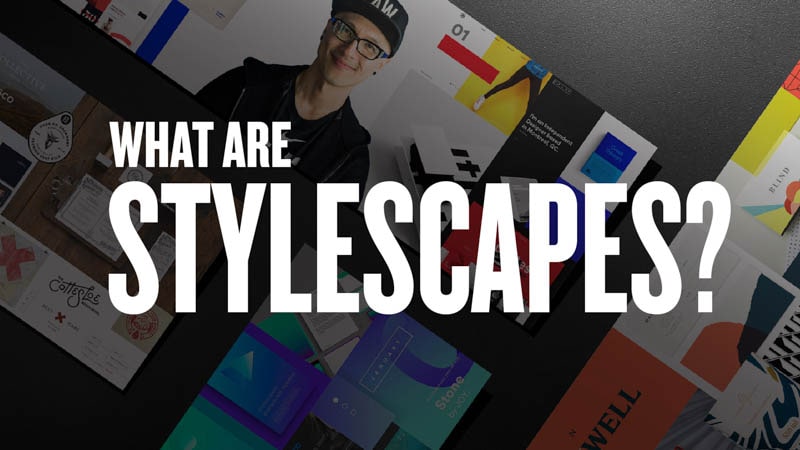
For us, our strategy relies on the use of Stylescapes.
Stylescapes are a carefully collected combination of images, textures, typography, and colors to communicate a certain look and feel of a brand, website, interior space, or any other design project. Think of them as moodboards taken to the next level.
Stylescapes bridge the gap between your ideas and your client’s. They help to get both of you to agree on the design direction before you design anything.
We use Stylescapes for virtually every design project we touch. They’re a vital piece to our creative process and how we keep our clients in the loop of where each project is headed.
If you’re not already incorporating Stylescapes into your design process, stick around. You’re about to find out why you and your clients keep butting heads, and how you can significantly simplify your design projects going forward.
The Problem with Your Process
How many times have your clients said something like, “this isn’t what I pictured?”
When you’re in a discovery session with a client, there’s a lot that can get lost in translation. They say one thing, but you interpret it as something else entirely. Then when you break from the meeting, you jump into designing and prepare to knock their socks off with what you’ve made.
When you present your deliverable, though, they’re not on board. They ask you to try again. They may even do a little research of their own and tell you what to do based on what they found. You keep editing, revising, making last-minute adjustments, and presenting new concepts to them, but you’re not making any progress. You’ve lost focus on what this project is supposed to be.
At that point, you’ve worked beyond the agreed scope, your client’s feeling frustrated, and you’re on the verge of calling it quits. Is any of this sounding familiar?
See, without Stylescapes, there’s no direction to agree on. There’s no transparency or exchange of ideas for the design. And if there’s anything we’ve learned working with clients, it’s that they want to know where the design direction is headed. This is where Stylescapes play a critical role.

You Need to Learn Your Client’s Language
When your client says “this isn’t what I pictured” you need to figure out what that is before you head to the drawing board. You don’t need a crystal ball or some magic spell to step inside their brains. You need to do something about your discovery process.
Through asking questions, you slowly start to figure out what your clients mean with each answer, but you can’t get the full picture with their words alone.
The reality is you and your client don’t speak the same language. You’re coming from a variety of perspectives as a designer, strategist, and problem-solver. You might think you know more than your client in terms of the best direction for the project, but you don’t.
Yes, they’re coming to you to lean on your expertise and design talent, but the fate of their business is in your hands. Don’t forget that clients put their trust in you to deliver something that can squash whatever challenge they’re facing.
When they make comments like, “I like the minimalist style,” or “I love so-and-so’s brand,” it’s important that you understand exactly what that means.
Stylescapes Tell You What Your Clients Want
You can essentially decode your client’s words with Stylescapes. Instead of coming back from the discovery session with a deliverable, you come back with one or a few Stylescapes to essentially ask them, “Is that what you were thinking?”
Stylescapes are meant to generate some sort of emotional response from the client when they see what’s in front of them. They’re also there to serve as a point of reference to establish the overall look and feel of the brand identity, digital product, music video, or whatever it is you’re designing.
Stylescapes open the door to a collusion of ideas, giving you and your client the chance to collaborate and communicate clearly and effectively. Your client can point to a specific element or an entire Stylescape and tell you, with zero hesitation, whether they like it or not.
Rather than continue to guess what their words and ideas look like, you can find certain images, colors, or typefaces that visually represent what they’re thinking.

